
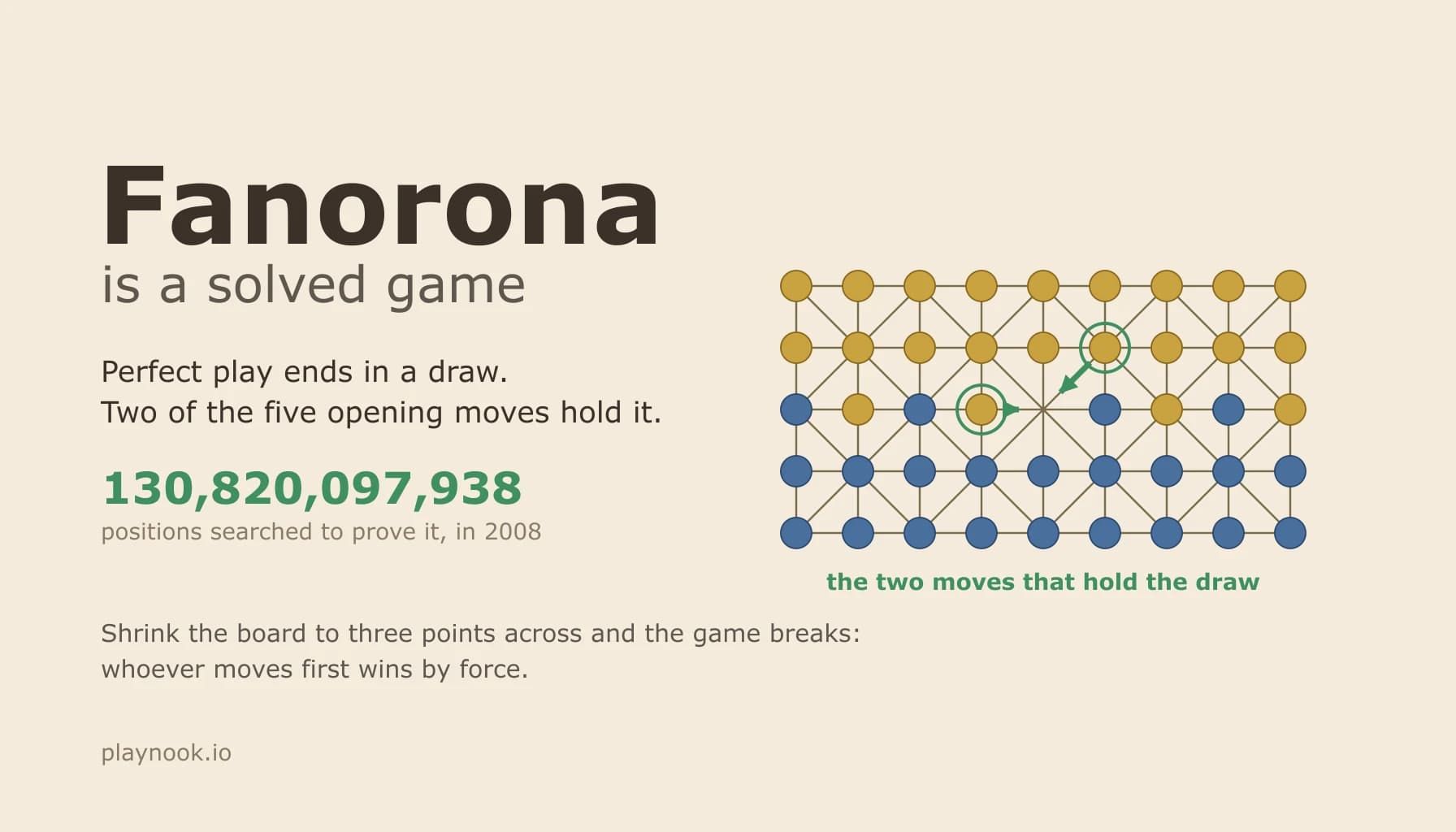
Most traditional board games keep their secret. Nobody can tell you what happens in chess or Go if both sides play perfectly, and nobody is going to find out soon. Fanorona is one of the rare exceptions: the national game of Madagascar, played on a board of 45 points with 22 pieces a side, has been settled. Best play ends in a draw.
The proof is from 2008, and it is unusually useful for a player — because it does not stop at the answer. It names which of the five possible opening moves still hold the draw, and which one throws it away.
- Draw what perfect play is worth
- 5 legal opening moves — all to one point
- 2 of them proved to hold the draw
- 130,820,097,938 positions searched
Is Fanorona a solved game?
Yes, weakly solved. That word is doing real work, and it is worth separating the three things it can mean.
A game is ultra-weakly solved when the result of the opening position is known but nobody can tell you how to achieve it — Hex is the classic case, proved a first-player win in 1953 by an argument that produces no moves at all. A game is weakly solved when the value is known and there is a strategy that achieves it from the start. A game is strongly solved when you can hand the computer any legal position whatsoever and it tells you the truth.
Fanorona is the middle one. Maarten Schadd, Mark Winands, Jos Uiterwijk, Jaap van den Herik and Maurice Bergsma at Maastricht University proved in Best Play in Fanorona Leads to Draw (New Mathematics and Natural Computation 4(3), 2008) that the starting position is a draw. It took 130,820,097,938 positions and over a week of machine time, on top of endgame databases — every position with seven pieces or fewer on the board, computed separately over several months.
That puts Fanorona in very short company. Checkers was cracked the year before, in 2007, by the Chinook team at Alberta — also a draw, and Checkers Arena covers that story on the checkers side. Nine Men's Morris fell in 1993, and is also a draw. The list of solved traditional games is still short enough to read in one breath.
Why Fanorona has exactly five opening moves
Everything about the opening follows from one feature of the setup: the centre point is the only empty point on the whole board. Both back rows are full on each side, the middle row alternates colour point by point, and e3 is the one gap.
That matters because capturing is compulsory in Fanorona. If any capture is available anywhere, a quiet move is illegal. And since the only empty point is the centre, the only moves that exist at all are moves into the centre — every one of which captures.
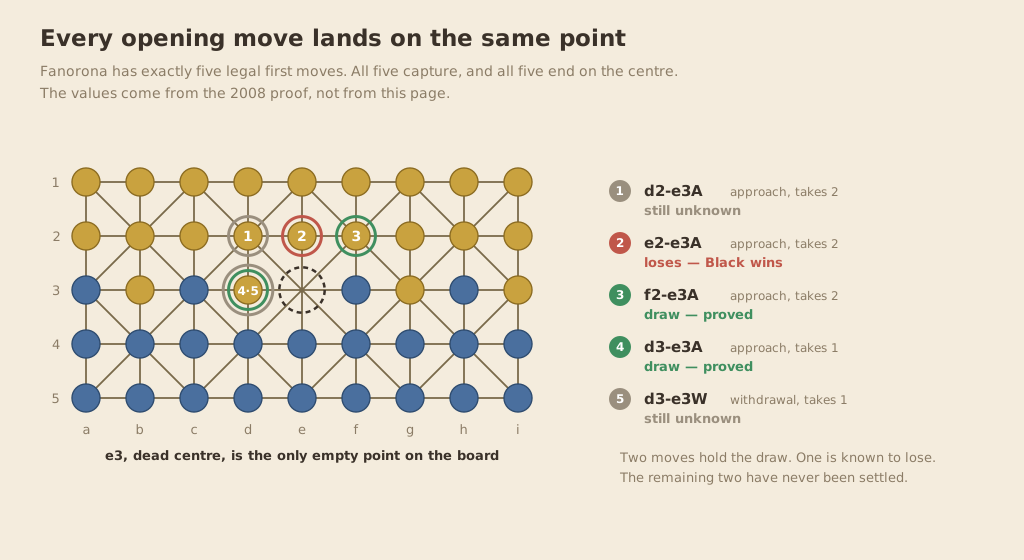
Five moves, then — and the board's own geometry decides which five. Three come
from the second rank: d2-e3A, e2-e3A and f2-e3A, each stepping into the
centre and capturing by approach, taking the two enemy pieces lined up
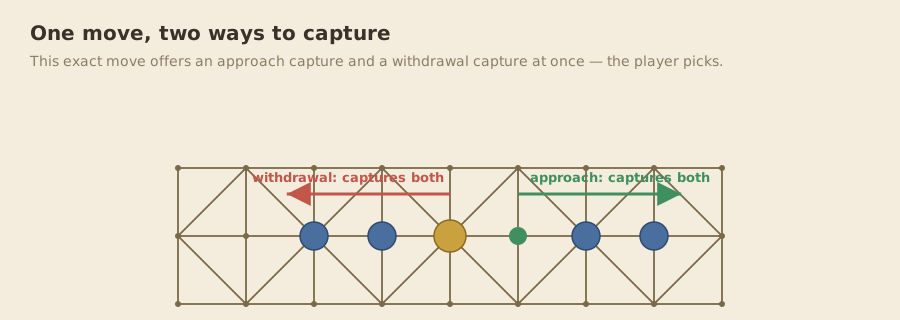
beyond it. The other two come from d3, the middle-row point immediately left
of the gap. That single step can be played as an approach, capturing the piece
on the far side of the centre, or as a withdrawal, capturing backwards along
the same line. One step, two entirely different captures, and the player
chooses.
Which Fanorona opening move should you play?
Two of the five are proved to hold the draw: f2-e3A and d3-e3A.
One is known to be bad. The authors report that e2-e3A — the straight step up
the middle, which looks like the natural move and takes two pieces — leads to a
win for the second player. That result is flagged as preliminary in the paper,
but it is the only opening move with a value attached that is not a draw.
The remaining two, d2-e3A and d3-e3W, have never been settled. The paper is
explicit that they are either a draw or a win for Black; what they are not is a
win for the player who starts.
So the practical rule for a human is short: open with f2-e3A or d3-e3A, and
do not play the obvious move up the middle.
There is a detail here that is easy to miss. d2-e3A and f2-e3A look like
mirror images of each other — one diagonal step in from the left, one from the
right — yet one is proved drawn and the other is unknown. They are not mirror
images. Because the middle row alternates straight across, the starting position
is symmetric under a half turn with the colours swapped, not under a left-right
flip. A move and its mirror are genuinely different moves, and they can have
genuinely different values.
What happens on a smaller Fanorona board?
Fanorona has traditional smaller versions — Fanoron-Telo on 3 × 3 and Fanoron-Dimy on 5 × 5 — and the 2008 work solved those too, along with several non-standard shapes. The pattern that comes out is sharp.
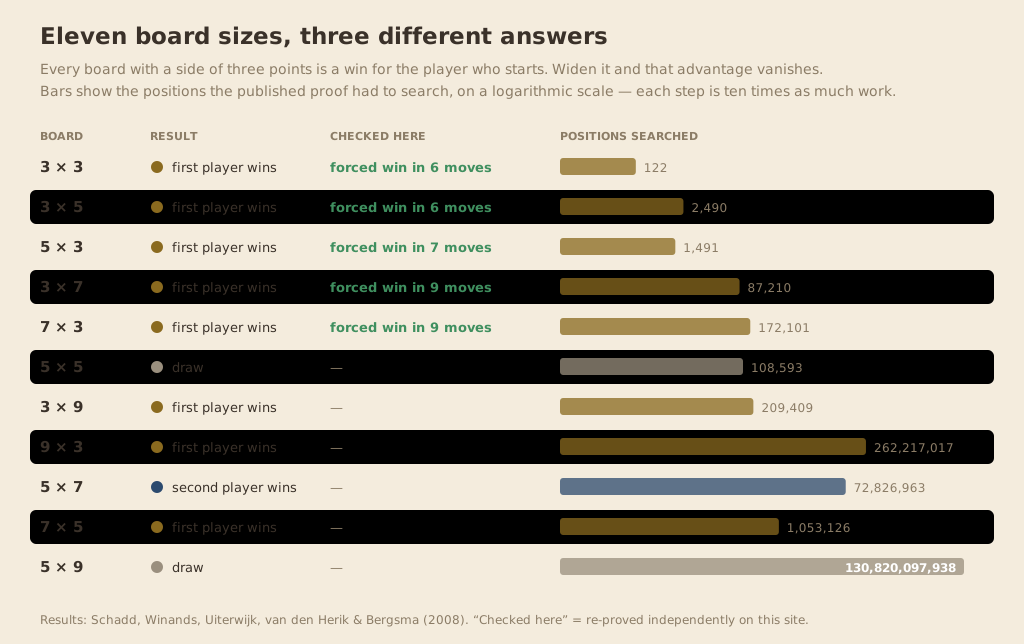
Any board with a side of three points is a win for the player who starts. Three by three, three by five, three by seven, three by nine — all first-player wins. Narrow the board and the forced-capture rule turns into a weapon: there is not enough room to get out of the way.
At five points across the advantage evaporates. The 5 × 5 board is a draw, so is the full 5 × 9 game. And then there is the oddity: 5 × 7 is a win for the second player — the only board in the table where moving first is a liability. Its mirror image, 7 × 5, is a first-player win. Those two boards hold the same number of points, the same number of pieces and the same rules; turning the board through a right angle changes who wins. It is a reminder that in Fanorona the direction of the lines is not decoration.
The five boards we re-proved here
Published tables are worth checking, so we wrote an independent solver for this article rather than quoting the numbers and hoping.
The rules had to be rebuilt first, because the engine behind the playable version is fixed at 5 × 9. Two independent implementations of a fiddly ruleset are two chances to get it wrong, so they were cross-checked move for move: over 1,564 positions from random games, both move generators had to produce exactly the same set of legal whole turns, capture chains included. They do.
Then the search. The obvious approach — minimax over all positions — fails immediately, and the reason is interesting. Because a repeated position is a draw, the value of a position depends on how you got there, so results cannot simply be cached and reused. On the 3 × 5 board that search ran through 152 million positions and managed to store 58 of them. Proving a forced win needs none of that: a side that wins in nine moves never has the chance to repeat anything. A depth-limited proof search, deepened one step at a time, does the job, and it hands back something the published table does not include — how long the win actually takes.
The five smallest boards came out matching the published values exactly: 3 × 3 and 3 × 5 are won in six moves, 5 × 3 in seven, 3 × 7 and 7 × 3 in nine. Those five are precisely the boards the original proof managed without endgame databases; the rest needed them, and without them our search runs out of room, exactly as you would expect.
The smallest Fanorona, from start to finish
Fanoron-Telo, the 3 × 3 game, is small enough to print the whole solved game on one line. Here it is — the shortest forced win, with the losing side defending as stubbornly as the position allows.
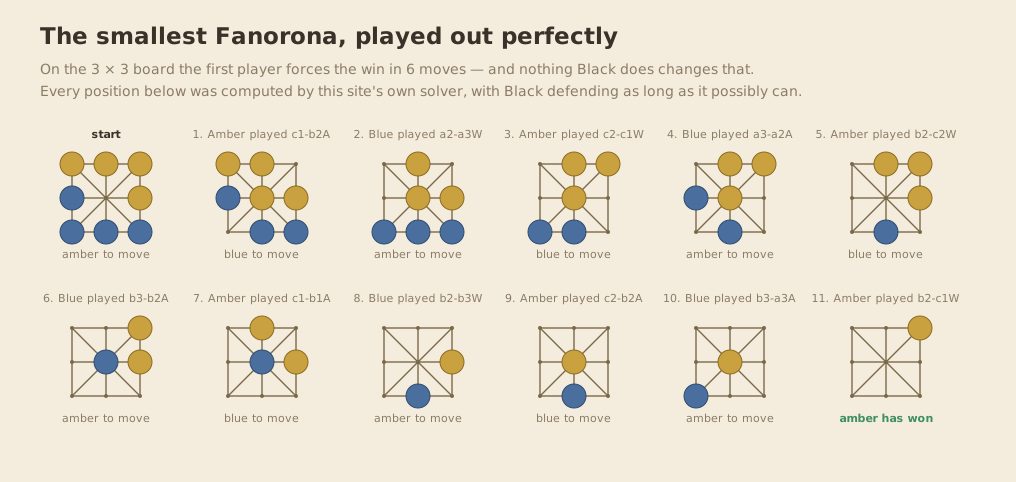
Watch what the forced-capture rule does to the defender. By the fourth move there is frequently only one legal reply on the board, because a capture is available and a capture must be played. The losing side is not outplayed so much as marched.
Does knowing the solution help you beat a person?
Honestly: a little, and not in the way you would hope. A draw under perfect play says nothing about a game between two people who will both miss things. What transfers is narrower and more useful:
- Open with
f2-e3Aord3-e3A. They are proved not to lose, which is more than can be said for the natural-looking move up the middle. - Count before you capture. Capturing is compulsory, but which capture is yours to choose, and so is whether to continue a chain. Stopping early is often the stronger move.
- Material alone does not finish the game. The endgame databases make this concrete: with four pieces against one, the player to move cannot lose — but cannot force a win either. It takes five against one before the win is guaranteed. Being three pieces up is not a won game.
That third point is the one that surprises people. In most capture games a big material lead is the end of the story. In Fanorona a single piece in open space is extraordinarily slippery, because every line you build to trap it is a line it can capture along.
What is still not known about Fanorona
Two of the five opening moves have no published value at all. The game has never been strongly solved — there is no table that answers an arbitrary position, only the databases for seven pieces or fewer, and the proof of the opening. The 2008 authors close by naming strong solving as the task for whoever comes next, and nobody has.
Which leaves the game in a comfortable place. The outcome is known, the first move is a matter of record, and everything between them is still an open contest. You can play Fanorona here against the computer, a friend online or someone next to you — and if the capture-in-two-directions idea is new to you, its ancestor Alquerque is the gentler board to meet it on.