
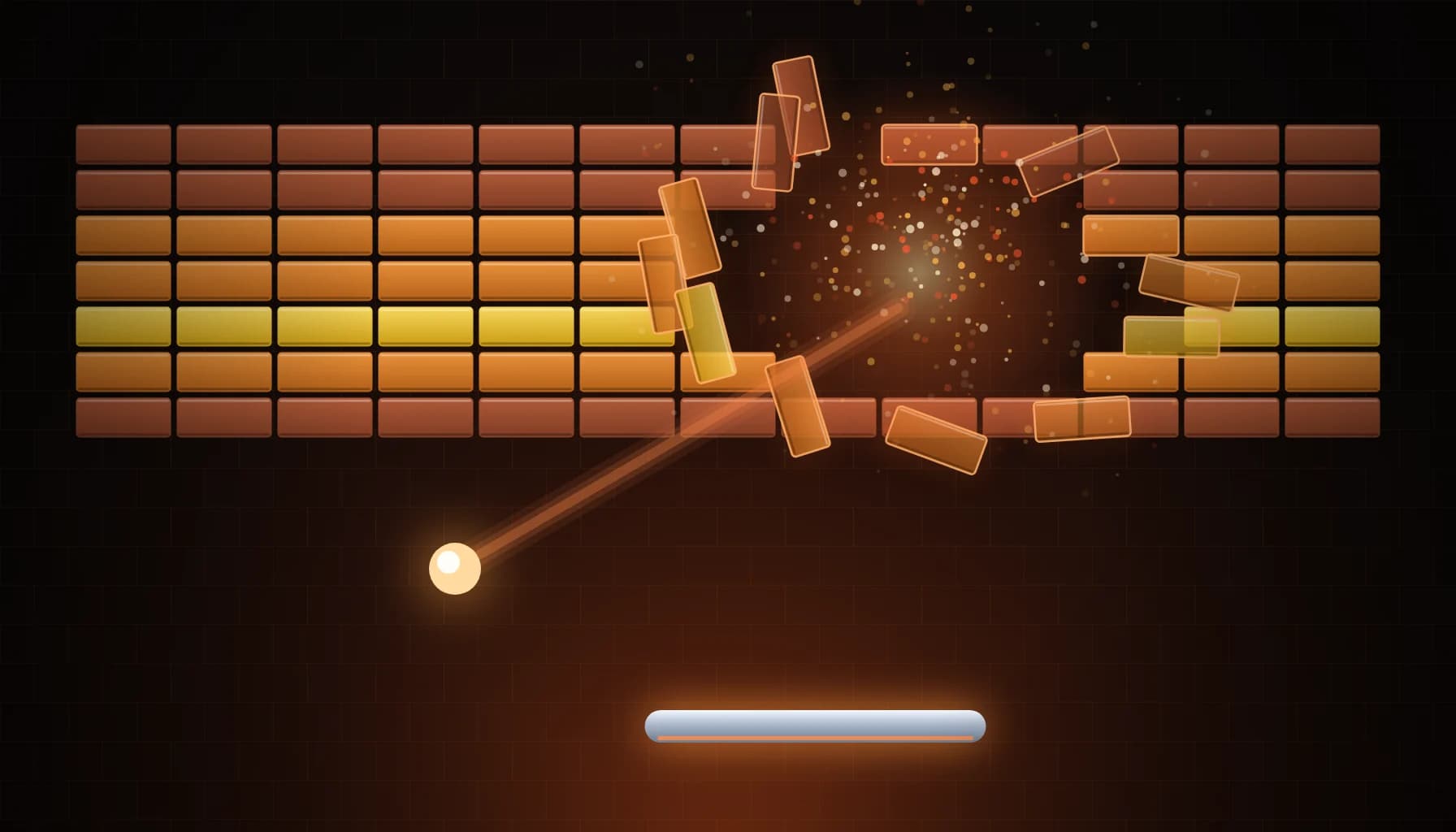
There is a moment, four or five minutes into any game of this kind, when the ball slips through a gap you did not mean to make, disappears above the wall, and starts eating it from the inside while you watch with your hands off the controls.
Nobody designed that moment. It fell out of the rules, and it is the reason a cabinet built in 1976 by two people who were not professional game designers is still being rebuilt, half a century later, by people who have never seen one.
Where did brick breaker games come from?
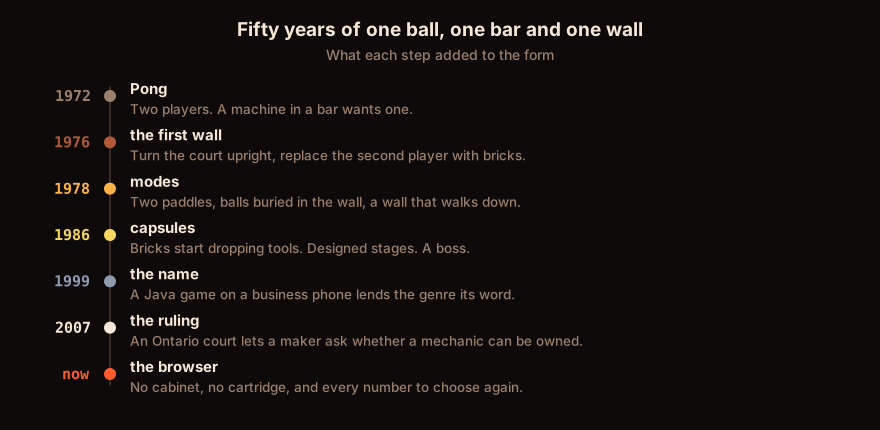
The ancestor is Pong — Atari, 1972 — and the problem Pong created. It was a two-player game. A machine standing in a bar makes money from one person with one coin, and a one-player Pong is a person hitting a ball at nothing.
The answer was to turn the game ninety degrees. Put the paddle at the bottom, put the second player's half of the court at the top, and replace that player with something that does not hit back: a wall. Now the opponent is the room itself, and it loses a piece of itself every time you score.
That is the entire design. Everything since has been decoration on it.
1976: the cabinet with no processor in it
Breakout was released by Atari on 13 May 1976. The concept came from inside the company — Nolan Bushnell and Steve Bristow — and the prototype was farmed out to a young technician named Steve Jobs, with a bonus attached to building it out of as few chips as possible.
Jobs brought in Steve Wozniak, who was working at Hewlett-Packard by day and who did the engineering over four consecutive nights. The result was a machine with no microprocessor at all: just logic chips wired together so that the behaviour of a ball emerged from the circuit itself. Accounts of the final count differ — Wikipedia puts Wozniak's schematic at 42 chips and the delivered breadboard at 44, while Wozniak has said they got it down to 45 — and so do the accounts of who was paid what, a dispute that outlived both the cabinet and the friendship for a while.
Atari did not ship that design. It was too clever to manufacture and, by one account, missing the unglamorous parts a coin-op actually needs, such as coin detection and on-screen scoring. The production version was reworked, by some accounts to around a hundred chips. The brilliance stayed in the story rather than in the cabinets.
One more thing about that cabinet is worth knowing, because it explains why old screenshots look the way they do. The monitor was black and white. The coloured rows were strips of coloured cellophane stuck to the glass. The game had no idea what colour anything was.
Why the tunnel is the whole game
The rules of Breakout say nothing about tunnelling. They say the ball bounces, bricks vanish, and the rows at the back are worth more than the rows at the front.
What players found was that if you dig a channel up one side and let the ball through, it gets trapped between the ceiling and the top of the wall and demolishes the expensive rows by itself. It is the most famous emergent strategy in arcade history, and it is the reason the game has depth at all: there is a thing to be good at that nobody told you about.
We were curious how large the effect actually is, so we measured it in Firebrick, our own game in this family. Same wall, same ball, same eight seconds, with the bar catching perfectly in both runs so that only the ball's starting position differs. Thirty runs each.
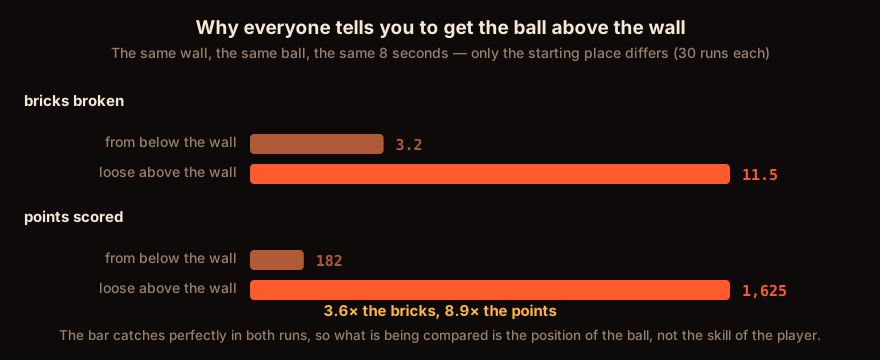
3.2 bricks against 11.5 in the same eight seconds, from the same ball. The folklore was right, and it is right by a factor of three and a half.
The points gap is wider still — nine times rather than three and a half — but that part is ours rather than history's: our game puts out your multiplier whenever the ball touches your bar, so a ball that never comes back is compounding as well as clearing. That is a 2026 idea bolted onto a 1976 frame.
1978: Super Breakout, and the first idea of a "mode"
Atari's own follow-up, Super Breakout (1978), is the first place the genre asks what else the wall could do. It is built on a microprocessor, which made it both cheaper to produce and able to hold more than one game, and it shipped with variations rather than power-ups:
- Double gives you two paddles and two balls at once.
- Cavity buries two extra balls inside the wall, which join in once you break through to them — tunnelling as a rule rather than a trick.
- Progressive brings the wall down towards you as you play, which turns a patience game into a clock.
There is no inventory, nothing drops, nothing is collected. The idea that the wall might hand you a tool had not arrived yet.
1986: Arkanoid, and the capsule that falls
It arrived with Arkanoid, Taito, July 1986 in Japan and later that year in North America. It is the second great landmark of the form, and almost everything people now think of as standard comes from it rather than from 1976.
The paddle became a spacecraft called the Vaus, escaping a mothership. More importantly, bricks began dropping capsules — colour-coded, lettered — that the Vaus catches on the way down: a longer paddle, a laser, a sticky ball that holds until you release it, extra balls. There are hand-designed stages rather than one wall repeated. There is a boss, DOH, waiting at the end.
Arkanoid is where the genre stops being a physics toy and becomes a game with things in it. Every brick breaker you have played on a phone is a descendant of this one, not of the Atari cabinet — the cabinet gave the form its ball, but Arkanoid gave it its furniture.
1999: how "brick breaker" became the name of the thing
The genre's generic name does not come from either of those. It comes from a small Java game written in 1999 by a Canadian developer, Ali Asaria, which Research In Motion put on BlackBerry handsets as BrickBreaker.
For most of a decade it was the only game a very large number of adults had on them at all times. It was played in meetings, in airports and under desks by people who would not have described themselves as playing video games, and the name came along with it. "Brick breaker" stopped describing a particular game and started describing the shape of all of them.
The court case nobody expects
Here is the part of the story that gets left out, and it is the interesting part if you have ever wondered how far a game mechanic can be owned.
In 2006, Atari wrote to Research In Motion — twice — asserting that BrickBreaker infringed its copyright in Breakout, and that another BlackBerry game infringed Asteroids. It asked for sales figures so that royalties could be calculated.
RIM did not pay and did not fold. It went to the Ontario Superior Court of Justice and asked for something unusual: a declaration that it was not infringing. Atari tried to have the action thrown out, arguing that Canada's Copyright Act offers no such declaratory remedy and that a provincial court had no business hearing a federal copyright question, and separately that Ontario was the wrong place for it.
In 2007, Justice Harvey Spiegel rejected all of it and let the case proceed — there was, he reasoned, no principled reason a declaration could not serve as a remedy in a copyright matter. How the dispute finally ended is not something we can find a reliable public record of, which is itself a fair description of how most of these things end.
But the shape of it is the useful part, and it matches what copyright law says everywhere: a game mechanic is not a work. A ball, a paddle and a wall of bricks cannot be owned by anybody. Specific artwork can be. Specific names can be: Breakout and Arkanoid are trademarks of Atari and Taito, and will stay that way. The rules are common property, and they always were.
That is why there are ten thousand of these games and why you are allowed to make one.
What a browser version has to decide for itself
Picking up a fifty-year-old form means every number is yours to choose, and they are not obvious choices:
How the bar steers. Most of this family maps the point of contact to an outgoing angle, and many add the bar's own sideways motion on top so that sweeping curves the ball. The second one feels alive and is much harder to be precise with. Ours uses contact point alone, linear from zero in the middle to sixty degrees at the edge, and nothing else — a mirror you aim by standing in the right place.
What stops the ball getting stuck. A flat bar centre returns a ball perfectly vertically, and a player tracking the ball with a mouse meets it dead centre every single time. Our own test harness, which catches perfectly, locked the ball into an unbreakable vertical loop on its first run and could not finish level one. The fix is that there is no flat spot: the middle twelve per cent returns the ball at 7.2 degrees. Old cabinets avoided the problem by accident, because nobody could aim that well with a knob.
How fast is too fast. Every version of this game speeds the ball up, and every version has to stop. The 1978 machine stepped the speed at the fourth, eighth and twelfth hit. Ours rises with each brick and each level and then stops dead at a ceiling, after which the walls get harder instead. A game that accelerates forever has an ending written into it rather than a difficulty curve.
Whether the score should argue with the clearing. This is the one nobody inherited an answer to, because the originals did not have the problem: in Breakout, the back rows are worth more, and that is the whole of the scoring design. We added a multiplier that rises while the ball is away from the bar and goes out the moment you catch it — which, as the measurement above shows, makes the oldest trick in the genre pay nine times over instead of three.
Play one
Firebrick is ours: twelve hand-built walls, steel that never breaks, embers that take their neighbours with them, and a multiplier you keep only while the ball is somewhere else. It runs in the browser, it costs nothing, and the art, the sounds and the walls are all our own work.
The ball, the bar and the wall are not. Those belong to everybody, and that is the point.