PlayNook

Retro Arcade · Brick Breaker

Play Firebrick — Free Brick Breaker Game Online

A ball, a steel bar and a wall of fired clay — with one rule the old machines never had. Every brick you break without the ball coming back to you is worth more than the last, and the moment you catch it the bonus goes out like a fire.

A ball, a steel bar, and a wall of clay that has been in the kiln too long. You know this game before anyone explains it, which is exactly what the machines it descends from were built for.

One rule is new. Your multiplier only lives while the ball is away from you. Catch it, and the fire goes out.

  • 12 hand-built levels, then mirrored and faster
  • 537 breakable bricks, plus 85 steel and 20 ember
  • 60° at the edge of the bar, 7.2° in the middle
  • ×5 top multiplier — one step per three bricks

How to play Firebrick

  1. Move the bar. Mouse, or ←/→, or drag anywhere on a phone — your finger does not need to be on the bar, so it never hides it.
  2. Launch. Space or a click. P or Esc pauses, M mutes.
  3. Break everything breakable. Steel never goes. The level ends when the last brick that can break has broken.
  4. Do not catch the ball unless you have to. Every touch of the bar puts the heat out.

How do you aim the ball in a brick breaker?

In this one, with your feet rather than your hands. The outgoing angle depends on where the ball lands on the bar and on nothing else — not on how fast you were sliding when it arrived.
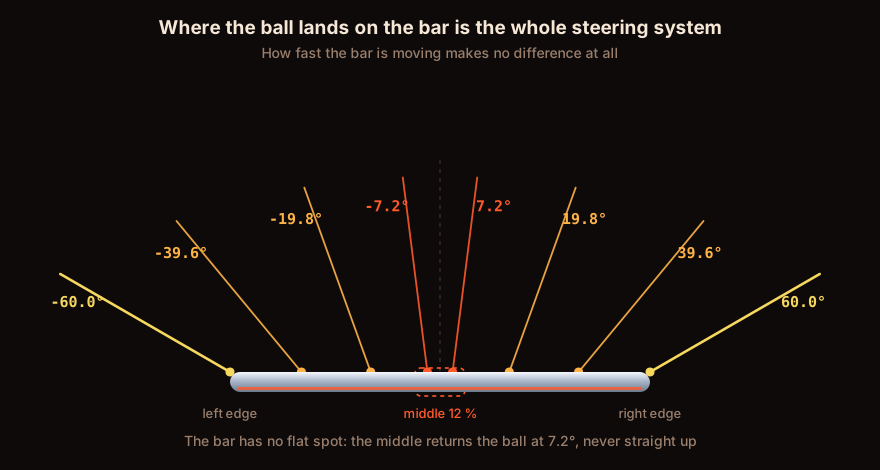
A diagram of the steel bar seen from the front with eight impact points marked along it, each with a ray showing the angle the ball leaves at. The outer rays leave at 60 degrees from vertical, the next pair at 39.6, then 19.8, and the two innermost at 7.2 degrees. A dashed outline marks the middle twelve per cent of the bar, which is labelled as the zone that still returns the ball at 7.2 degrees rather than straight up.
The bar is a mirror whose angle you pick by standing in the right place. Edge to edge it runs from -60° to +60°, perfectly linearly.

That makes the bar a mirror you aim by positioning, and it is worth knowing because it is not how every game in this family works — several add the bar's own motion to the bounce, so that sweeping sideways curves the ball. Here it does nothing.

Why the middle of the bar is not flat

There is one deliberate exception, and it exists because of a bug we caught before launch. A player who tracks the ball accurately with a mouse meets it dead centre every single time, and a perfectly flat centre returns the ball perfectly straight up — so the ball bounces between the bar and the ceiling forever, and the game cannot be finished. Our own test harness, which catches the ball exactly, walked into it on the first run.

So the bar has no flat spot. The middle twelve per cent returns the ball at 7.2°, carrying on in the direction it came from, and a ball that falls dead straight is sent back towards the centre of the field. Nothing about it is random, and it cannot be trapped.

How does scoring work in Firebrick?

Every brick raises the heat by one. Every three points of heat adds one to the multiplier, up to five. Touching your bar puts it out.
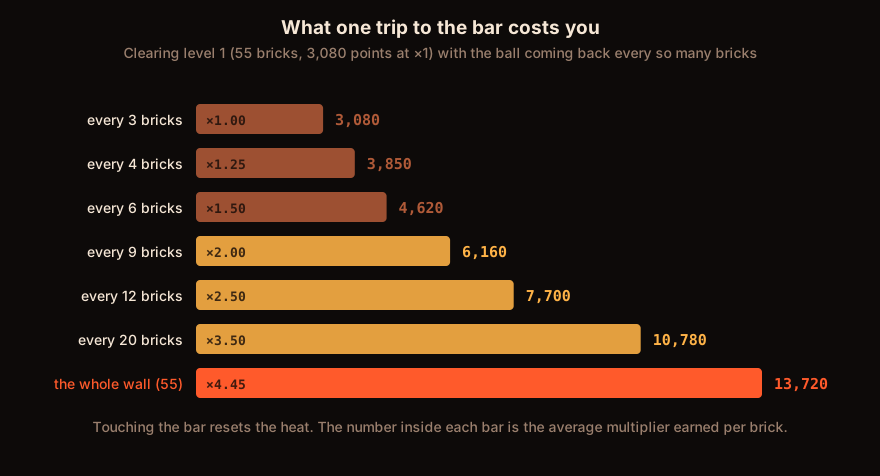
A horizontal bar chart showing what clearing level one is worth depending on how many bricks are broken between visits to the bar. Returning every three bricks scores 3,080 points at an average multiplier of one; every six bricks scores 4,620; every twelve scores 7,700; every twenty scores 10,780; and clearing all fifty-five bricks in a single trip scores 13,720 at an average multiplier of 4.45.
The same fifty-five bricks, scored seven ways. The only variable is how often the ball comes back down to you.

The gap between the top and bottom bar is 10,640 points — over half an extra bar, on the first level of the game.
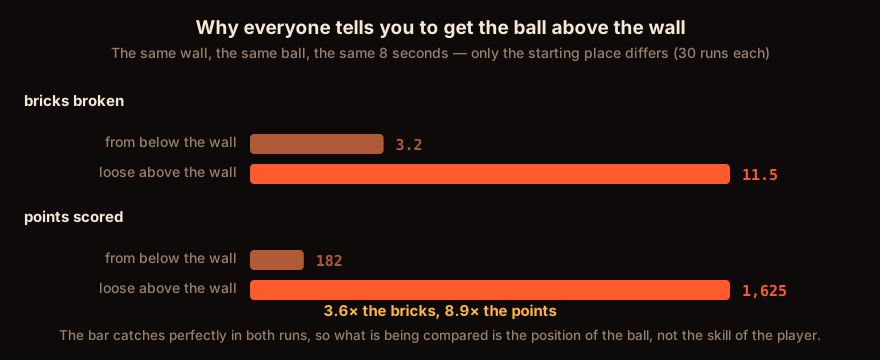
A bar chart comparing a ball started below the wall with one started in the gap above it, over eight seconds and thirty runs each. The ball below the wall breaks 3.2 bricks and scores 182 points; the ball loose above the wall breaks 11.5 bricks and scores 1,625 points, which is 3.6 times the bricks and 8.9 times the points.
3.6× the bricks — and 8.9× the points. The gap between those two numbers is the heat multiplier doing its work.

That gap is the whole design. A ball above the wall breaks about three and a half times as many bricks, but earns almost nine times as many points, because it never comes down to put the fire out. Clearing a column up one side and letting the ball through is the single most valuable thing you can do in this game.

What do the power-ups do in Firebrick?

Twenty-two per cent of broken bricks drop one. The numbers below are shares of all drops, so they add to a hundred.

Power-upShareWhat it doesLasts
Wide23 %Bar goes from 120 to 180 units12 s
Narrow20 %Bar goes down to 76 units12 s
Guns18 %Two cannons, firing by themselves every 0.26 s12 s
Multiball18 %Every ball in play splits into three—
Slow15 %Ball drops to 68 % speed12 s
Extra bar6 %One more life—

Narrow is the trap. It falls exactly like the others, and it is the only one you should step away from. It is drawn in cold violet with a vertical arrow while every useful one is warm — but in the middle of a fast level, the thing to watch is the shape, not the colour.

Multiball is the odd one: it clears a level quickly and costs you score, because any of the three balls touching your bar puts the heat out for all of them. It is a tool for surviving a bad level, not for a high score.

What are the steel and ember bricks for?

Steel never breaks. Bullets bounce off it too, so there is no way through and only ever a way round. It is hatched and riveted rather than simply a different colour, so it reads correctly without colour vision. Eighty-five of them are spread across the twelve levels, and in the later ones they turn the game from reaction into geometry.

Embers take their neighbours with them. Break one and all eight surrounding bricks take a hit; any ember among them goes off as well, up to four links deep. There are twenty, and they are generally buried in the most expensive part of a wall. Because every brick in a chain counts toward the heat, one good ember hit is also the quickest route to a ×5.

How many levels does Firebrick have, and does it end?

Twelve, built by hand rather than generated: The first firing, The arch, Steel ribs, The kiln door, Checker, The ladder, Embers, The vault, The wedge, The grate, Hot core and The last firing. Between them they hold 537 breakable bricks and need 963 hits to clear if nothing chains.

After the twelfth, the designs return mirrored and faster and the counter keeps climbing, so the saved highest level is a real record rather than a ceiling.

Does the ball get faster?

Twice over: a little with every brick inside a level, and a step up at the start of each new one.

Crossing the field, top to bottom
Start of level 12.18 s
End of level 11.68 s
The cap1.29 s

The cap is first touched late in level twelve, and from level eighteen the ball simply starts there. Past that point nothing gets quicker — the walls get harder instead, which is a different problem with the same controls.

If you like this one

Shatterbelt is the other game here built on a single unforgiving physics rule, and Warp Tunnel and Sprocket Tower are the other reflex games. Everything else is in retro and arcade.

Where this kind of game comes from

Firebrick is an original game: the art, the sounds, the twelve wall designs and the name are all ours. The idea underneath it — one ball, one bar, one wall — is public property, and it has been passed around since the middle of the nineteen-seventies. How the ball-and-bar game got from a coin-op cabinet into your browser is the story of that journey.
Frequently asked questions

+ How do you play Firebrick?

Slide the steel bar along the bottom with the mouse, with the left and right arrow keys, or by dragging anywhere on a phone — your finger does not have to be on the bar, so it never covers it. Press Space or click to launch the ball. Keep the ball off the floor, break every brick that can be broken, and the next level loads. You start with three bars and get another every 20,000 points.

+ How do you aim the ball in Firebrick?

By where the ball lands on the bar, and by nothing else. The middle sends it almost straight up, the edges send it out at 60 degrees, and everything in between is a straight line through those two: hit halfway out and you get 30 degrees. How fast you were moving the bar makes no difference at all, which is unusual — many brick breakers add the bar's own motion to the bounce. Here the bar is a mirror whose angle you choose by standing in the right place.

+ What is the heat multiplier?

It is the whole scoring game. Every brick you break raises the heat by one; every three points of heat raises the multiplier by one, up to five times. The moment the ball touches your bar, the heat goes out completely. So the score is not in how many bricks you break but in how many you break per trip. Level one is worth 3,080 points if the ball comes back every three bricks, and 13,720 if you clear the whole wall in a single visit.

+ How do I get a high score in Firebrick?

Get the ball above the wall, and we can tell you exactly what it is worth because we measured it. Over thirty runs of eight seconds each on level one, with the bar catching perfectly in both cases, a ball working on the wall from below broke 3.2 bricks for 182 points. A ball loose in the gap above the wall broke 11.5 bricks for 1,625. That is 3.6 times the bricks but 8.9 times the points, and the difference between those two numbers is the heat: the ball up there never comes down to put the fire out.

+ What do the power-ups do in Firebrick?

Twenty-two per cent of broken bricks drop one, and there are six. Wide (23 of every 100 drops) and narrow (20) change the bar; guns (18) bolt two cannons to it that fire by themselves; multiball (18) splits every ball in play into three; slow (15) takes the ball down to 68 per cent speed; and an extra bar (6). All but multiball and the extra bar last twelve seconds. Narrow is the trap — it looks like the others and it is the only one you should let fall.

+ What are the steel bricks for?

They never break. Bullets bounce off them too, so there is no way through — only around. They are hatched and riveted rather than merely a different colour, so you can tell them apart without relying on colour vision. A level is finished when the breakable bricks are gone; the steel simply stays there, which is why the later levels are as much about finding an angle as about reaction time.

+ What happens when you break an ember brick?

It takes all eight of its neighbours with it, and any ember among those neighbours goes off too, up to four links deep. Twenty of them are spread over the twelve levels, usually in the middle of something expensive. One well-placed hit on the ember row in level twelve clears more of the wall than the previous thirty hits did, and because every brick in that chain counts toward the heat, it is also the fastest way to reach a five-times multiplier.

+ How many levels does Firebrick have?

Twelve hand-built ones, with 537 breakable bricks between them, 85 steel bricks and 20 embers. Clearing all twelve takes 963 hits if nothing chains. After level twelve the designs come back mirrored and faster, and the level counter keeps going up, so the saved 'highest level' means something rather than stopping at a ceiling.

+ Does the ball get faster in Firebrick?

Yes, in two ways at once. It speeds up a little with every brick you break inside a level, and it starts each new level faster than the last. At the start of level one the ball crosses the playing field top to bottom in 2.18 seconds; by the end of that level, 1.68. The speed stops rising at 1.29 seconds a crossing, which the ball first reaches late in level twelve and which it starts at from level eighteen onwards. After that the game never gets quicker — only the walls get harder.

More games like this