
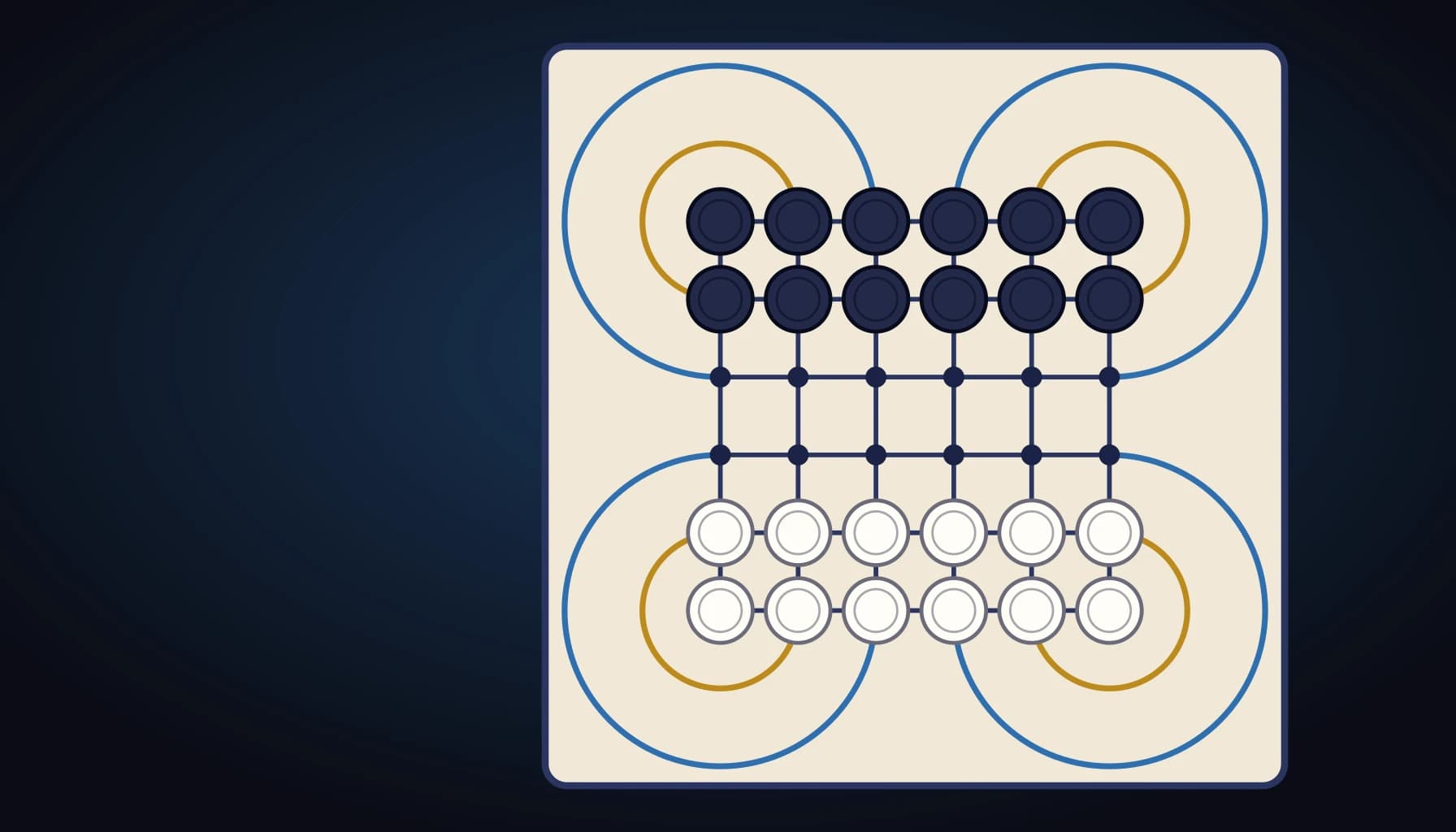
Every capture game you have played works one of three ways. You jump over something, you land on something, or you surround something. Surakarta does none of them.
In Surakarta a piece sets off along its row, leaves the board at the edge, curves around a loop, comes back in along a column, and takes the first enemy it meets. It is capture by momentum, and as far as anyone knows no other traditional board game does it.
A game from the court city
Surakarta — also called Solo — is a royal court city in central Java, Indonesia, a heartland of gamelan and batik, and the game carries its name. It was traditionally played on boards drawn in the dirt or inked on paper, which is part of why its early history is thin: nothing survives that you can date.
What it has instead is a reputation among programmers. The capture rule creates a threat structure unlike anything in draughts or chess, and Surakarta became a regular event at the ICGA Computer Olympiad for exactly that reason.
The board and the loops
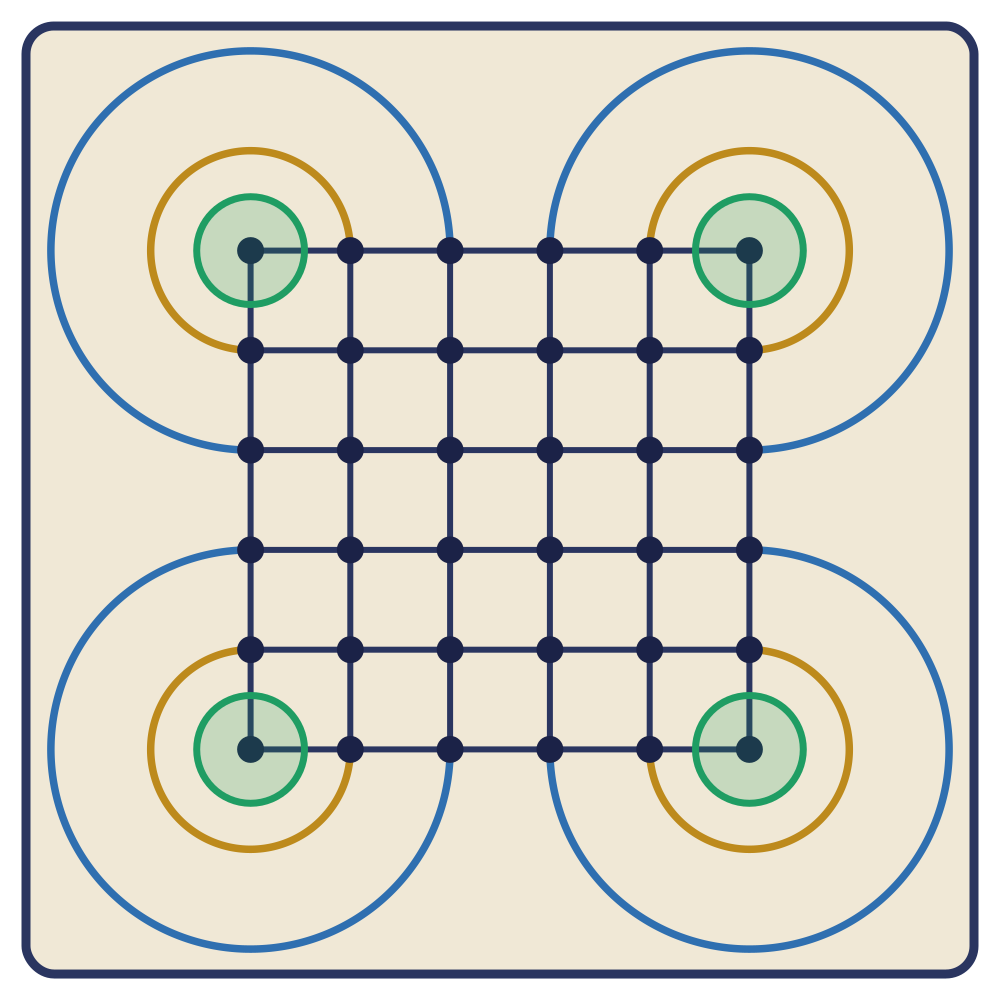
Thirty-six points in a six-by-six grid, and eight curved loops swinging out around the corners — four small, four large. Each loop is a three-quarter circle that leaves the grid tangent to one line and rejoins it tangent to another.
They form two separate circuits:
- The small loops join the 2nd and 5th lines — rows and columns alike — into one continuous racetrack.
- The large loops join the 3rd and 4th lines into another.
The outermost lines, the 1st and the 6th, have no loops at all. That single fact gives the game its most important feature: the four corner points lie only on loop-less lines, so no capture path can ever reach them. A man standing on a corner is untouchable — and equally, it can never launch a capture itself.
Getting the loops right matters more than it looks. If the radius is wrong the circuit connects the wrong pair of lines and the whole capture rule quietly breaks, which is why so many hand-drawn Surakarta boards on the internet do not work. If you want one on paper, our printable Surakarta board draws all eight in their right places, with the two circuits in their own colours.
The rules
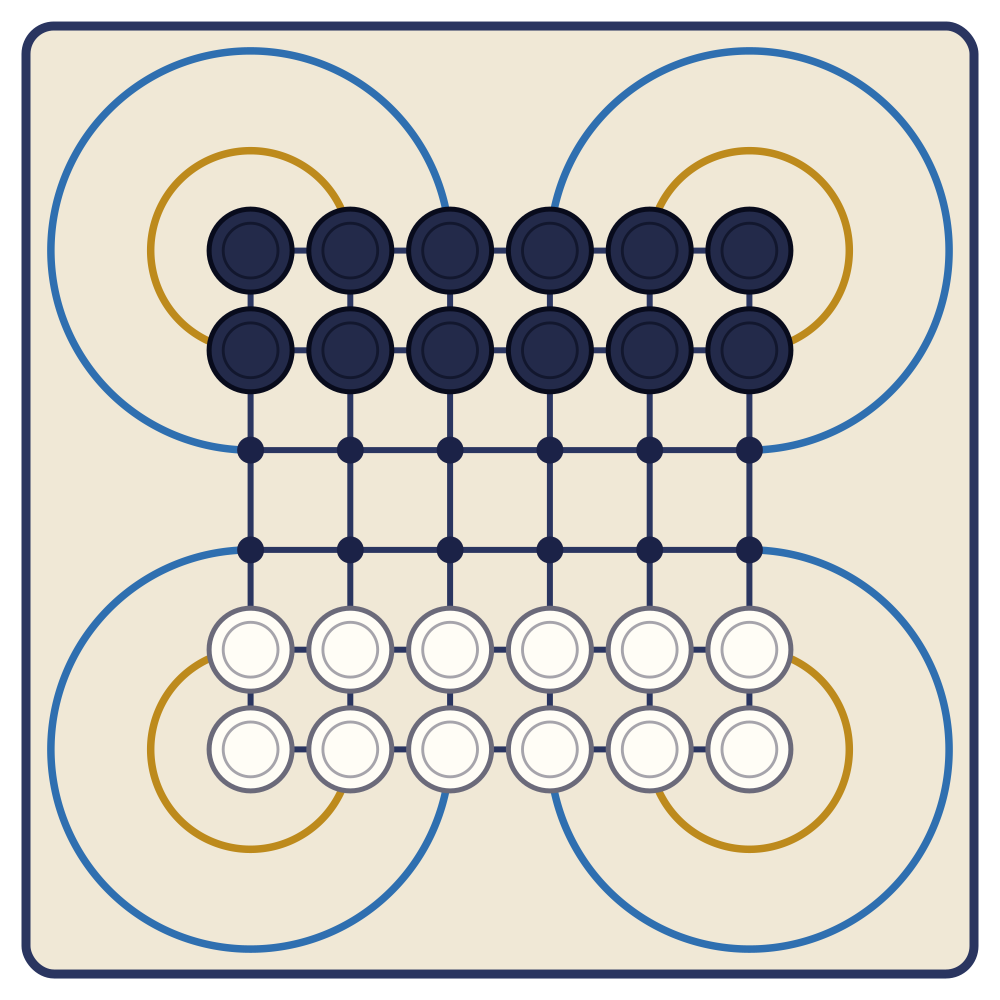
- Each player has twelve men on the two rows nearest them. White moves first.
- A quiet move is one step to an adjacent empty point, in any of the eight directions. A quiet move never captures anything.
- A capture travels along a row or column, around at least one loop, and takes the first enemy man on the path. Your man ends on the captured man's point.
- The path must be completely clear. Your own man anywhere on it blocks the capture; so does reaching a line end that has no loop.
- At least one loop is required. You cannot simply slide down a row and take something — without a loop it is not a capture.
- Capturing is optional, never forced.
- You win by taking all twelve enemy men, or leaving your opponent with no legal move. A hundred moves without a capture is a draw.
A capture, step by step
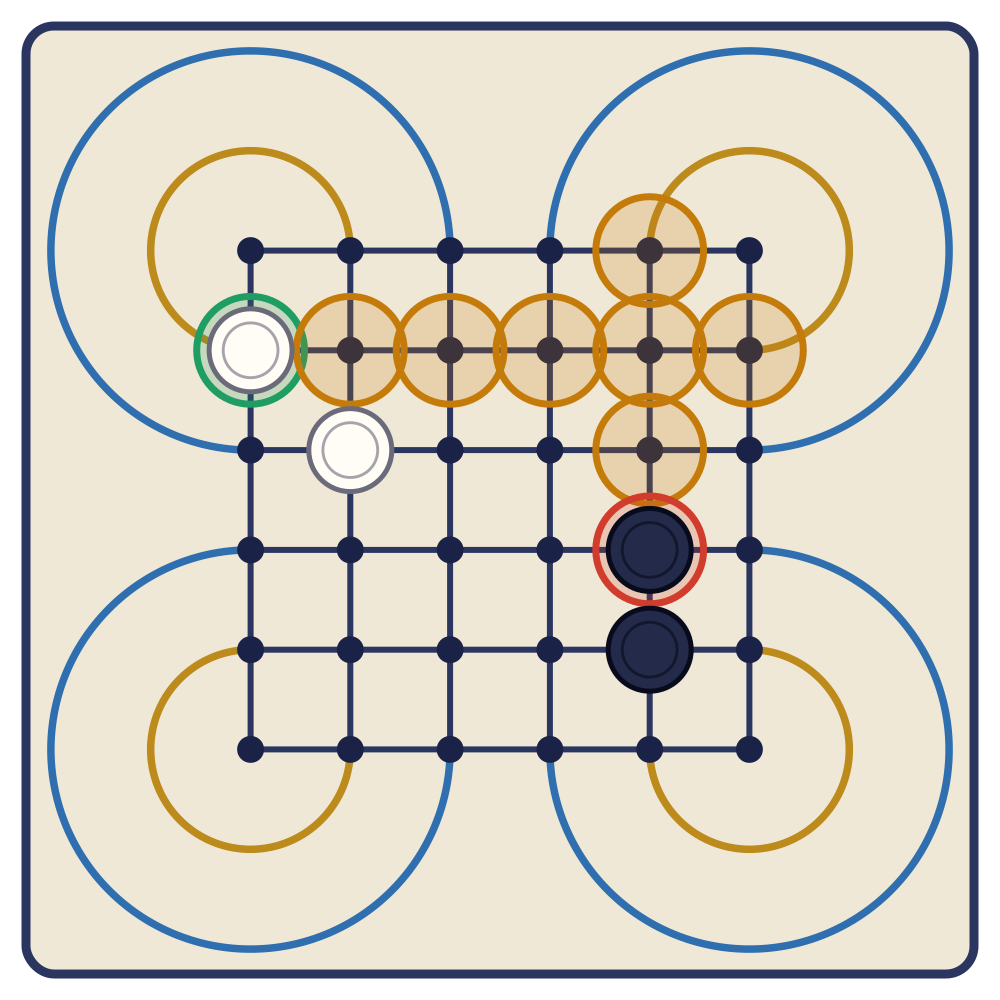
Follow the amber trail. The man starts at the left end of the 2nd row and travels right. At the edge it does not stop — the small loop carries it around the corner and back onto the board travelling down the 5th column, where it strikes the first enemy in its way.
That is the whole rule, and it takes about three games to stop feeling like magic and start feeling like geometry.
Thinking in circuits
Ask which circuits your man is on. Every point on a loop line belongs to one of the two racetracks. Before you move, work out which one you are joining, and who else is already on it. A man on an outer line is on neither, which makes it safe and useless at once.
Clear your own runway. Your pieces block your own capture paths. Two men on the same circuit with one behind the other means the back one can do nothing. In a game where both sides start with twelve men on crowded rows, whoever opens their lines first attacks first.
Check the landing, not just the target. A capture drops your man deep in enemy territory, on a loop line, often with several enemies sharing the circuit. Count who can reach the square you are landing on before you strike.
Threats beat strikes. Because captures are optional, the strongest move is usually a quiet step that sets up two captures at once. Your opponent can block one. This is the game's version of the fork, and it decides most matches.
Remember the corners. A man in a corner cannot be captured. It cannot capture either, so parking there is not free — but when you are down to a few men, a corner is a genuine refuge and a place to wait.
Common questions
Can a capture go around more than one loop? Yes. A path may run several loops in sequence, as long as it stays clear the whole way. Long captures are rare and extremely satisfying.
Can I capture my own man? No. Your own man blocks the path instead — the capture is simply not available.
Do I have to capture if I can? No. Unlike draughts or Alquerque, captures in Surakarta are always optional, and that is a large part of the strategy.
Can a man in a corner ever be taken? No, and this is a rule rather than an accident: every capture must travel a looped line, and the outer lines carry no loops.
How long is a game? Twenty minutes or so. It is faster than it looks, because once the lines open up the captures come quickly.
Ready to try it? Play Surakarta against the computer — every capture animates around the curves, which is the fastest way to understand what the loops actually do. To play it at a table, print the board, the men and the rules, or try Alquerque, the other board on this site that nobody sells.