
Keep score
Spades Score Sheet
Put in the bid and the tricks won. It does the ten-a-bid, counts the bags and remembers to take a hundred off at the tenth — which is the bit everyone forgets.
Teams
Paper
Enter the bid and the tricks actually taken — the sheet works out the score, counts the bags and takes 100 off every 10. A bid of 0 is nil. Scores stay on this device and survive a reload.
| Hand | ||||
|---|---|---|---|---|
| Bid | Won | Bid | Won | |
| 1 | ||||
| 2 | ||||
| 3 | ||||
| 4 | ||||
| 5 | ||||
| 6 | ||||
| 7 | ||||
| 8 | ||||
| 9 | ||||
| 10 | ||||
| 11 | ||||
| 12 | ||||
| 13 | ||||
| 14 | ||||
| Bags | 0 | 0 | ||
| Total | 0 | 0 | ||
Playing to 500. A red cell is a contract that went down.
What is on the Spades score sheet?
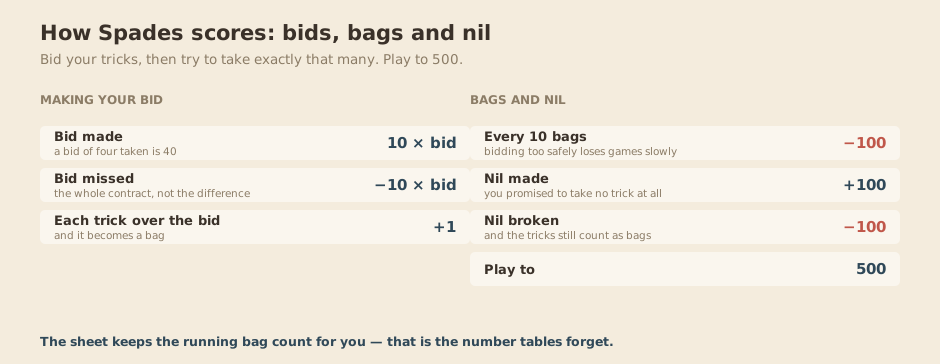
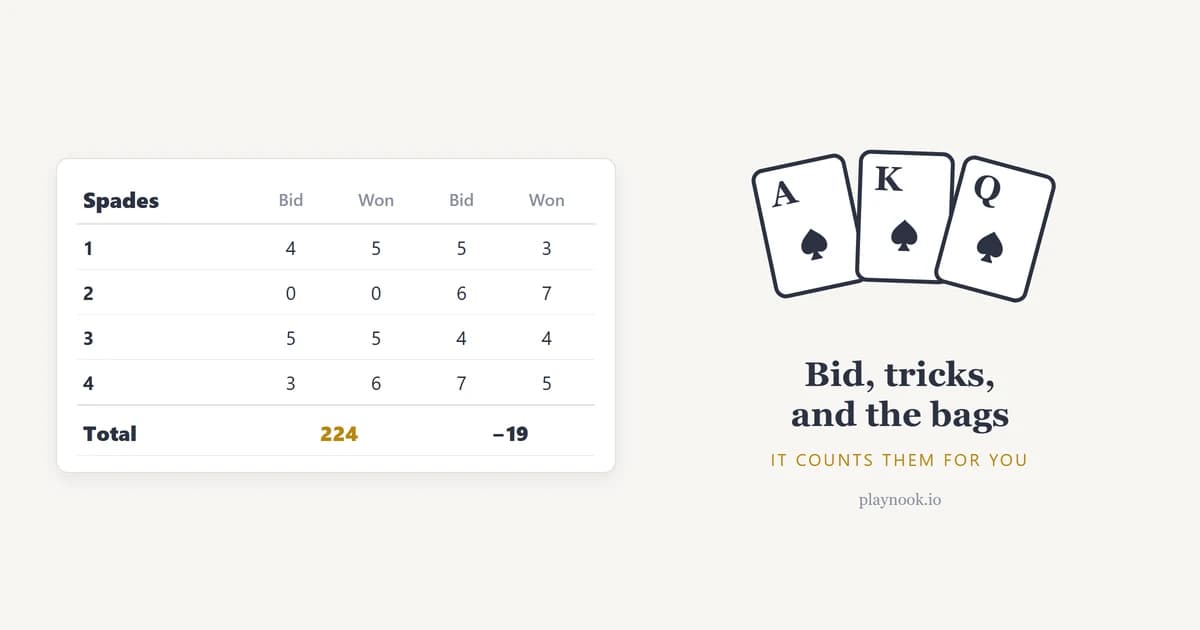
Two numbers per side per hand — bid and tricks actually won — and everything else follows: ten points a bid when the contract is made, minus ten a bid when it is not, a point for each overtrick, and the hundred-point penalty when the bag counter reaches ten. A contract that went down is shaded, so you can see the wreckage at a glance.
How do bags work in Spades?
Most people who learn Spades casually score it as “ten a bid” and ignore the overtricks, and then wonder why the game feels flat. The bags are what give bidding its teeth. Bid low to be safe and you collect overtricks; collect ten and you have handed back the equivalent of a whole made contract of ten. Bid honestly and you risk going down.
That tension is the reason the sheet counts bags separately rather than folding them into the total. You can see how close you are to the penalty, which is exactly the information you need when deciding whether to take that last trick or duck it deliberately.
How does a nil bid score in Spades?
A bid of nil promises no tricks at all: a hundred if you keep it, minus a hundred if you do not. It looks reckless and is usually arithmetic. A hand with no ace, no king and few spades is worth almost nothing in tricks — bidding one and making it earns ten, while a successful nil earns a hundred. The risk is that your partner must now cover the whole contract alone.
Enter it as a bid of 0. The sheet applies the bonus or the penalty and still counts any tricks you were forced to take as bags, which is the part that catches people out on paper.
How does bidding work in Spades?
Count your likely tricks: aces are nearly certain, kings are probable with a guard, and spades beyond the third are worth roughly one each because they will eventually run. Then add your partner’s bid and look at the total. If the four sides together have bid more than thirteen, somebody is going down; if they have bid fewer than eleven, the table is drowning in bags.
Spades scoring: questions people ask
How is Spades scored? Each side adds its partners' bids together. Make the contract and you score ten points per bid; miss it and you lose ten per bid. Every trick above the contract is a bag, worth one point on its own — and ten bags cost you a hundred.
What are bags and why do they matter? A bag is an overtrick — a trick you won but did not bid for. Each one adds a single point now and moves you closer to a hundred-point penalty later. It is what stops everyone from bidding four and taking seven: winning tricks you did not promise is quietly expensive.
How do I enter a nil bid? Type 0 as the bid. If that side takes no trick it scores a hundred; if it takes any, it loses a hundred — and the tricks still count as bags. The sheet applies all of that automatically.
Does it work for three or four individual players? Yes. Set the number of sides to three or four and each column becomes a single player instead of a partnership. The scoring is identical; only the bids stop being added together.
Does it save my game? Yes, in your own browser. Reload the page or close the tab and the scores are still there. Nothing is uploaded, there is no account and there are no ads.
Can I print a blank pad? Yes — switch Print to “Blank pad” for a clean sheet with bid and won columns for four sides, a bag row, a total row and the rules along the bottom. A4 or US Letter.
Other score sheets: Hearts — the same four players, no bidding, and you want the low score — Rummy, five-dice games and Farkle.