
Score & Play
Bowling Score Sheet
Ten frames, and the strike and spare carry-over worked out for you — the part everybody gets wrong on paper. Or print blank sheets and do it the hard way.
Players
Pages
Paper
Type the pins knocked down, or X for a strike and / for a spare. Frames fill in as soon as the carry-over is decided. Scores stay on this device.
1
2
3
4
5
6
7
8
9
10
1
2
3
4
5
6
7
8
9
10
What is on the bowling score sheet?
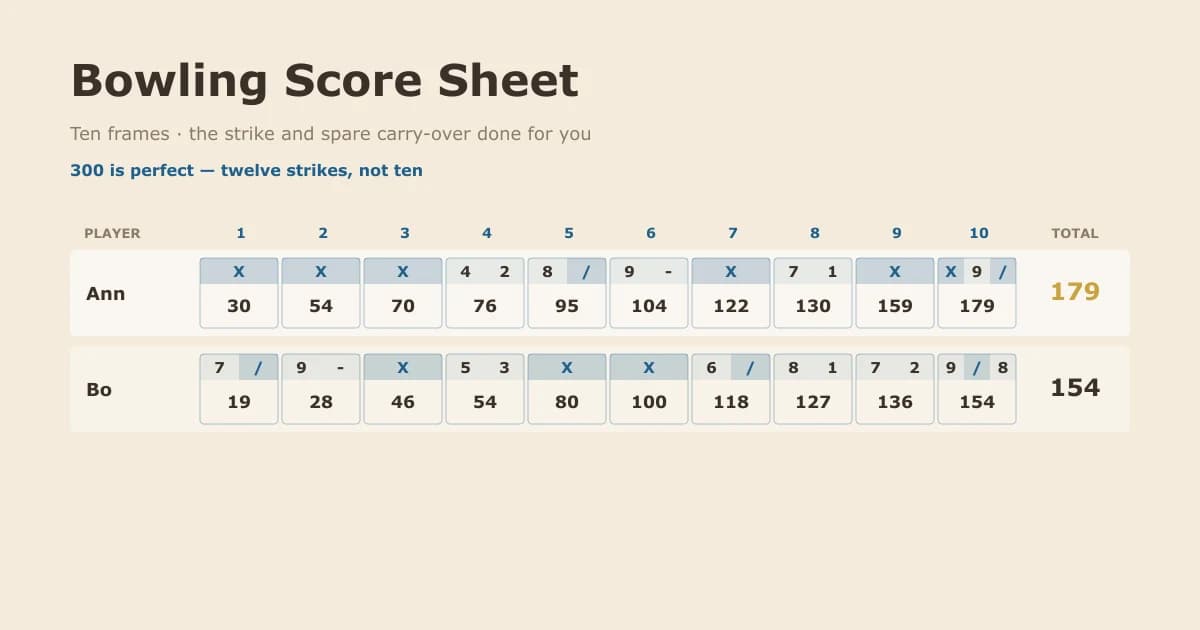
Ten frames across, up to six lanes down. Type what fell — X for a strike, / for a spare, a number otherwise — and the frame totals appear as soon as they are decided.
That last part is the whole point. A frame with a strike in it stays blank until two more balls have gone down the lane, because until then its score genuinely is not known yet. A printed grid cannot tell you that; it just sits there while somebody argues.
How does bowling scoring actually work?
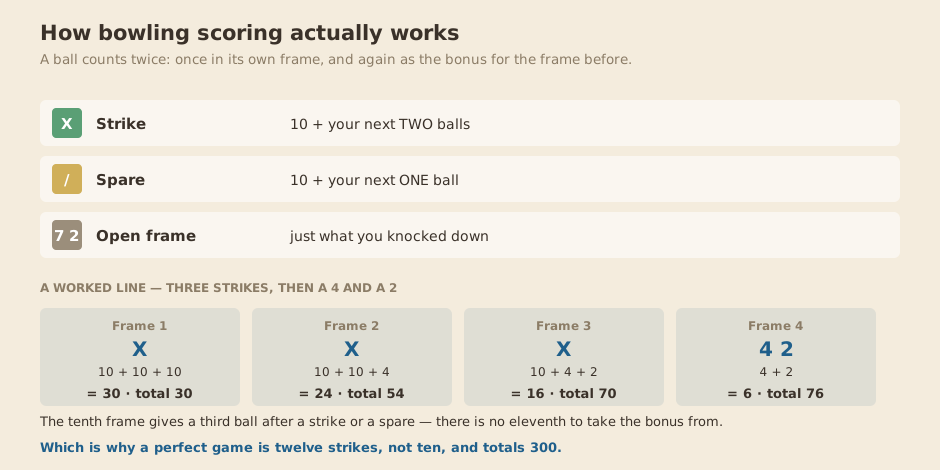
A strike — all ten with the first ball — scores 10 plus your next two balls. A spare — all ten with the second — scores 10 plus your next one. An open frame is simply what you knocked down.
So a ball counts twice, sometimes three times: once in its own frame and again as the bonus for the frames before it. Three strikes in a row make the first of them worth thirty — ten pins plus two more strikes — and that compounding is why a good game climbs so steeply at the end.
Why does the tenth frame have three balls?
Because a strike in the tenth still earns two bonus balls, and there is no eleventh frame to take them from. So you roll them right there. Same for a spare, which earns one.
That is also the answer to the question everybody asks: a perfect game is twelve strikes, not ten — nine in the first nine frames, then three in the tenth — and it totals 300, because every one of the ten frames scores thirty.
What can you actually score?
A gutter game is 0. Nine pins and a miss in every frame is 90 — the number that surprises people, because nine out of ten pins sounds far better than it scores. Spares all the way with a five each time is 150. Twelve strikes is 300.
The gap between 90 and 150 is entirely carry-over. Knocking the same pins down in a different order is worth sixty points, and that is the whole game.
How to print a blank bowling score sheet
Choose Blank sheets and print one, two or three pages, on A4 or US Letter — landscape, because ten frames do not fit sensibly any other way. Each sheet has six lanes with the two-box-and-total layout you would recognise from an alley, and the scoring rules underneath.
Bowling scoring: questions people ask
How does a strike score in bowling? Ten, plus whatever you knock down with your next two balls. That is why a frame with a strike in it cannot be totalled straight away — and why three strikes in a row are worth thirty for the first of them.
How does a spare score? Ten, plus your next one ball. So a spare followed by a nine is worth nineteen, and the nine also counts again in its own frame.
Why does the tenth frame have three boxes? Because a strike or a spare there still earns its bonus balls, and there is no later frame to take them from. You roll them in the tenth itself — which is why a perfect game needs twelve strikes rather than ten.
What is the highest possible score? 300. Twelve strikes: one in each of the first nine frames, then three in the tenth. Each of the first ten frames scores thirty.
How do I type a strike or a spare? Type X for a strike and / for a spare — the same marks you would write by hand. A dash or a zero means none, and the sheet works out the carry-over itself.
Where do my scores go? Into your own browser and nowhere else. Nothing is uploaded, a reload will not lose the game, and pressing New game twice clears the sheet.
Playing something else tonight? There are score sheets for Farkle, five-dice games, Golf and Hand and Foot here too.