A hundred squares, nine ladders, ten snakes, and not a single decision from beginning to end. You roll, you move, and where you land is entirely the die's business.
That is usually said as a complaint. It is actually what makes this game interesting to write about — because a game with no choices is a Markov chain, and a Markov chain does not have to be played to be understood. It can be solved. Everything below is calculated, not sampled.
How to play Snakes and Ladders
Roll one die, move that many squares along the boustrophedon track — 1 to 10 left to right, 11 to 20 right to left, and so on up to 100.
- Foot of a ladder: climb to the top.
- Head of a snake: slide down to the tail.
- Square 100 needs the exact roll. Too high and you stay put.
That last rule is why square 99 is not the near-certain win it looks like: only a 1 gets you home, so it takes exactly six rolls on average to leave. (That figure is a useful check on our arithmetic — a one-in-six chance repeated has an expected wait of exactly six, and the solver returns 6.00 without being told.)
How long does a game take?
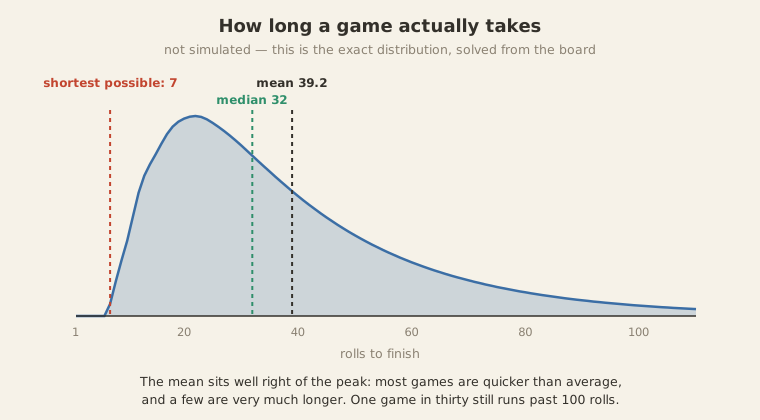
| Average game | 39.2251 rolls |
| Median | 32 rolls |
| Most likely single length | 22 rolls |
| Shortest possible | 7 rolls (once in 662 games) |
| Finished within 100 rolls | 96.9 % |
The mean sits seven rolls to the right of the peak, which is the shape of this game in one sentence: most games are quicker than average, and the ones that are not are much longer. About one game in thirty is still going after a hundred rolls.
The shortest possible game is a single fixed route, and the solver found it rather than being told: a 1 onto the ladder at square 1, then 1, 6, 6, 1, 6, 6, taking the ladders at 51 and 80 on the way.
Does the first player win more often?
Yes: 50.79 %. Not measured over a sample of games — worked out exactly, by taking the distribution above for both players and asking how often the first one finishes on a roll at which the second has not. The edge is real and comes to about one game in a hundred and thirty.
What each snake and ladder is actually worth
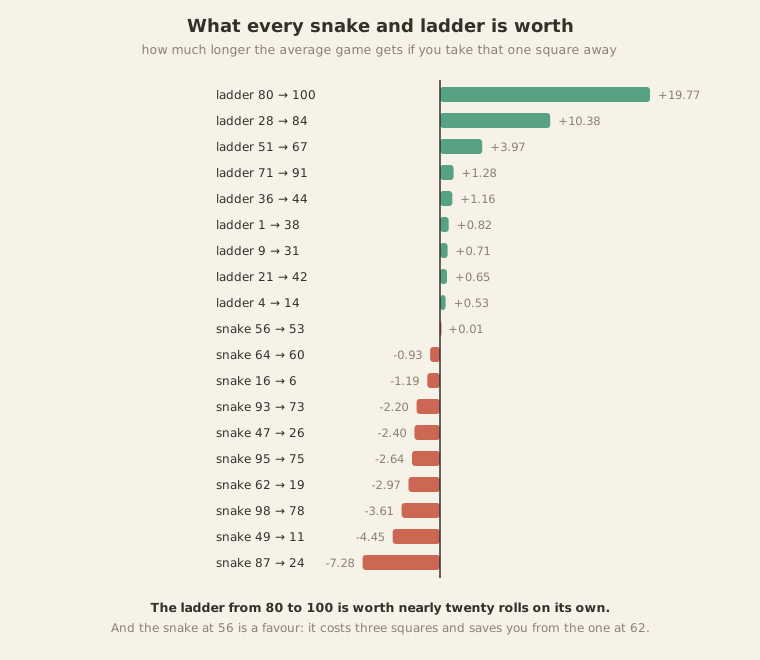
Remove one square from the board, solve the game again, and the difference is what that square was worth. The results are wildly uneven:
| Effect on the average game | |
|---|---|
| Ladder 80 → 100 | +19.77 rolls if removed |
| Ladder 28 → 84 | +10.38 |
| Snake 87 → 24 | −7.28 |
| Snake 49 → 11 | −4.45 |
| Everything else | under 4 rolls each |
The ladder from 80 to 100 is worth more than the other eight put together. Take it away and the average game stretches from 39 rolls to 59 — half again as long. It sits at the top of the board where a snake would otherwise be waiting, and it ends the game outright.
The snake that helps you
One entry sits on the wrong side of the line. The snake at 56, which drops you three squares to 53, makes games very slightly shorter — removing it costs 0.014 rolls.
The reason is a small piece of geometry. From 56 a roll of 6 lands you on 62, where a snake drops you all the way to 19. From 53 you cannot reach 62 at all. The snake costs you three squares and moves you out of range of a fall of forty-three.
It is not a big effect and nobody at the table will ever notice it. But it is a real one, and it is the sort of thing that only shows up if you calculate rather than play.
What you actually play here: the three-piece rule
Everything above is about the traditional game, and the traditional game is a spectator sport. You roll, you watch, you have no say. It is worth solving and it is not worth playing, so the board on this page does not offer it.
What you get instead is ours, not traditional — we know of no source for it and are not pretending otherwise:
Each side gets three pieces, and after every roll you choose which one to move. First piece home wins. That one change gives the turn a question: do I send the leader up the ladder at 80, or move the straggler off square 87 before the snake there eats him?
We checked whether that question is real, because adding clicks is not the same as adding a decision. Two computer opponents, one choosing well and one choosing at random:
| Good choices beat random ones | |
|---|---|
| Classic, one piece | 50.5 % — indistinguishable, as it must be |
| House rule, three pieces | 97.2 % |
The first row is the control, run against the traditional rules. With one piece nobody chooses anything, so any difference would have meant the measurement was broken. It came out at 50.5 % with a margin of 0.6, which is exactly nothing — and that is what makes the second row trustworthy.
97.2 % is a wider skill gap than most games on this site. It is also faster: three pieces finish in 33 turns against the classic 52, because you have three chances at the good ladders instead of one.
The computer opponent in that mode is not guessing either. It uses the solved board directly — the expected-rolls figure for every square from the table above — and moves whichever piece leaves its best piece closest to home.
Where it comes from
The game is Indian, and it was originally about morality. As Moksha Patam or Gyan Chaupar the ladders were virtues and the snakes were vices, and the imbalance was the point: there were more snakes than ladders, because falling is easier than climbing. The board taught that progress toward liberation was slow and slipping back was quick.
British publishers brought it home in the 1890s and quietly dropped all of that. Milton Bradley's Chutes and Ladders of 1943 is the layout most people picture, and it is the one solved on this page — nine ladders and ten snakes, so the original imbalance survives even though nobody meant it to.
If you like this one
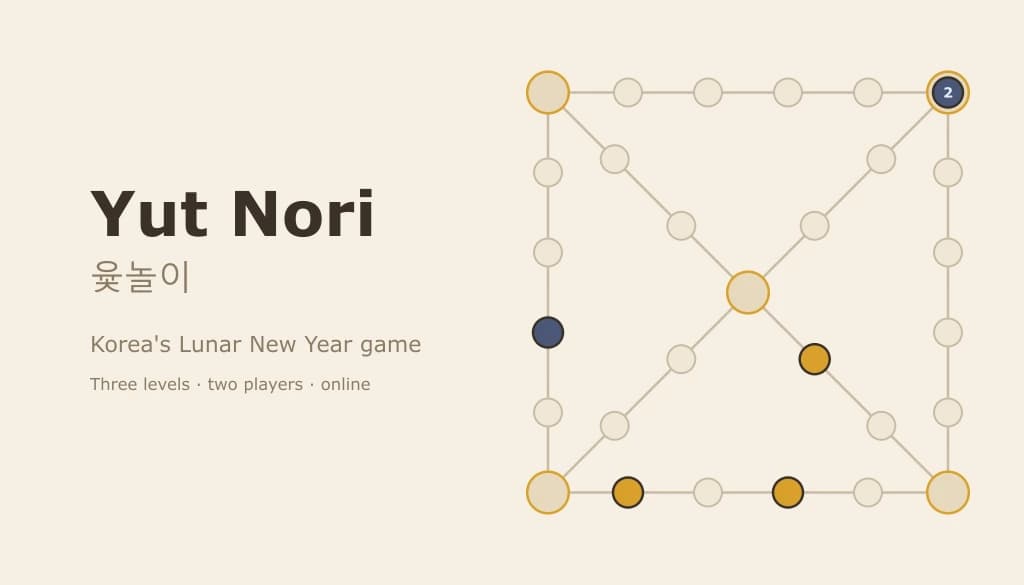
- Yut Nori — a Korean race where the shortcuts are the game, and where a turn carries 2.64 steps rather than 2.31
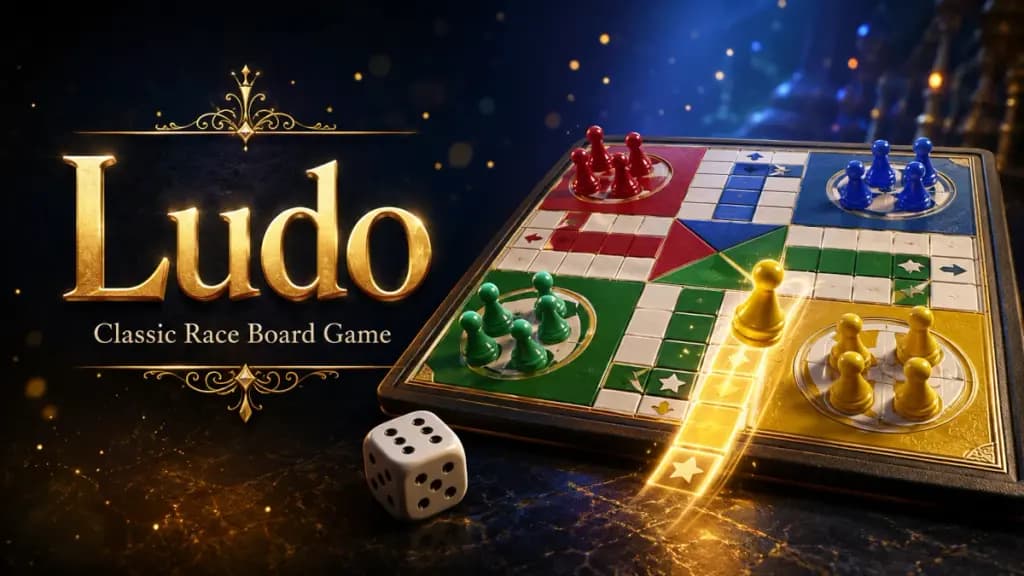
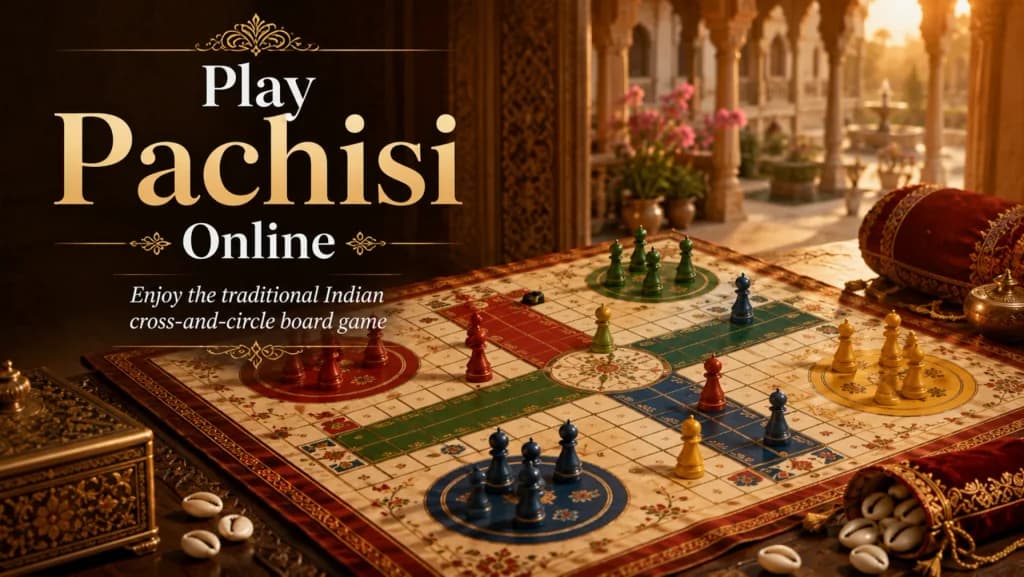
- Ludo and Pachisi — the race game with real decisions in it: which piece to move, and when to strike
- Senet — the Egyptian ancestor, thrown with sticks, where landing on a lone enemy swaps places instead of sending it home