PlayNook

Board Game · Mill Game

Play Shax Online — Free 2 Player Somali Mill Game

Somalia's mill game, and the only one in the family where the board fills up completely before a single piece moves. Rows made while placing catch nothing — they decide who opens the board. And being shut in is not a loss: your opponent has to let you out.

Twelve men a side. Twenty-four points on the board. Place them all and the arithmetic does something no other mill game allows: every point is occupied, and neither player has a single legal move.

Shax — the Somali mill game, called jare, "cut", in central and southern Somalia — is built on that dead end. It does not avoid the full board. It starts there.

How to play Shax
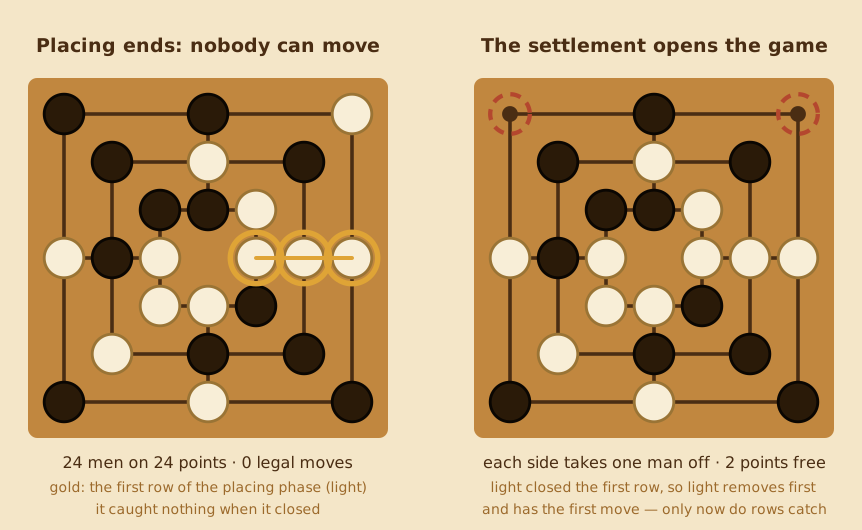
Two Shax boards side by side. The left board is completely full with twelve light and twelve dark men on all twenty-four points, with one row of three light men marked by gold rings and a gold line, labelled as the first row of the placing phase. The right board shows the same position after the settlement, with two points now empty and marked by dashed red rings where one man of each colour has been removed.
Placing ends with no moves available at all. Each side then takes one enemy man off, and the game proper begins on a board with two free points.
  1. Place. Take turns putting a man on any empty point until all twenty-four are down. A row of three closed now captures nothing.
  2. Settle up. Whoever closed the first row takes one enemy man off; the opponent then takes one too, row or no row. That player moves first.
  3. Move. Slide a man along a line to an empty neighbour. No flying, ever — three men left still have to walk.
  4. Take. From here every row you close takes one enemy man. Break a row and remake it and it pays again.

A man standing in a row cannot be taken unless every one of that player's men is in a row — the usual mill rule. It applies to the settlement too, which is why a row built while placing is worth more than it looks: it shelters the three men in it.

What happens when the Shax board is full?

With twenty-four men on twenty-four points there is nothing to slide into. A man has to come off, or there is no game. That is not an interpretation of the rules; it is the condition for the rules to continue at all, and it is the single most useful thing to know about Shax.

  • 24 points, 16 rows of three, no diagonals
  • 12 men each — exactly half the points
  • 0 free points once placing ends, then 2 after the settlement
  • No flying, ever — and being shut in is not a loss

Why being shut in does not lose in Shax

In nine men's morris, leaving your opponent with no legal move simply wins. On a board this crowded that would end most games by accident, so Shax has the opposite rule, and it is the one the game is remembered for.
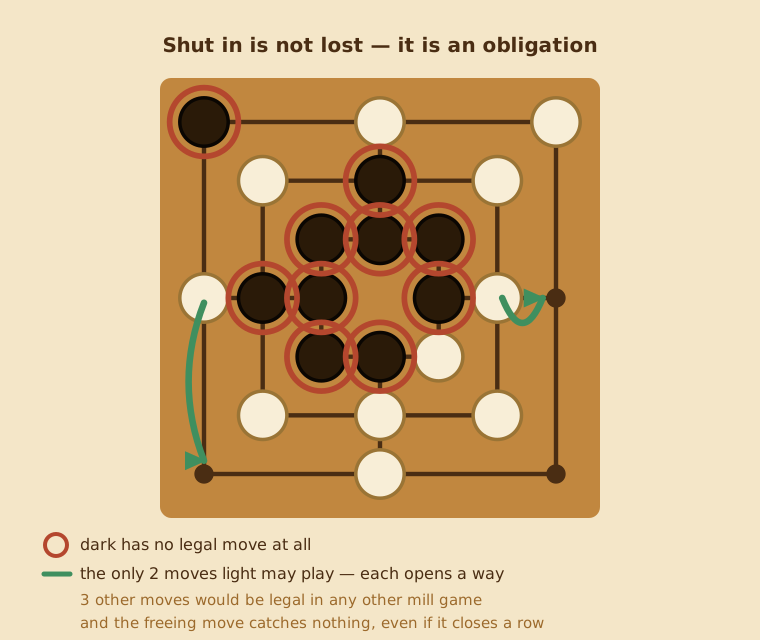
A Shax board part-way through the moving phase with about twenty men still on it. Every dark man is circled in red to show the side that has no legal move at all, and two green curved arrows mark the only two moves the light player is allowed to make, each one vacating a point next to a dark man. A caption notes that three other moves would be legal in any other mill game and are forbidden here.
Dark cannot move a single man. Light is not allowed to do anything except open a way — and that move takes nothing, even if it closes a row.

If you have no move, your opponent must play a move that frees you, and that move captures nothing. The phrase for asking is jid i sii aan jar aheyn — give me a way, without cutting.

Which moves qualify is exactly determined, and the engine on this page proves it rather than guessing. Being shut in means no man of yours has an empty neighbour. A move changes two points: the one it fills, and the one it vacates. The filled one can never help you, and every other empty point already failed to help. So only the vacated point can free you — the destination is irrelevant. Our test harness checks that claim against a second, independently written calculation at every blockade that comes up.
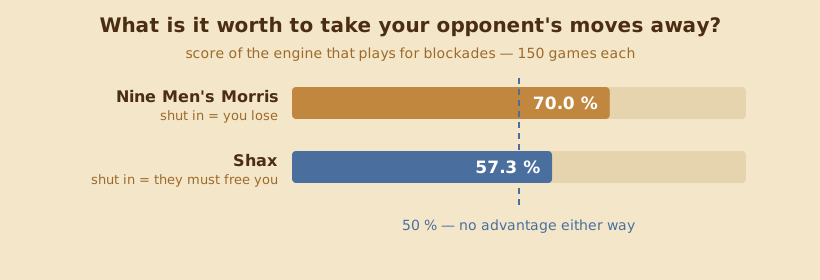
A horizontal bar chart comparing what the blocking term in the engine's evaluation is worth in two games. Nine Men's Morris, where being shut in loses the game, scores 70.0 per cent. Shax, where being shut in obliges the opponent to open a way, scores 57.3 per cent. A dashed vertical line marks 50 per cent, the level at which the term would be worth nothing.
The same engine with and without its blocking term, 150 games each. The freeing rule takes about thirteen points off what a blockade is worth.

What the written rules of Shax disagree about

Shax is a folk game, and the two detailed English descriptions of it contradict each other at the settlement. One says the first row's owner takes a man and so does the opponent. The other gives the removal only to the first row's owner.

Worse, the first of them also says that if neither side closed a row, nothing is removed and the second placer moves first. That cannot be: on a full board the second placer has no move either. The two accounts also agree on who acts in that case, so only one of the two "whats" is physically possible, and that settles the no-row case on its own.

The remaining question — one removal or two — is not settleable by reading. So we measured it.
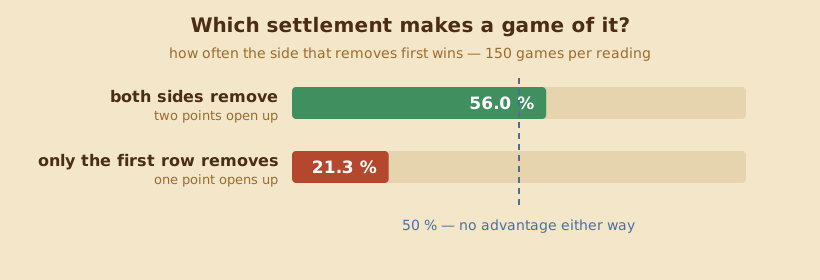
A horizontal bar chart of two readings of the Shax settlement rule, measured over 150 games each with the same engine on both sides. When both sides remove a man, the player who removes first goes on to win 56.0 per cent of games. When only the first row's owner removes a man, that player wins just 21.3 per cent. A dashed line marks 50 per cent.
Under the single-removal reading, the one thing the placing phase is played for turns out to be a liability. That is not how a game people have played for generations behaves.

With both sides removing, the player who takes first wins 56.0% — a clear edge for winning the placing phase, which is what you would expect. With only the first row's owner removing, that player wins 21.3%, despite being a man up and having the move. One free point is too few: with a single hole on the board, having to move is a burden, and the freeing obligation fires in 68.7% of those games instead of 22.7%.

That might have been our own engine's fault rather than the rule's — it is built to play for the first row, so under a reading where the first row hurts, it would be steering into its own loss. So we checked it under control, two engines differing only in whether they want the first row:

ReadingEngine that plays for the first row
both sides remove65.8 %
only the first removes30.4 %

It takes the first row in about 118 of 120 games either way. Under the single-removal reading, getting what you played for makes you lose. We therefore use the two-removal reading here, which is also the one stated outright by the fuller of the two sources. The other is not offered as an option, because a game whose only objective is a trap is not a variant — it is a misreading.

Shax, Morabaraba and Twelve Men's Morris

All three put twelve men a side on twenty-four points, so all three fill the board completely. Morabaraba and Twelve Men's Morris add four diagonals and call the full board a draw. Shax has no diagonals and takes a man off instead. Same arithmetic, opposite conclusion — and the livelier game for it: in our own games the first capture of the moving phase comes after 3.6 half-moves, and 92% of games end in a capture rather than by repetition.

Where Shax comes from

Shax is played across Somalia, Djibouti and eastern Ethiopia, scratched in the sand with pebbles and camel droppings for men, and it carries the kind of apparatus a living game accumulates: a run of four straight wins is a "pool", five is a "girl". It also has the one quality that matters when you go looking for rules — nobody writing it down thought to mention how many men each player has, because everybody already knew.


Frequently asked questions

+ How do you play Shax?

Each player has twelve men and the board has twenty-four points, so placing ends with every single point occupied. Take turns placing; a row of three made while placing captures nothing. Once the board is full, whoever closed the first row takes one of the opponent's men off, the opponent then takes one too, and the player who removed first has the first move. From then on you slide a man along a line to an empty neighbouring point, and every row you close takes one of their men. Reduce them to two men and you have won.

+ Why does nothing get captured while you are placing in Shax?

Because the board is going to be completely full either way, so a capture during placing would mean nothing was really at stake until the end. Instead a row made while placing is a claim: the first one made earns the first removal once placing is over. That turns the whole placing phase into a race for one thing, which is a tighter contest than a series of small captures would be. Our engine measures it as worth having — a version that plays for the first row beats an otherwise identical version that ignores it.

+ What happens when the Shax board is full?

Something has to come off, because with twenty-four men on twenty-four points neither side has a single legal move. This is the part of the game that makes it unlike any other mill variant: the full board is the starting position, not a dead end. The player who closed the first row during placing removes one enemy man, the other player removes one as well, and play begins with two points open. If neither side ever closed a row, the player who placed second removes one instead.

+ What happens if you cannot move in Shax?

You do not lose — that is the rule people remember Shax for. If you have no legal move, your opponent is obliged to play a move that opens a way for you, and that move captures nothing even if it closes a row. The Somali phrase for asking is jid i sii aan jar aheyn: give me a way, without cutting. In every other mill game on this site, leaving your opponent with no move wins the game outright. Here it costs you a free move and hands you a row you are not allowed to cash.

+ Is Shax the same as Nine Men's Morris?

Same board, different game. Shax uses the standard twenty-four point board with no diagonals, exactly as nine men's morris does, but with twelve men each instead of nine — and twelve plus twelve is the number of points, which is what sets everything else off. Nine men's morris leaves six points open after placing, captures from the first mill onward, lets a player with three men fly, and ends the game if you cannot move. Shax does none of those four things.

+ Is Shax the same as Morabaraba or Twelve Men's Morris?

Closer, but no. All three have twelve men a side on twenty-four points, so all three fill the board. Morabaraba and Twelve Men's Morris add four diagonals, which turns sixteen rows into twenty and makes the corners strong instead of weak; Shax has no diagonals. And where those two call a full board a draw, Shax takes a man off and plays on. It is the same arithmetic with the opposite conclusion drawn from it.

+ Is it worth blocking your opponent in Shax?

Less than in ordinary morris, but still worth something. We measured it the only way that answers the question cleanly: the same engine with and without the term that rewards taking an opponent's moves away, 150 games each. In Nine Men's Morris the blocking version scores 70.0%. In Shax it scores 57.3%. The freeing obligation takes most of the value out of a total blockade, but squeezing a man's options is still good play — a man with nowhere to go is a man doing nothing, even if the rules will eventually free it.

+ Does the first player have an advantage in Shax?

A small one. Over 150 games with our Medium engine on both sides, the player who places first won 54.0% and the second placer 38.0%, with 8.0% drawn. Most of that comes through one channel rather than directly: placing first helps you close the first row, and the first row earns the first removal and the first move. Nobody has solved Shax — nor have we — so treat that as a measurement of our own engine playing itself, not a fact about the game.

+ Can I play Shax with a friend online?

Yes. Choose 'With a friend online' below the board and press Open a table. You get a four-character code; send it to your friend, they type it in and press Join. There is a chat window built in, and neither of you needs an account or a download.

More games like this