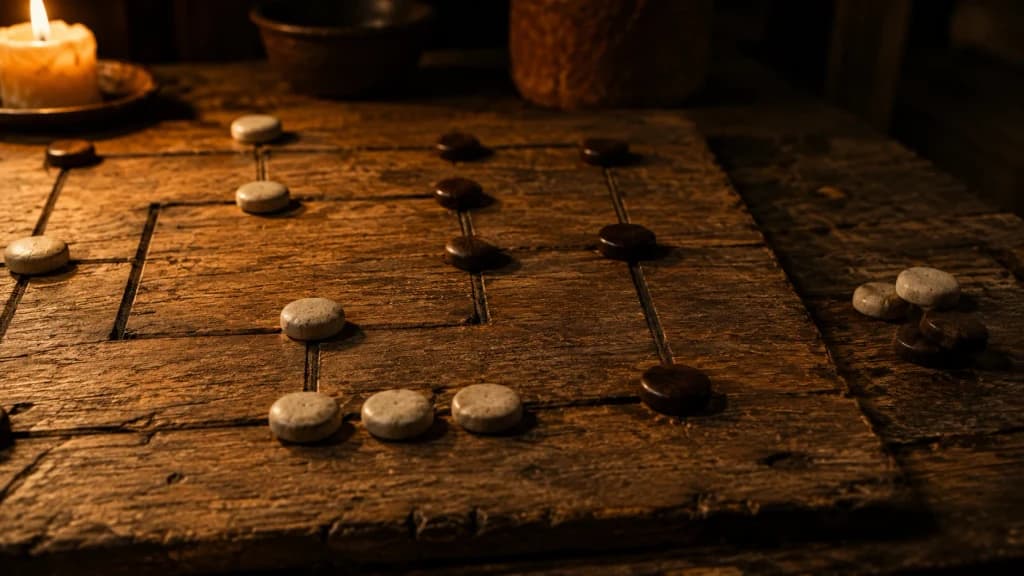
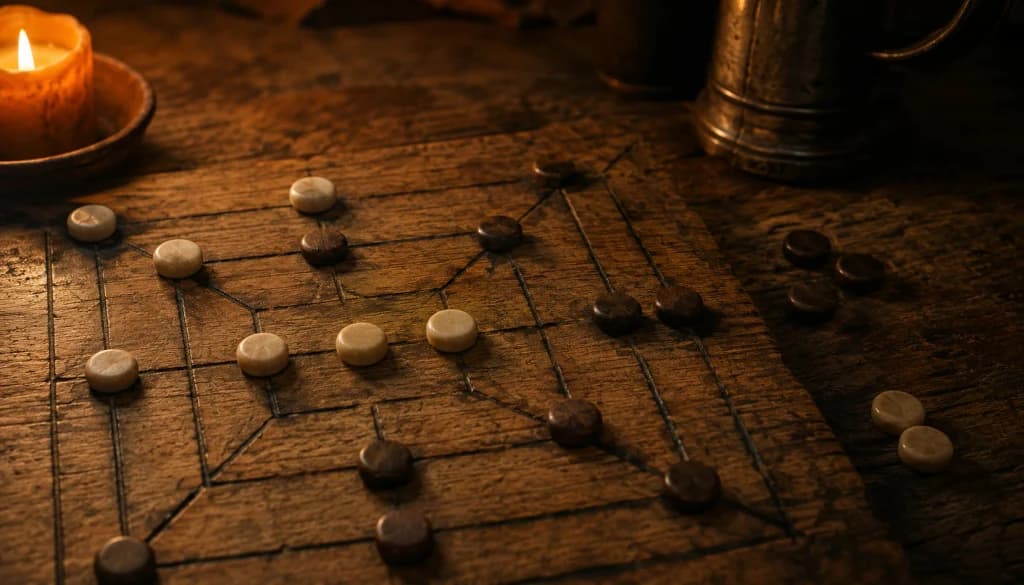
Thirty holes scooped in the ground, twelve pieces a side, and once everything is down there are exactly six empty holes left on the board. That number is the whole game: six holes is all the room you get, so where you put your pieces decides what you will be able to threaten for the rest of the match.
Dara — also written derrah — is played across Nigeria, Niger, Mali and Burkina Faso. It looks like a mill game and is not one.
How to play Dara
What counts as a row in Dara?
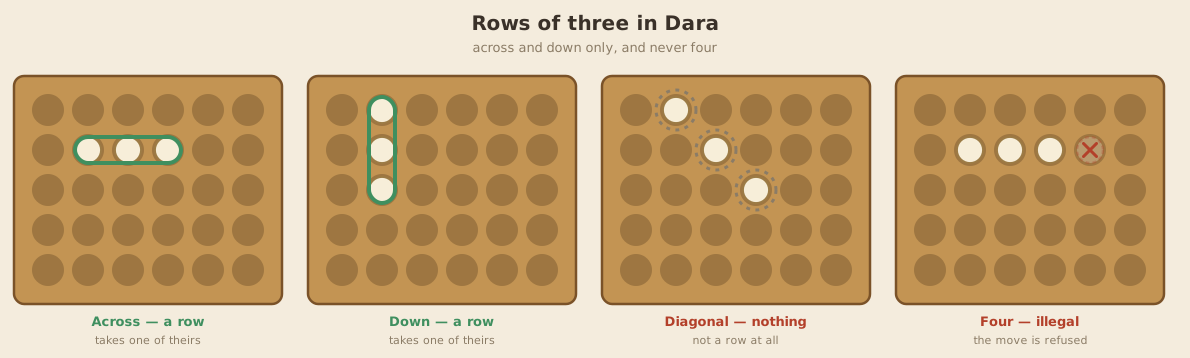
Six columns, five rows, and thirty-eight places a row of three can sit — twenty across and eighteen down. Diagonals count for nothing.
How does capturing work in Dara?
- Place. Take turns putting one piece in any empty hole until all twenty-four are down. Rows made now take nothing.
- Move. Slide one piece into an empty neighbouring hole. No diagonals, no jumping.
- Take. If the move leaves three of yours in a line, remove one enemy piece — but not one that stands in a row of three itself.
Two rows closed by a single move still take only one piece.
Why a finished row in Dara is not finished
Here is the part that makes Dara worth playing, and the part most written descriptions leave out entirely.
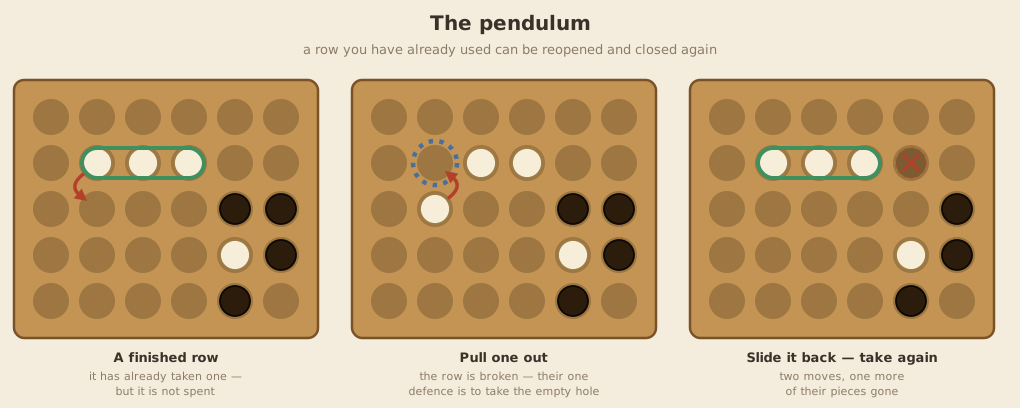
A row that has already taken a piece is not spent. Pull one piece out of it, slide it back next turn, and the row forms again — another capture. Every finished row is therefore a standing threat, and the defence is a race for a single hole.
What is the bull in Dara?
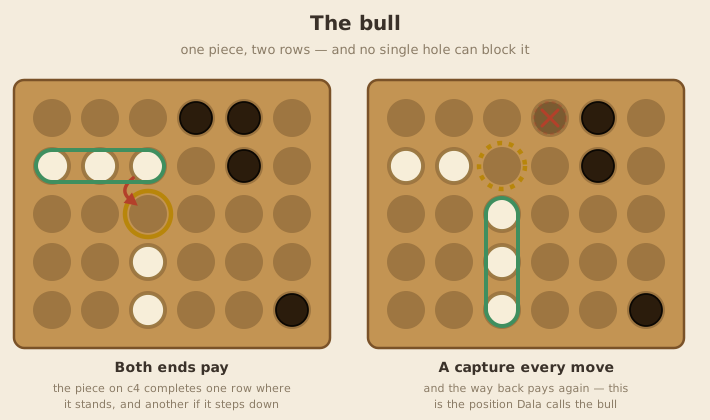
The strongest version has a name, borrowed from the related Sudanese game Dala: the bull. One piece, two rows, a capture every move. Dala's own written rules describe the position and do not forbid it.
Does the pendulum break Dara?
That was our first worry, so we measured it rather than guessing. The engine on this page played itself under three policies: one that sets pendulums up deliberately, one that simply takes the captures when they appear, and one that refuses them altogether.
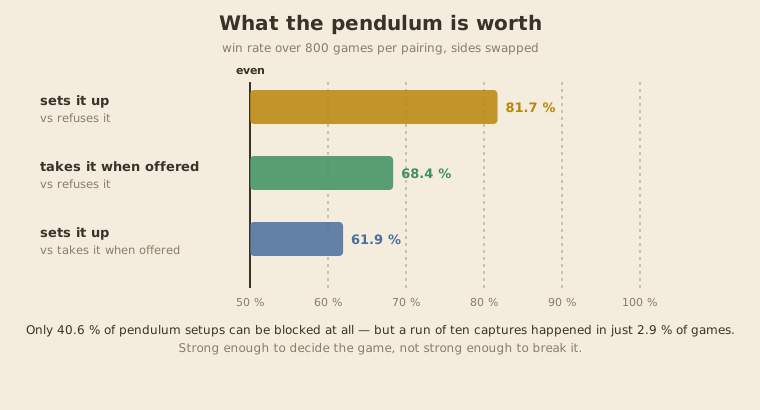
It decides the game without breaking it. Only 40.6% of pendulum setups can be blocked at all — the defender often has no piece able to reach the hole. And yet a run of ten captures, which is a won game on its own, happened in just 2.9% of games. The threat is answerable often enough that the game stays a game.
Can you make three in a row while placing?
Here the written sources disagree, and this is the one place where a measurement overturned our own first decision.
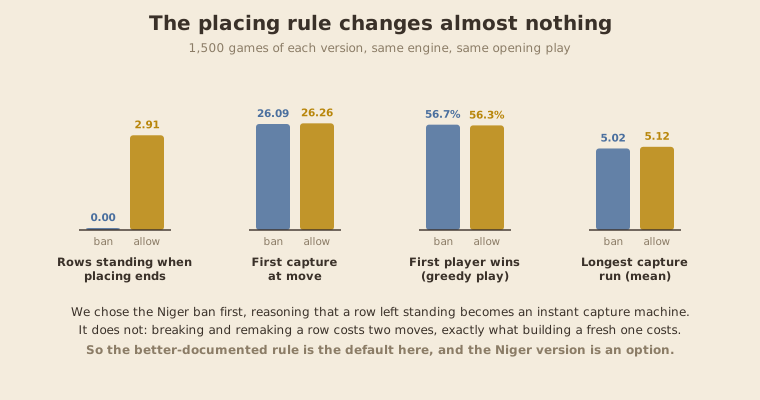
We chose the Niger ban first, reasoning that a row left standing is a capture machine waiting to be switched on. It is not. Breaking and remaking a standing row costs two moves — exactly what building a fresh row costs from the crowded position placing leaves behind. Both versions are here; the better-documented one is the default.
Playing Dara against the computer
Four levels, and they differ in what they understand rather than how deep they look. Easy sees only material and is therefore blind to the pendulum — which, given the numbers above, is a serious handicap. Medium counts finished rows. Hard tells a pendulum the opponent can block from one they cannot, and knows what a bull is worth. Expert adds mobility and the value of keeping your own pieces inside rows, where they cannot be taken.
Played against each other, Medium beats Easy 87.5% of the time and Hard beats Medium 95.0%. Expert beats Hard only 55.6% — a real step, but a small one, and we would rather say so than round it up.
The board marks the pendulums for you while you learn: a green ring on a piece that can step out and return unopposed, a faint ring where the defender can block, a solid gold ring for a bull.
Where Dara comes from
Dara belongs to the Dakarkari of north-western Nigeria and is played widely across the Sahel, traditionally in holes scooped out of the ground with stones, seeds or pellets of dung for pieces. It is a close relative of Wali in Ghana and of Dala in Sudan, and the family runs on to Dama Tuareg across the Sahara.
Which Dara is this?
Written rules for Dara differ, so we had to choose — and the choices are worth stating plainly.
- Twelve pieces, thirty holes, orthogonal rows of three. All four readable sources agree on this.
- Rows while placing: allowed, but they take nothing. The general rule; the Niger ban is a switch on this page. Measured to make no difference, as above.
- A piece in a row cannot be taken, unless every enemy piece is in one. The two fullest accounts say so; two briefer ones let you take anything.
- Reduced to two pieces, you lose. Some sources instead say "capture ten of their pieces". These are the same rule: twelve minus ten is two, and with two pieces no row of three — and so no capture — is ever possible again.
- No legal move, you lose. With six empty holes this genuinely happens, in about one game in a hundred.
The one question no source answers is the pendulum. We could not find a rule against it anywhere, so we built it and measured what it does. The numbers are above.