

Shisima has nine points and six pieces. You can teach it in thirty seconds and play a game in a minute.
You can also lose it twenty times in a row to a nine-year-old, because the entire game is a fight over a single point — and that point is one you cannot afford to stay on.
The pond and the insects
Shisima means body of water in Tiriki, a language of western Kenya. The board is a pond. The pieces are imbalavali, the water insects that dart across its surface, and the game is played by children who draw the octagon in the dirt and use bottle caps or pebbles.
It belongs to the oldest and most universal family of board games — the three-in-a-row games, which very nearly every culture invented independently. Mathematics teachers found it some decades ago and it has been quietly circulating through classrooms ever since, because it teaches symmetry and forced moves in the space of a spare minute.
The board and the rules
An octagon of eight rim points with spokes running into a ninth point in the centre — the shisima itself.
- Sit opposite each other. Each player takes three men and places them on the three rim points nearest them. The two side points and the centre start empty.
- Slide one man one step along a line each turn: to a neighbouring rim point, or into the centre, or out of it again.
- Nothing is ever captured and nothing is ever added. All six men are on the board from the first move to the last.
- Three of your men in a straight line wins.
- The same position three times is a draw.
That is the complete rule set. There is no more of it.
Every winning row goes through the middle
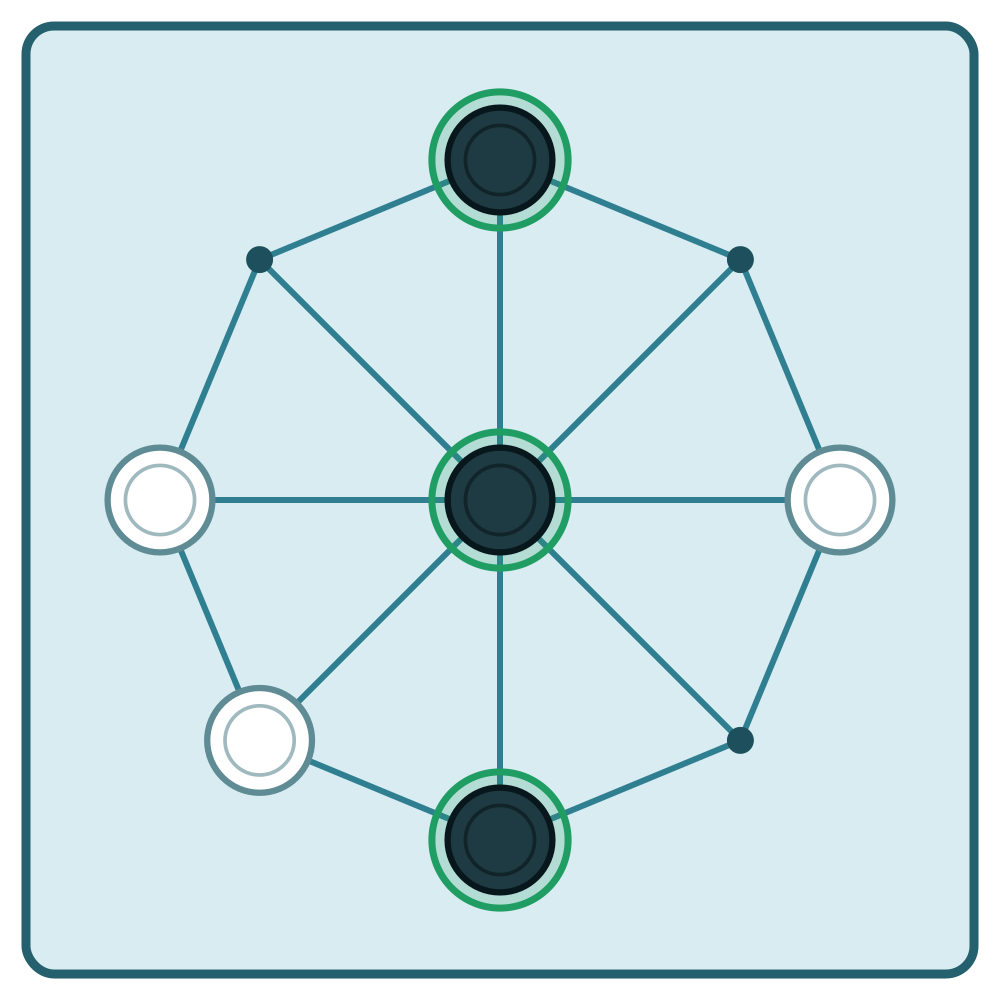
This is the design, and everything follows from it. On an octagon of eight rim points around a centre, the only straight lines of three points are the four diameters: any rim point, the centre, and the rim point opposite it.
Four winning rows. All four share one square.
Two neighbouring rim points and the centre do not make a line — they make a bent path, and it does not win. This is the rule newcomers get wrong most often, and it is worth pointing at the board once before the first game.
The joke at the heart of the game
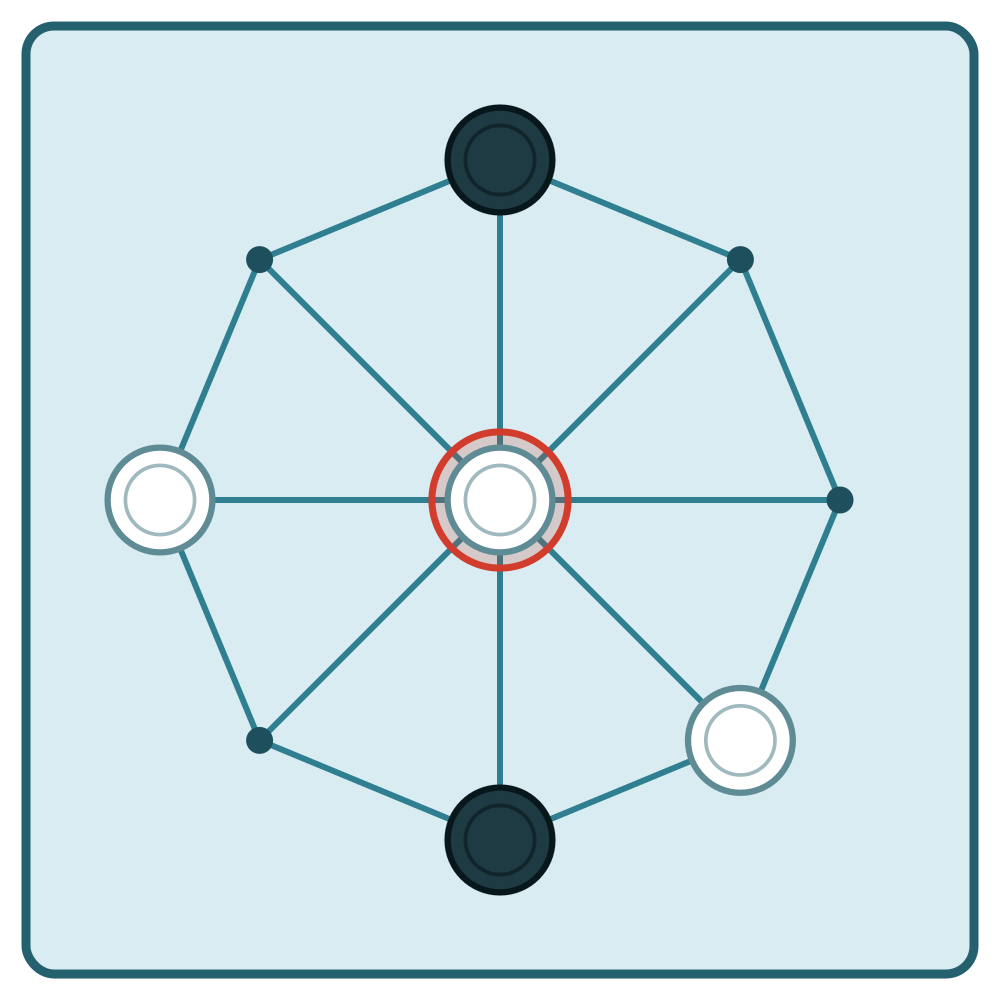
A man in the shisima blocks every winning row simultaneously. That makes it the strongest point on the board by a distance.
It is also the point you cannot win from while you are sitting on it — because your own row needs the centre too. Occupy it and you have made yourself unbeatable and unable to win at the same time.
So the skill in Shisima is entirely about timing: hold the centre while you are defending, leave it the instant your own row is ready. The whole game is that one decision, repeated.
How to win more often
Claim opposite ends. Two men on the two ends of the same diameter is the strongest shape in the game. The moment the centre is free, you slide in and win. Building that shape is the only plan worth having.
Watch which diameter your opponent is on. They have exactly four rows available. Knowing which one they are building takes one glance, and there is nowhere for them to hide it.
Make threats that build. Every move that forces your opponent to answer is a free move for you. In a game this small, one free move is often the whole difference.
Do not crowd your own water. Three men bunched on neighbouring rim points block each other's paths. Keep them spread so that every piece has somewhere to swim.
Swap who starts. With perfect play Shisima is a draw, like noughts and crosses — but the first move is worth enough that a best-of-seven should alternate.
Common questions
How is it different from noughts and crosses? In noughts and crosses you place marks that never move, and the game ends when the board fills. In Shisima all six men are down from the start and one slides every turn, so the position never fills up and the game never runs out of moves. There are also only four winning rows instead of eight, and all of them pass through one point.
Can pieces jump or capture? Neither. It is a pure movement game — one step per turn, along a line, onto an empty point.
Do two neighbouring rim points and the centre count as a row? No. Only the four diameters count. Draw a straight line through the three points: if it bends, it does not win.
What age is it good for? Six and up. The rules take half a minute, and the strategy underneath is deep enough that adults lose to children with some regularity.
Can it end in a draw? Yes, by threefold repetition, and between two careful players that is the usual result.
Ready to try it? Play Shisima against the computer — same pond, three difficulty levels, a game a minute. To play it at a table, print the board and the six men — it is the quickest set in the collection to cut out. If you like three-in-a-row games with more board to work with, Nine Men's Morris is the same instinct with twenty-four points and pieces that get taken.