
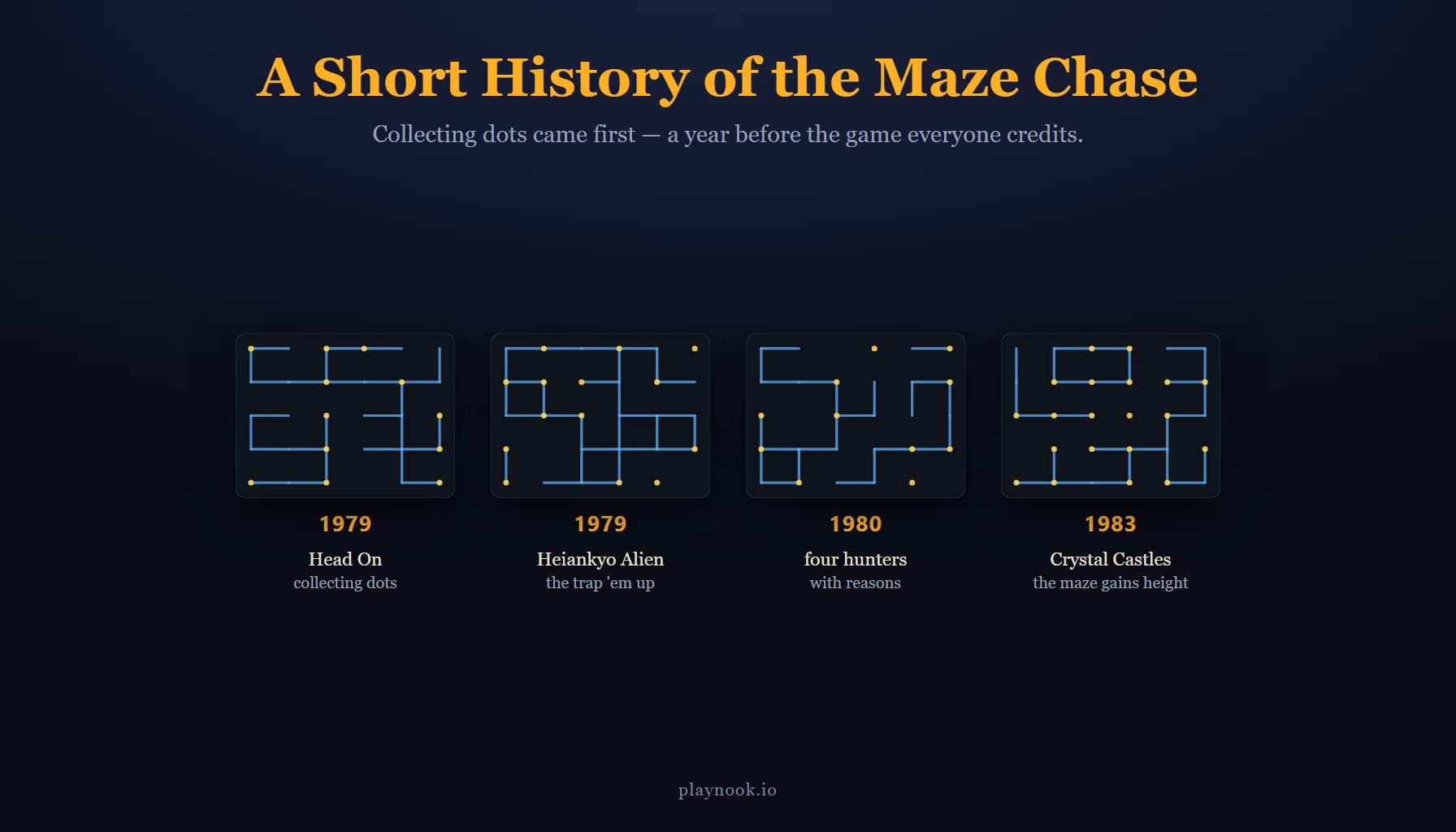
Every account of this genre starts in the same place, in 1980, with one game. And almost every account is wrong about what that game actually contributed.
The maze was not new. Enemies that chase you through a maze were not new. Even collecting dots — the thing everybody remembers — had been done a year earlier, by a driving game, and it was a hit.
What follows is the lineage with the evidence attached, including the two claims that circulate most widely and neither of which survives a look.
The first claim: "Heiankyo Alien was the first maze chase game"
You will see this a lot, and it is half right in a way that matters.
Heiankyo Alien is real, it is from 1979, and it does predate Namco's game. It was made by the Theoretical Science Group at the University of Tokyo and published as an arcade machine by Denki Onkyō in November 1979 — a student project that became a commercial success, finishing among the top ten highest-grossing arcade games in Japan in both 1979 and 1980. It reached North America in 1980 as Digger, via Sega-Gremlin.
So far so good. Here is the part that gets dropped: you do not collect anything in it.
You play a police officer in Heian-period Kyoto, and your job is to dig holes in the streets, wait for the aliens to fall in, and then fill the holes back in. It is a maze game and it has pursuers, but the genre it founded is the trap 'em up — it is the ancestor of Space Panic and Dig Dug, not of the dot-collectors. It is also credited as the first game with a digging mechanic, which is a genuinely significant first, just not this one.
Calling it the first maze chase game takes a real achievement and files it under the wrong heading.
What actually came first: Head On, 1979
The game that established the defining mechanic is Head On, designed by Lane Hauck at Sega/Gremlin in the United States and released in 1979.
It looks nothing like what came after. You drive a car through rectangular channels — a maze of concentric loops with gaps at the four compass points where you can switch lanes. Scattered along the lanes are dots, and your goal is to run over every one of them while a computer-controlled car drives the circuit in the opposite direction, trying to hit you head-on.
That is the genre's actual founding move: clear the maze of everything in it, while something hunts you through the same corridors. It is documented as the first maze game whose goal is collecting dots, a full year before Pac-Man, and it was no obscurity either — the fourth highest-grossing arcade game of 1979 in both Japan and the United States.
Its influence is traceable. Namco's Rally-X (November 1980) is a maze driving game where you collect flags while enemy cars pursue you, and it descends visibly from Head On. Rally-X has its own claim to fame, incidentally: it is generally credited as the first arcade game with background music, and the first with a bonus stage.
So what did Pac-Man actually add?
If dot collecting was 1979, and mazes with pursuers were older still, then the 1980 game's contribution needs stating precisely. It is not the maze, and it is not the dots.
It is the pursuers having reasons.
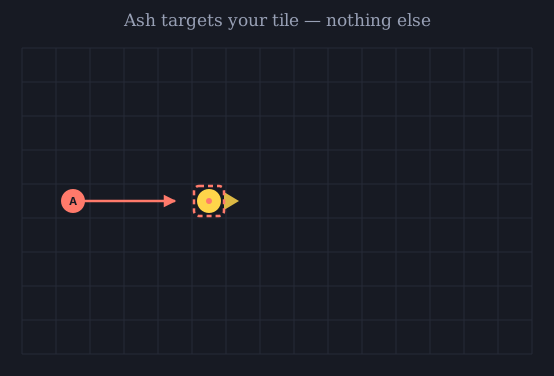
Head On has one opponent driving a fixed circuit. What arrived in 1980 was four hunters, each computing a different target tile every time it reached a junction — one aiming at you, one aiming at the space ahead of you, one deriving its target from another hunter's position, one that gives up when it gets close. No communication between them, no shared plan, and the result reads as coordination.
Two more ideas came in the same box, and both are structural rather than decorative:
- Scatter mode. Periodically all four abandon the hunt and head for their own corners. The genre's rhythm — pressure, release, pressure — dates from here.
- The reversal. Eat a power pellet and the hunted becomes the hunter for a few seconds. Almost nothing before this let you turn the game's core threat into its core reward.
That combination is what everyone actually copied, and it is why the genre is named after the chase rather than after the maze. How that ghost AI works is worth a piece of its own — the four rules are simpler than anyone expects.
The wave, 1981–1984
What followed was one of the most thorough cloning operations in the medium's history. A few that are worth knowing about, for different reasons:
Snack Attack (Datamost, 1982) — written by Dan Illowsky for the Apple II, and a good example of how the genre reached home computers before official ports did. You play "the Snacker", a small white creature eating gumdrops through a maze. It is unashamedly a clone, and it is also a small feat of programming for the hardware it ran on.
Crystal Castles (Atari, July 1983) — the most interesting divergence. Bentley Bear collects gems through a maze rendered in trimetric projection, so the maze has height: ramps, stairs, and structures you can go behind. It is played with a trackball, it is the earliest known game to include hidden warps that skip you forward several levels, and it is one of the first arcade games with a real ending sequence rather than an endless loop.
Crystal Castles matters because it is the moment the genre stopped being flat. Everything after it that gives a maze a third dimension is walking through a door Atari opened.
Why the genre stopped and why it came back
Maze chase games all but vanished from arcades after the mid-eighties, and the reason is not that players tired of them. It is that the hardware moved on. Scrolling backgrounds, sprite scaling and then polygons made fixed single-screen games look old, and a maze chase is the most fixed and most single-screen thing there is.
It came back on phones, and for a very specific reason: a maze chase needs four directions and nothing else. No aiming, no buttons, no camera. It is one of the few arcade genres that survives a touchscreen intact, which is why swipe controls suit it and why it reappeared the moment everyone had a screen in their pocket.
That is also the argument for it being a genuinely good design rather than a nostalgic one: the rules are simple enough to survive forty-five years of hardware change without needing a single adjustment.
The lineage, short version
| Year | Game | What it contributed |
|---|---|---|
| 1979 | Heiankyo Alien | Maze with pursuers; the trap 'em up; the digging mechanic |
| 1979 | Head On | Collecting every dot in a maze while pursued |
| 1980 | Pac-Man | Four rule-driven pursuers, scatter cycle, the power-pellet reversal |
| 1980 | Rally-X | The driving branch; first background music, first bonus stage |
| 1982 | Snack Attack | The genre on home computers |
| 1983 | Crystal Castles | Height, a trackball, hidden warps, an actual ending |
Where Glimmer sits
Glimmer is squarely in the 1980 branch: neon mazes, everything to collect, four hunters with the four classic targeting rules, a scatter cycle that tightens as you climb, and orbs that flip the chase.
We did not modernise the ghost logic, and that was deliberate — the greedy one-step rule is what makes the hunters readable and therefore beatable. Replacing it with real pathfinding would produce something that catches you more often and is much less interesting, which is a trade the genre has never been tempted by in forty-five years.
Common questions
What was the first maze chase game? If you mean the first game where you clear a maze of dots while being pursued: Head On (Sega/Gremlin, 1979). If you mean the first maze game with pursuers at all, that is older still — and Heiankyo Alien (1979) belongs to the trap 'em up branch rather than this one.
Did anything come before Pac-Man? Yes. Head On and Heiankyo Alien both shipped in 1979. What arrived in 1980 was the four-personality pursuit AI, scatter mode and the power-pellet reversal, not the maze or the dots.
Was Heiankyo Alien the first maze chase game? It is a 1979 maze game with pursuers, but you trap enemies in holes rather than collecting anything. It is credited as the first trap 'em up and the first game with a digging mechanic.
What is a maze chase game? An arcade genre with a fixed maze, a collect-everything goal, and enemies that hunt you through the same corridors under fixed rules.
Why did maze chase games disappear from arcades? Hardware moved to scrolling and then 3D, and a single-screen fixed maze looked dated beside it. The genre returned on touchscreens, which suit its four-direction control perfectly.
Are there modern maze chase games? Plenty, mostly on phones and in browsers. Glimmer is ours — free, no download, and built on the 1980 rules rather than a modernised version of them.
Pac-Man is a trademark of Bandai Namco Entertainment Inc., and other titles named here are the property of their respective owners. They are referred to only to describe the history of the genre. Glimmer is an original game and is not affiliated with, sponsored by or endorsed by any of them.