
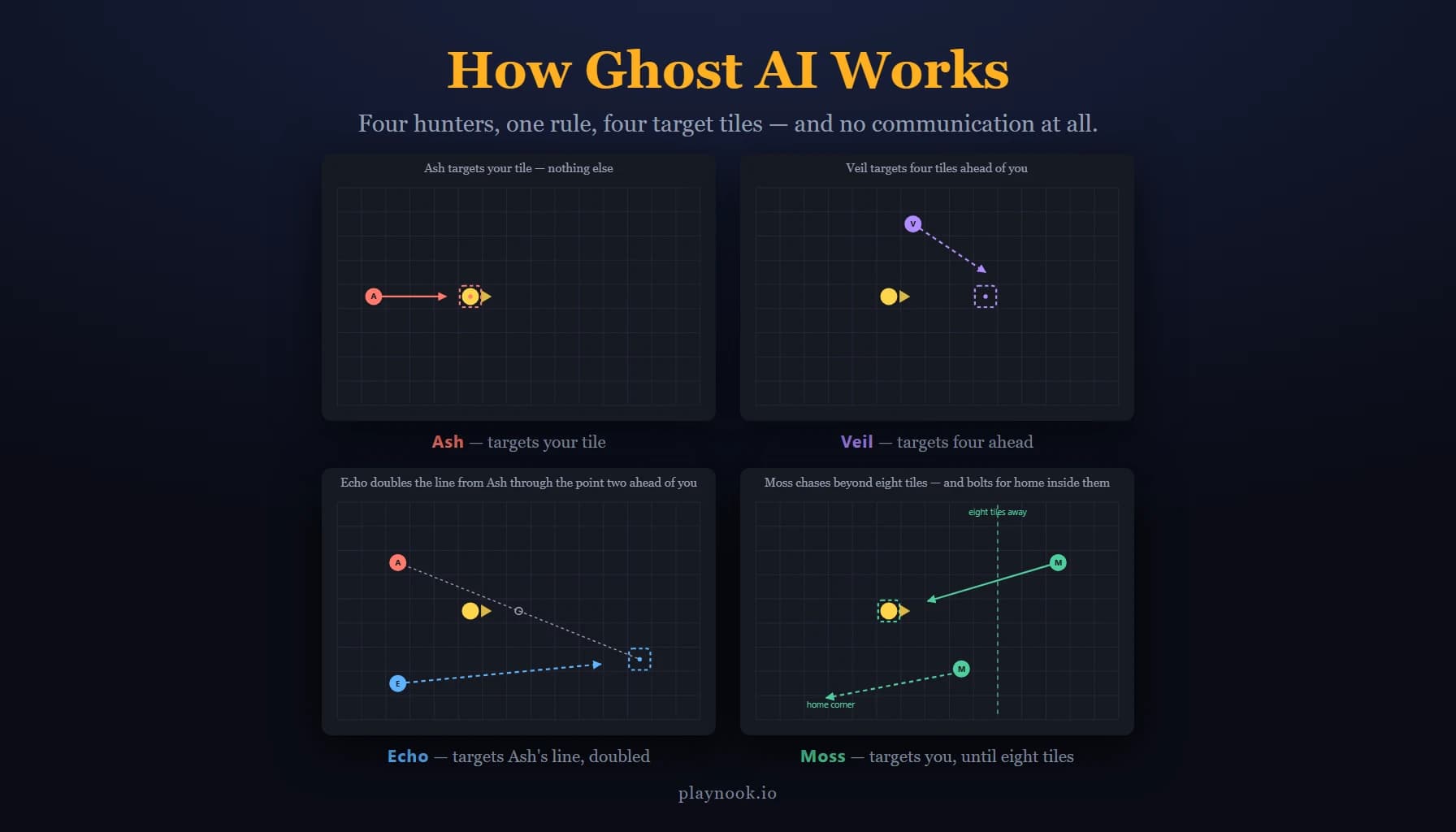
The most quoted fact about maze chase games is that the four hunters have personalities. One chases, one ambushes, one flanks, one is a coward.
It is true, and it is also the least interesting way to say it — because it makes the design sound like four different programs. It is not. All four run exactly the same code. The only thing that differs between them is a single number pair: the tile each one is currently aiming at.
That is the whole trick, it is forty-five years old, and it is still one of the most elegant things in game design.
One rule, four answers
Here is the engine, complete.
Every hunter always has a target tile — a coordinate on the maze grid, which may be a wall, may be outside the maze, and is frequently a square it can never actually stand on. When a hunter reaches a junction, it does one thing:
Look at the exits. Ignore the one you came from. For each of the rest, measure the straight-line distance from that exit to your target tile. Take the shortest.
That is it. No pathfinding. No search. No lookahead. No cooperation, no shared plan, no messages passed between them. Each hunter is one subtraction and one comparison, repeated a few times a second.
Everything you experience as cunning comes from the answer to a different question: what is the target?
Ash: the target is you
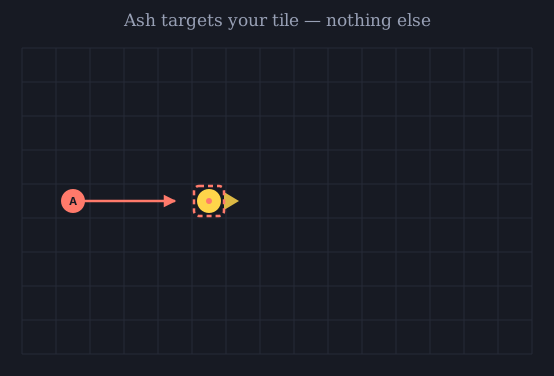
The simplest possible rule: target the player's current tile.
Because the movement step is greedy, this produces a hunter that is permanently behind you and never gives up. It cannot cut you off, because it is always aiming at where you are rather than where you will be — but it is relentless, and it is the one that punishes you for doubling back.
In the arcade original this is Blinky, and there is a detail worth knowing: in that game the red one speeds up as the pellets run out, which is why the last stretch of a level feels so much worse than the first.
Veil: the target is four tiles ahead of you
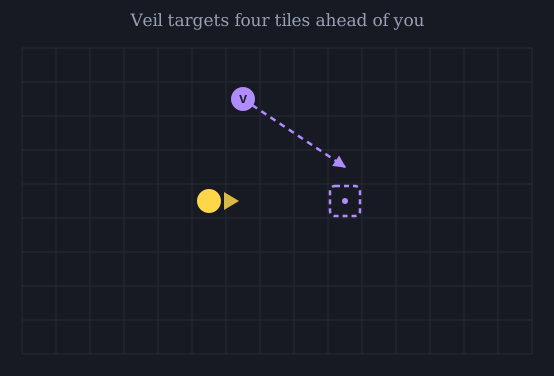
Take the player's tile, add four tiles in the direction the player is facing, and target that.
This is the ambusher, and notice what makes it work: it is not chasing you at all. It is racing to a place you have not reached yet. When it appears around the corner you were about to take, it did not predict anything — it simply had a head start on a destination you were also heading to.
Its weakness follows directly from its rule. The target is defined by the direction you are facing. Turn to face the ambusher and its target lands behind itself, which sends it away from you. Running straight down a long corridor is what feeds it.
Echo: the target is a doubled vector
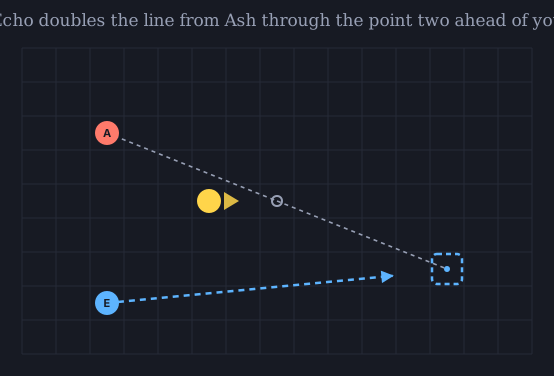
This is the clever one, and it is the reason the four feel like a team.
- Take the point two tiles ahead of the player.
- Draw the line from Ash's current position to that point.
- Double it — extend the line the same distance again.
- Target the far end.
Read that again and notice what it means: Echo's behaviour depends on where Ash is. No message passes between them; the rule simply refers to the other hunter's coordinates. When Ash is behind you, the doubled vector lands far in front of you, and Echo swings round to meet you head-on. Ash pushes, Echo appears — and it looks exactly like a pincer that two intelligences agreed on.
Nobody agreed on anything. One of them just happens to read the other's position. This is, to my mind, the single best idea in the whole design: emergent cooperation from a formula.
It also makes Echo the least predictable of the four, because you cannot reason about it without tracking Ash at the same time.
Moss: the target is you, until you get close
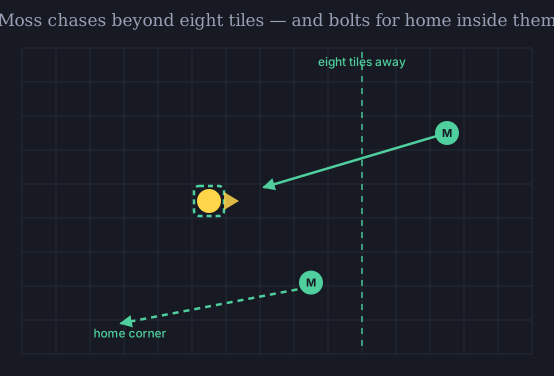
Measure the distance from the hunter to the player.
- More than eight tiles? Target the player's tile, exactly like Ash.
- Eight or fewer? Target its own home corner instead.
The result is a hunter that advances menacingly and then, at the worst possible moment for the drama, turns and wanders off. Players read this as cowardice or as stupidity. It is neither — it is a deliberate release valve. Four relentless hunters would make the game unplayable; one that keeps opening a gap is what makes the maze survivable.
It also produces the most human-looking behaviour of the four, because approaching-then-retreating is exactly what an indecisive creature would do.
Scatter: the rhythm underneath
There is a fifth behaviour, it applies to all four at once, and most players never consciously notice it.
The game alternates between two modes on a timer:
- Chase — everyone uses the rules above.
- Scatter — everyone abandons the player and targets their own fixed corner of the maze.
During scatter the hunters drift away, circle their corners, and leave you alone. Then chase resumes and they all turn round at once.
This is the rhythm the whole game is built on, and once you see it you cannot unsee it. Good players do not react to the hunters; they plan around the cycle — clearing the dangerous, open parts of the maze during scatter and retreating to the safe corridors when chase resumes.
In Glimmer the timings tighten as you climb: the scatter window starts around seven seconds and shrinks toward two and a half, while the chase window grows. That single curve is most of what makes later stages feel frightening — the hunters are not smarter, you simply get fewer breaks.
Frightened: the one time they are honest
Eat a power orb and every hunter switches to a different rule entirely: move at random, and reverse direction immediately.
That reversal is not decoration. It is what prevents the mode from being a free lunch: the hunter that was about to catch you is now running away, but so is the geometry you had planned around.
Random movement also means the frightened phase is the only time the hunters are genuinely unpredictable. The rest of the game they are perfectly deterministic — which is precisely why they can be learned.
The greedy step is the exploitable part
The rules above get all the attention. The movement step deserves more, because that is where the actual weaknesses live.
Remember: at each junction a hunter takes the exit that most reduces the straight-line distance to its target. It does not know whether that exit leads to a dead end, a long detour or a wall. It cannot see the maze at all.
Three consequences you can use:
Walls beat hunters. A target on the other side of a long wall sends a hunter into a corridor running the wrong way, because the exit looked closer. Maze shapes that create this are the safe pockets on any board.
They cannot reverse mid-corridor. Hunters only choose at junctions and never turn back on a straight — which means a corridor you have both entered has a predictable outcome. That is why doubling back through a junction just as one commits to it is such a reliable escape.
Turning changes two targets at once. Face a different way and both Veil's target and Echo's reference point move. A single turn can redirect half the opposition. This is the technique that separates people who survive stage ten from people who do not.
Why this design has lasted
It would be easy, today, to give each hunter a proper pathfinder. It would also be a mistake, and it is worth being clear about why.
A hunter that computes the true shortest path to you is not scarier — it is boring, because it is correct. It never makes the mistake that lets you escape, so the only remaining variable is how fast it moves, and a game whose difficulty is a speed slider stops being interesting immediately.
The greedy rule is worse at catching you, and that is the point. It produces near misses, wrong turns and moments where a hunter visibly goes the wrong way round a block — and every one of those is a thing you can learn, exploit and feel clever about. The imperfection is the game.
It also has a property that modern AI-driven enemies often lose: it is readable. You can watch a hunter for ten seconds and form a correct theory about it. That is what makes mastery possible.
Try it against the real thing
Everything above is running in Glimmer: four Shades, the four targeting rules, the scatter cycle, the greedy step. It takes about a minute to verify each claim.
The one to try first is Veil's blind spot. Get it following you down a corridor, then turn to face it. Watch it leave.
Common questions
Do the ghosts in a maze chase game work together? No. Each one independently targets a tile and takes the greedy step toward it. What looks like a pincer comes from Echo's rule referring to Ash's position — one formula reading another hunter's coordinates, with no communication of any kind.
Are the ghosts random? Only in frightened mode. The rest of the time they are completely deterministic, which is why the same route can be repeated.
Which ghost is the most dangerous? Echo, because you cannot predict it without also tracking Ash. Ash is the most persistent, but it is the one you always know the location of — it is behind you.
Why does one ghost keep running away? That is Moss's rule: it chases while it is more than eight tiles from you and heads for its own corner once it is closer. It is a deliberate pressure valve, not a bug.
What is scatter mode? A periodic phase where all four abandon the hunt and head for their own corners. It shortens as the stages go on, which is most of the reason later stages feel harder.
Can you beat a maze chase game by learning patterns? In the original arcade machine, yes — deterministic behaviour made fixed routes possible. Modern versions usually introduce a small amount of randomness specifically to prevent that, so what transfers is the understanding rather than the exact route.
Pac-Man is a trademark of Bandai Namco Entertainment Inc. It is referred to here only to describe the genre and the design it originated; Glimmer is an original game and is not affiliated with, sponsored by or endorsed by Bandai Namco.