
Checkers is one of the best known board games in the world and one of the least examined. Everybody learns it at six and nobody asks where it came from — which is a shame, because the answer runs through a thousand years, three continents and one of the longest computations ever aimed at a game.
This is the story of the game rather than the rulebook: where it began, how old it actually is, whether it beat chess to the board, and what happened when a research team spent eighteen years proving what perfect play produces.
Checkers or draughts?
The two names describe the same family of games. Checkers is the common term in the United States and Canada, draughts in Britain and much of the Commonwealth. The word draughts comes from the Middle English draught, simply meaning a move or a pull — the same root as drag.
The differences that matter are regional rule sets, not names. English draughts uses an 8×8 board with twelve pieces a side; international draughts uses 10×10 with twenty. Both are called draughts by their players.
Chinese checkers, despite the name, is not related at all. It is a nineteenth century German game called Stern-Halma, played on a star-shaped board, renamed for the American market.
Where the game comes from
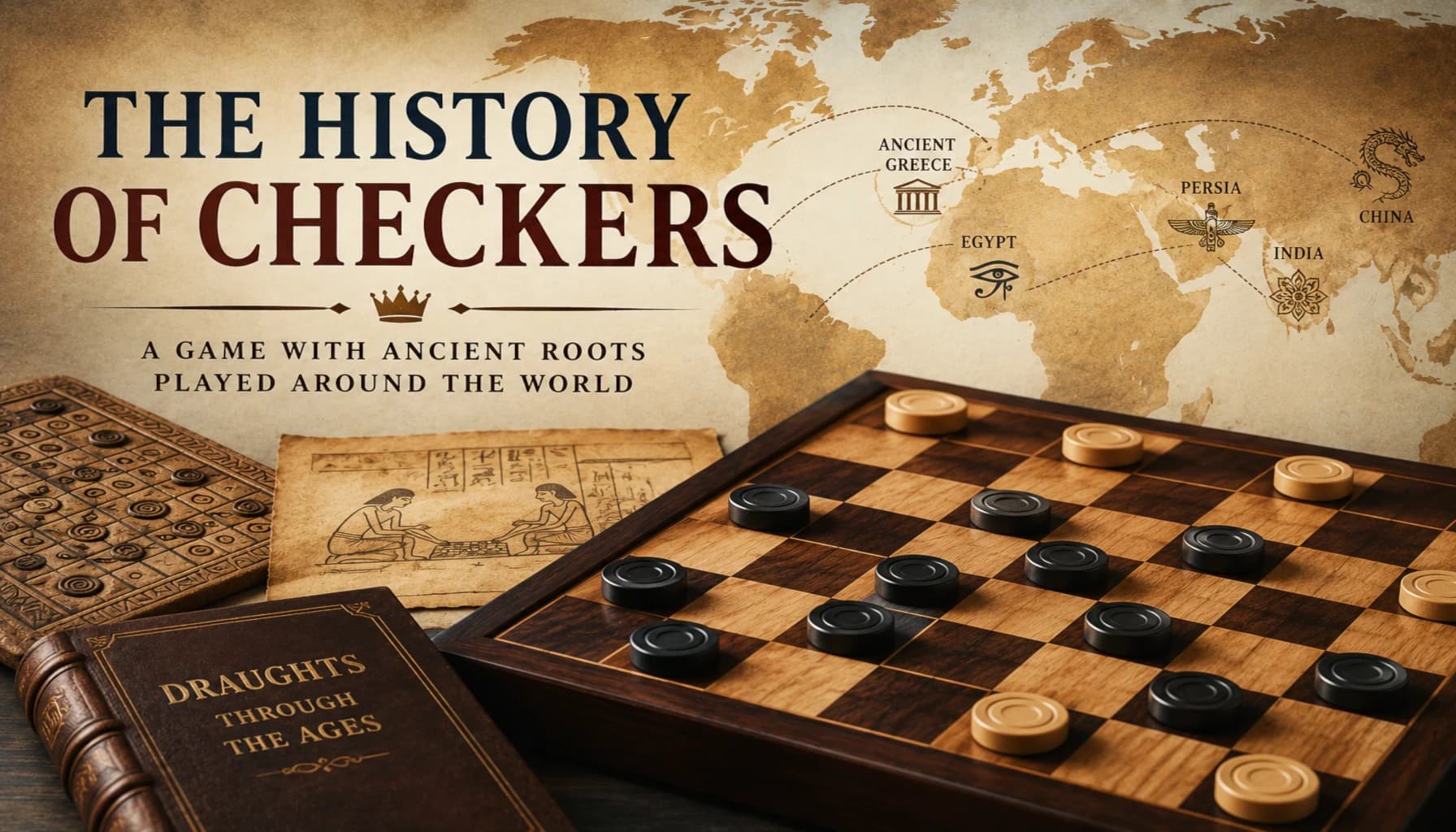
Games where you capture by jumping appear in many places and many centuries, and popular accounts tend to run them all together. The traceable line to the game on your screen is narrower than that, and it starts in one place.
The ancestor: Alquerque
The direct ancestor is Alquerque, whose name comes from the Arabic al-qirq. It spread through the medieval Islamic world and reached Spain with the Moors. Rather than squares, it used a lined board where pieces sat on the intersections.
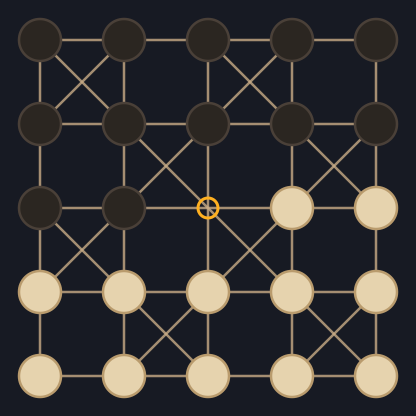
Its decisive contribution was the method of capture: jump over an enemy piece, land on the empty point beyond, remove it from the board. That single mechanic is the one checkers still runs on a thousand years later.
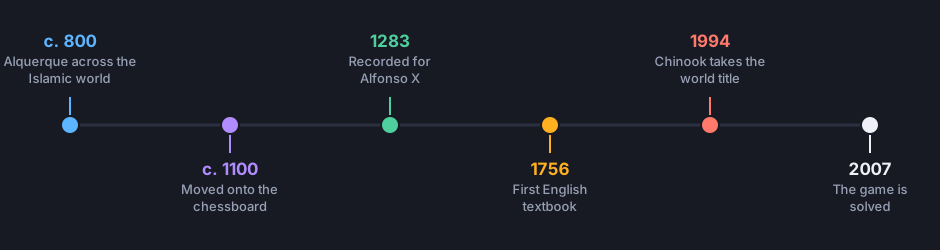
The game was important enough that King Alfonso X of Castile had it recorded in his Libro de los juegos in 1283 — the same manuscript that documents early European chess. You can still play Alquerque or print the board and see the family resemblance for yourself.
Onto the chessboard
Sometime around the twelfth century, players in southern France moved those pieces onto the 64-square chessboard. Because a chessboard is chequered, the diagonal lines of Alquerque mapped naturally onto squares of a single colour.
The new game was called fierges or ferses, after the medieval chess queen. When the chess queen gained her modern sweeping power, the draughts piece that reached the far rank took the same name — which is why in French the game is jeu de dames and the promoted piece is a dame, and why English speakers call it a king.
That relocation produced almost everything that defines checkers today:
- diagonal movement on squares of one colour;
- capture by jumping;
- promotion on reaching the far side;
- twelve pieces per player on the 8×8 board.
The rule that came last
One familiar rule arrived surprisingly late: compulsory capture. For centuries, taking was optional. A player who declined an available capture could be punished by huffing — the opponent removed the offending piece from the board as a penalty and then took their own turn.
Huffing survived in English play into the twentieth century and was only formally abolished in 1934, once compulsory capture had become the standard everywhere. It is worth knowing, because it explains why so many older books describe positions in terms that make no sense under modern rules.
Britain turns it into a discipline
The game took particular hold in Britain and Scotland, where it moved from pastime to serious study. William Payne published An Introduction to the Game of Draughts in 1756; Joshua Sturges followed with his Guide in 1800, the first systematic treatment of openings. Clubs, newspaper columns and championship matches followed through the nineteenth century, with players like the Scottish champion James Wyllie — known as "the Herd Laddie" — holding the title on and off for decades.
That depth of study created a problem. By the late nineteenth century the top players knew the standard openings so thoroughly that games between them almost always ended drawn. The response was to stop letting players choose: under the two-move restriction, and later the three-move ballot adopted in 1934, the opening moves are drawn at random from a list of tested positions. Serious tournaments still use it.
British and European settlers carried the game to North America, where the name checkers stuck and where its most famous chapter would eventually play out.
So how old is checkers?
It depends which question you are really asking, and the honest answer comes in two parts.
The game as it is played today is roughly nine hundred years old. Diagonal moves on a chequered board, twelve pieces a side, promotion at the far rank — that combination dates from the move onto the chessboard in about the twelfth century, in southern France.
The capture that makes it checkers is older still. Jumping an enemy piece to take it comes from Alquerque, documented in writing by 1283 and in play for a long time before anyone bothered to write it down.
What you will often read — that checkers is five thousand years old and was found in the ruins of Ur — conflates several different ancient board games that have no traceable connection to it. Boards were scratched into stone all over the ancient world. Very few of them were this game.
Did chess or checkers come first?
Chess, comfortably. Its ancestor chaturanga is documented in India by around the sixth century, and the game reached Europe through Persia and the Islamic world by roughly the tenth.
Checkers arrived later and, in a quite literal sense, borrowed from it. It took the chessboard, because a chequered surface happened to suit a game of diagonal moves. Then it took the name of chess's most powerful piece: the promoted draughts piece became the fierge, then the dame, then in English the king.
So the older game lent the younger one both its equipment and its vocabulary — and the younger one is the one that has now been solved.
Is checkers a sport?
It is organised like one, which is usually what the question is really about.
Draughts has a world federation, the FMJD, which has run international championships since the middle of the twentieth century. There are rated players, national associations, formal time controls and a world championship title with an unbroken lineage. The three-move ballot exists precisely because the game was studied seriously enough for opening theory to become a competitive problem.
Whether that makes it a sport rather than a mind sport is a question about definitions rather than about checkers. What is not in doubt is that people have trained for it, travelled for it and held titles in it for over a century.
The variants, and why they matter
There is no single global rulebook. Assuming otherwise is the most common cause of arguments over a board.
| Variant | Board | Pieces | Key differences |
|---|---|---|---|
| English / American | 8×8 | 12 | Men capture forward only; kings move one square; any legal capture allowed |
| International | 10×10 | 20 | Men capture backwards; flying kings; must take the maximum |
| Brazilian | 8×8 | 12 | International rules on the smaller board |
| Russian | 8×8 | 12 | Backward captures; flying kings; promotion mid-chain continues |
| Italian | 8×8 | 12 | A man may not capture a king; must take the maximum |
| Turkish (Dama) | 8×8 | 16 | Movement and capture are orthogonal, never diagonal |
| Canadian | 12×12 | 30 | International rules, much larger board |
The two that catch people out most often are flying kings — in international and Russian rules a king slides any distance along a diagonal, like a bishop — and the maximum capture rule, which removes the choice English players are used to having.
The game computers solved
Checkers holds a particular place in the history of artificial intelligence, and this is the part of its story that deserves to be better known.
The central human figure is Marion Tinsley, a mathematics professor who was world champion on and off from 1955 and is widely regarded as the most dominant player any board game has produced. Across roughly forty-five years of competition he lost only a handful of games — the figure usually quoted is seven.
Two of those losses were to a computer. The program Chinook, built by Jonathan Schaeffer's team at the University of Alberta, played Tinsley for the world title in 1992 and lost, four games to two with thirty-three draws. They met again in 1994, but after six drawn games Tinsley withdrew: he had been diagnosed with pancreatic cancer. He died the following year. Chinook was declared champion, becoming the first program to hold a world title in a recognised game — a result its own authors were careful never to describe as beating Tinsley.
Schaeffer's team kept computing. In 2007 they announced that 8×8 checkers had been weakly solved: from the standard starting position, with perfect play by both sides, the game is a draw. The search covered a space of roughly 5×10²⁰ positions — five hundred billion billion — and ran, on and off, for eighteen years. It remains one of the largest computations ever completed for a game.
Two things are worth keeping straight. That figure counts positions, not possible games, which is a far larger number again. And "weakly solved" means the outcome from the opening position is known, not that every position on the board has been catalogued.
None of it says anything about your next game. Perfect play means calculation far beyond human capacity, and between two people checkers remains exactly as sharp as it ever was.
Questions people actually ask
Who goes first in checkers? The darker pieces, traditionally called black, though on many sets they are red. In tournament play the opening moves themselves are drawn from the three-move ballot rather than chosen.
How many pieces does each player get? Twelve on the standard 8×8 board, twenty on the 10×10 international board, and sixteen in Turkish dama.
Is checkers solved? Yes, weakly, since 2007: perfect play from the standard start is a draw. Chess is not solved and, on current understanding, will not be for a very long time.
Is checkers easier than chess? Easier to learn, certainly — one kind of piece, one kind of move. Strong play still demands deep calculation and precise endgame knowledge. The irony is that the simpler game is the one that has been solved.
Where was checkers invented? There is no single place. The capture mechanic comes from the medieval Islamic world by way of Spain; the board and the shape of the modern game come from twelfth-century France; the competitive tradition and the name checkers come from Britain and North America.
Want the rules and the strategy?
This article deliberately leaves them out. For the full rulebook, the tactics that decide real games and the opening theory, Checkers Arena has a set of dedicated guides: how to play, the complete rules, strategy and openings — covering the Brazilian, International and Turkish variants alongside the classic 8×8 game.
Want to try the game itself first? Play checkers against the computer here — three difficulty levels, or pass and play with somebody next to you.