PlayNook

Board Game · Sowing Game

Play Sungka Online — Free, 2 Player or vs Computer

Seven holes a side, seven shells in each, and a hand that does not stop: land on an occupied hole and you pick it up and carry on. One turn can go round the board five times.

Ninety-eight shells, seven to a hole, and a hand that refuses to stop. That last part is what separates Sungka from every other sowing game on this site: drop your final shell onto a hole that already had shells in it, and you pick that hole up — all of it — and carry straight on.

How to play Sungka

How do you set up a Sungka board?
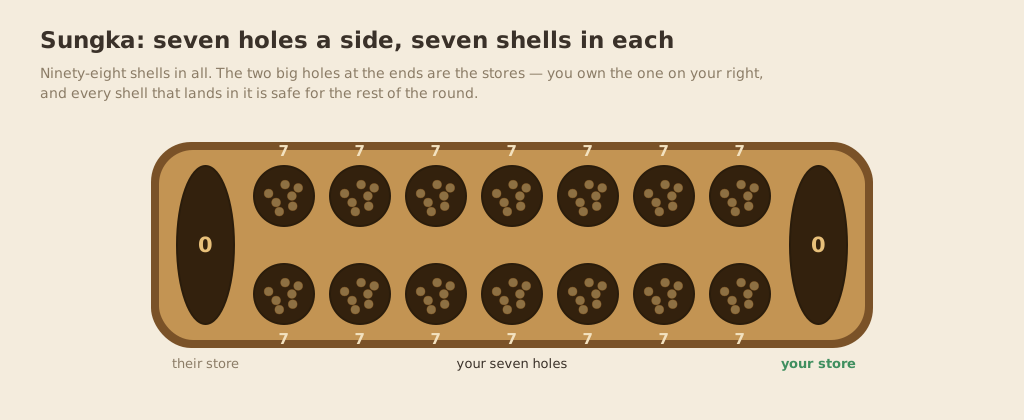
A Sungka board with seven holes in each row holding seven shells apiece and a large empty store at each end, the right-hand store marked as yours
Seven holes a side, seven shells in each, both stores empty. You own the bottom row and the store on your right.

Each player owns the seven holes in front of them and the big store at their right-hand end. A move starts by picking up everything in one of your own holes and dropping the shells one at a time around the board — through your own store, and past your opponent's, which is always skipped.

Sowing: why the hand keeps going
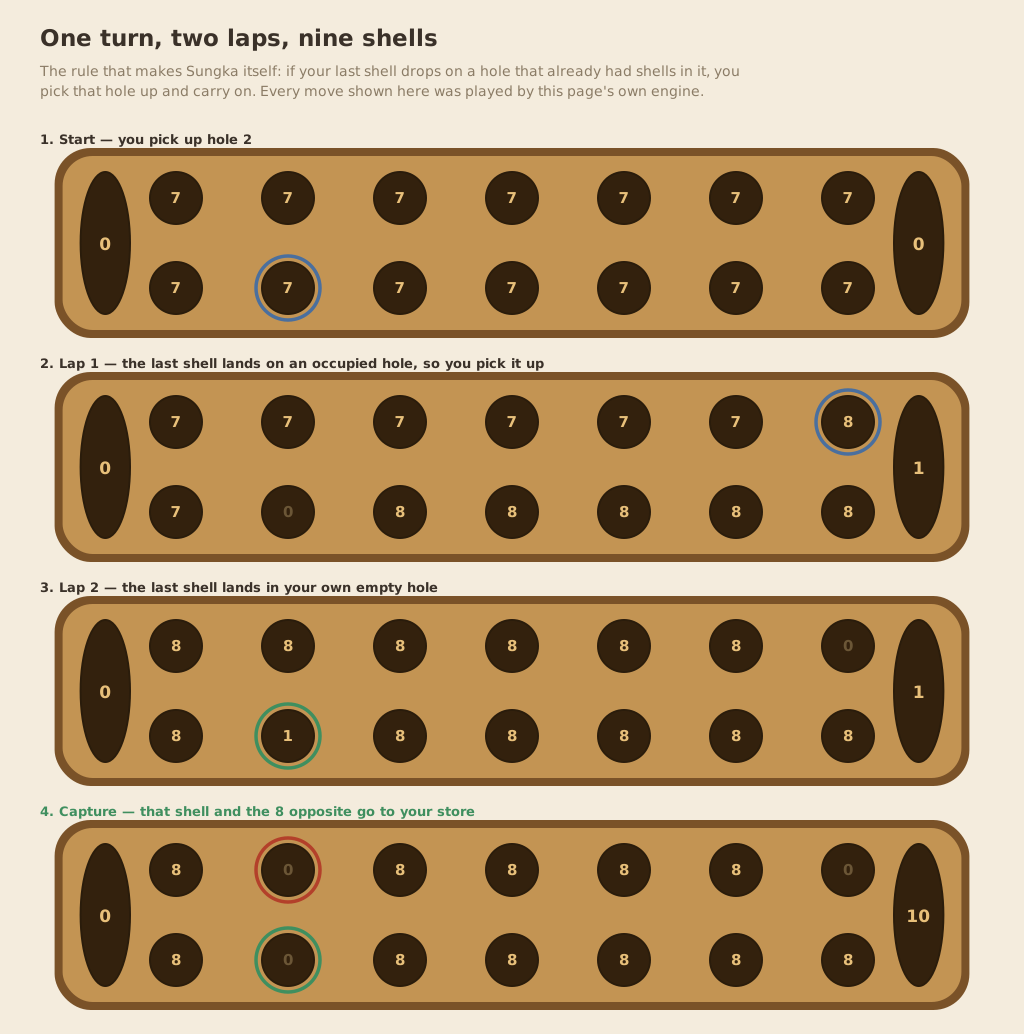
Four boards in sequence showing one Sungka turn: the player picks up their second hole, sows seven shells, picks up the occupied hole the last shell landed on, sows eight more, lands in an empty hole on their own side and captures nine shells
A real opening move, played out by this page's engine: two laps, fifteen shells sown, nine captured.

If the last shell lands in a hole that already had shells in it, you scoop that hole up, the new shell included, and keep sowing. Then again, and again. Most turns end after one lap; some go round the board five times and leave it unrecognisable. The longest turn we have measured picked up 57 times before it stopped.

Capturing, and sowing again

The turn ends when the last shell falls into an empty hole. Where it falls decides what you get:

  1. An empty hole on your own side — you take the shells sitting in the hole directly opposite, together with that last shell, into your store.
  2. An empty hole on the opponent's side — nothing. The shell stays there, now theirs to sow.
  3. Your own store — you go again, from any of your holes.

Why every Sungka opening already pays
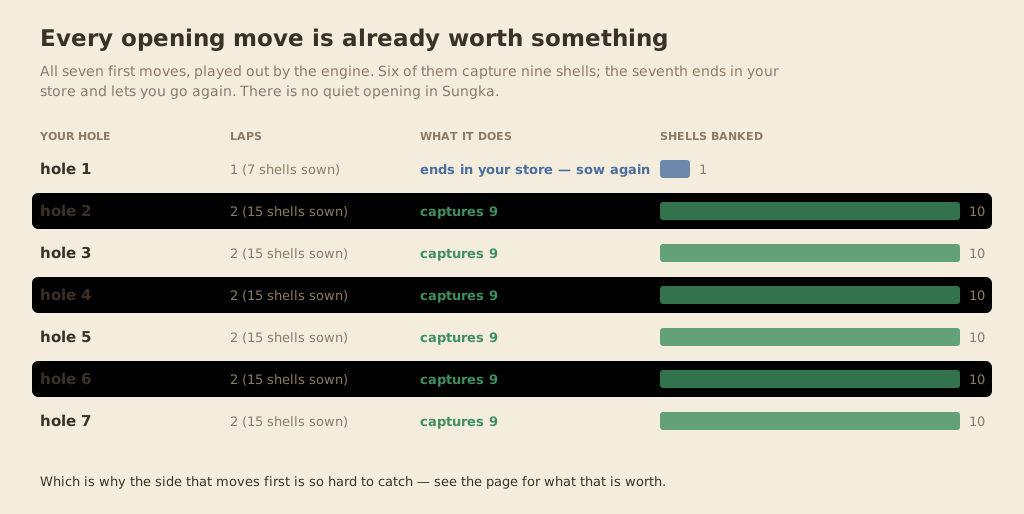
A table of the seven possible first moves in Sungka, six of them capturing nine shells and the seventh ending in the player's own store, with bars showing the shells banked
All seven first moves, played out. Six capture nine shells; the seventh ends in your store and lets you sow again.

There is no quiet opening here. Six of the seven first moves travel exactly far enough to land back in your own empty hole and capture nine shells; the seventh — your leftmost hole — holds exactly the seven needed to finish in your store, so you simply go again.

Rounds and burnt holes
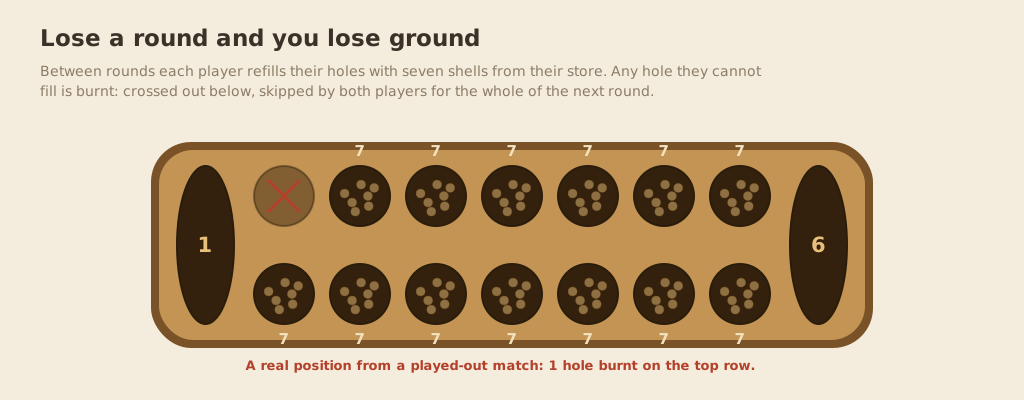
A Sungka board part-way through a long match with one hole crossed out in red, showing a hole that could not be refilled between rounds and is skipped by both players
A position from a played-out match. The crossed hole could not be refilled, so it is out of play for the whole round.

Choose a two- or three-round match and the game grows a second layer. Between rounds, each player refills their own holes with seven shells apiece out of their store, working from the hole farthest from it. Any hole they cannot fill is burnt: skipped by both players, for the whole of the next round.

Lose a round and you do not merely fall behind on shells — you lose places to start from, which makes the next round harder still. It is the mechanism that turns one bad round into a losing match, and it is the reason the game is worth playing past a single round.

Sungka strategy

Counting is harder than it looks, and that is the whole game. In Kalah you can work out where a move ends with one division. Here the hand picks up whatever it lands on, so the only way to know where a move finishes is to follow it hole by hole — which is exactly what makes a long relay feel like a magic trick the first few times you see one.

Three things that actually help:

  • Empty holes on your own side are traps you set for yourself. They are what makes a capture possible, so leaving one open opposite a well-stocked enemy hole is worth more than it looks.
  • A big hole on your side is a liability as much as a store of value. It will eventually be sown out into your opponent's row, and the bigger it gets, the more of it ends up over there.
  • Finishing in your store is worth more than a small capture, because going again is what chains into the large relays.

Playing against the computer

Four levels, and they differ in how forgiving they are rather than only in how deep they think. Measured over sixty games a pairing: medium beats easy 95 % of the time, hard beats medium 73 %, and perfect beats hard 55 % — the last gap is small because the search has largely converged by then.

Where Sungka comes from

Sungka is the Philippine member of a family that runs right across maritime Southeast Asia: the same seven-hole board is congkak in Malaysia and congklak or dakon in Indonesia, and the rules for all of them are near enough identical that a player of one can sit down to another without asking. The name of the store, ulo, is simply the Tagalog word for head.

Which Sungka is this?

Folk games vary by village, and the written sources disagree in places. The rules here follow the seven-hole Southeast Asian game as described on Wikipedia, which was the most complete and self-consistent account we could reach, cross-checked against the popular Philippine rule sheets. Two choices are worth stating plainly: landing in an empty hole on your own side banks your last shell even when the hole opposite is empty, and the traditional simultaneous first move is not used, because a turn-based table cannot express it.

If you want the better-known cousin with six holes and a hand that stops after one lap, that is Mancala; for the West African game where you may not starve your opponent, see Oware. The whole family, and how differently these boards play, is laid out in mancala variants.
Frequently asked questions

+ How do you play Sungka?

Each player owns the seven holes in front of them and the big store at their right-hand end. Ninety-eight shells, seven to a hole. Pick up all the shells from one of your holes and drop them one at a time around the board, through your own store and past your opponent's, which is always skipped. If your last shell lands in a hole that already had shells in it, you pick that hole up — including the shell you just dropped — and keep going. The turn only ends when the last shell lands in an empty hole, or in your own store.

+ What is the difference between Sungka and Mancala?

The hand. In Kalah — the game most people mean by 'Mancala' — you sow once and your turn is over. In Sungka a hand that lands on an occupied hole picks it up and sows again, over and over. We measured turns on this page that picked up 57 times before stopping. The board is also bigger: seven holes a side rather than six, and 98 shells rather than 48.

+ What happens when the last shell lands in an empty hole?

The turn ends. If that empty hole is on your own side, you take the shells in the hole directly opposite, together with your last shell, into your store. If it is on your opponent's side, nothing is captured and the shell simply stays where it fell — which is why sowing into their row without a plan is how shells get lost.

+ Do you get an extra turn in Sungka?

Yes. If your last shell drops into your own store, you start again from any of your holes. It is the same idea as the extra turn in Kalah, except that reaching your store exactly is far harder to arrange, because the hand keeps picking up along the way.

+ What are burnt holes?

They belong to the long version. After a round, each player refills their own holes with seven shells each out of their store, starting from the hole farthest from it. Any hole they cannot fill is burnt: crossed out, skipped by both players, and out of play for the whole of the next round. Losing a round therefore costs you ground and not just shells. Choose a two- or three-round match below to play with them.

+ Does the player who goes first win?

Usually, and by a lot. We played the computer against itself at equal strength: whoever moved first won 86.7% of one-round games. Over three rounds it falls to 76.7%, because the loser of each round starts the next. That is not a quirk of this page — it follows from the opening, where six of the seven possible first moves capture nine shells and the seventh earns another turn. Traditionally both players make their first move at the same time, which is exactly how the advantage is avoided; it cannot be done at a turn-based table, so pick who starts instead.

+ How long does a game of Sungka take?

A single round runs about 33 half-moves, so a few minutes. A three-round match is roughly three times that. Individual turns vary wildly: most are short, but a hand that keeps finding occupied holes can go round the board several times, and the animation speeds up when it does.

+ Can I play Sungka with a friend online?

Yes. Choose 'With a friend online' below the board and press Open a table. You get a four-character code; send it to your friend, they type it in and press Join. There is a chat window built in, and neither of you needs an account or a download.

+ Is it free?

Yes, and there is no sign-up, for the online tables either. Nothing about a solo game is saved anywhere; close the tab and start fresh next time.

More games like this