Fourteen cups, six seeds in each, and not a single store on the board. That last part is what separates Pallanguzhi from every other sowing game here: there is nowhere to bank a seed by sowing into it. Capturing is the only way to score — and the rule that does most of the capturing is a number.
How to play Pallanguzhi
How do you set up a Pallanguzhi board?
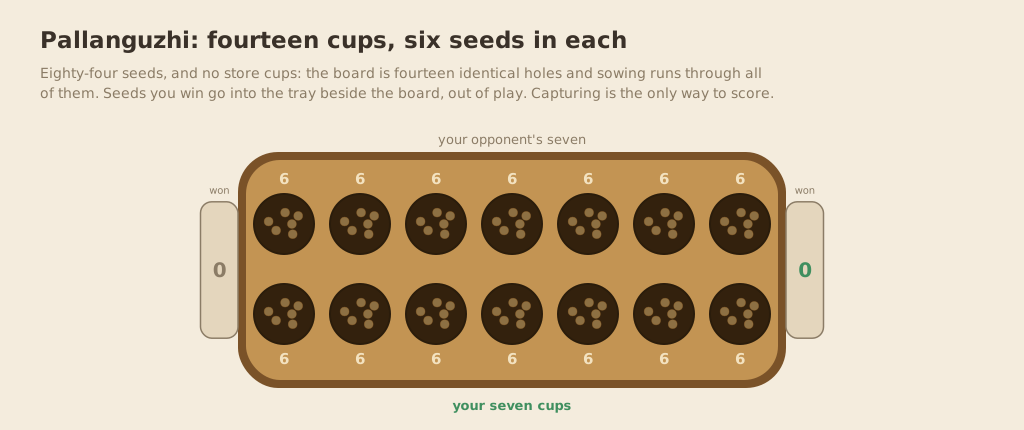
You own the seven cups in front of you. A move starts by picking up everything in one of them and dropping the seeds one at a time, anticlockwise, through all fourteen cups — yours and your opponent's alike.
Why your turn keeps going
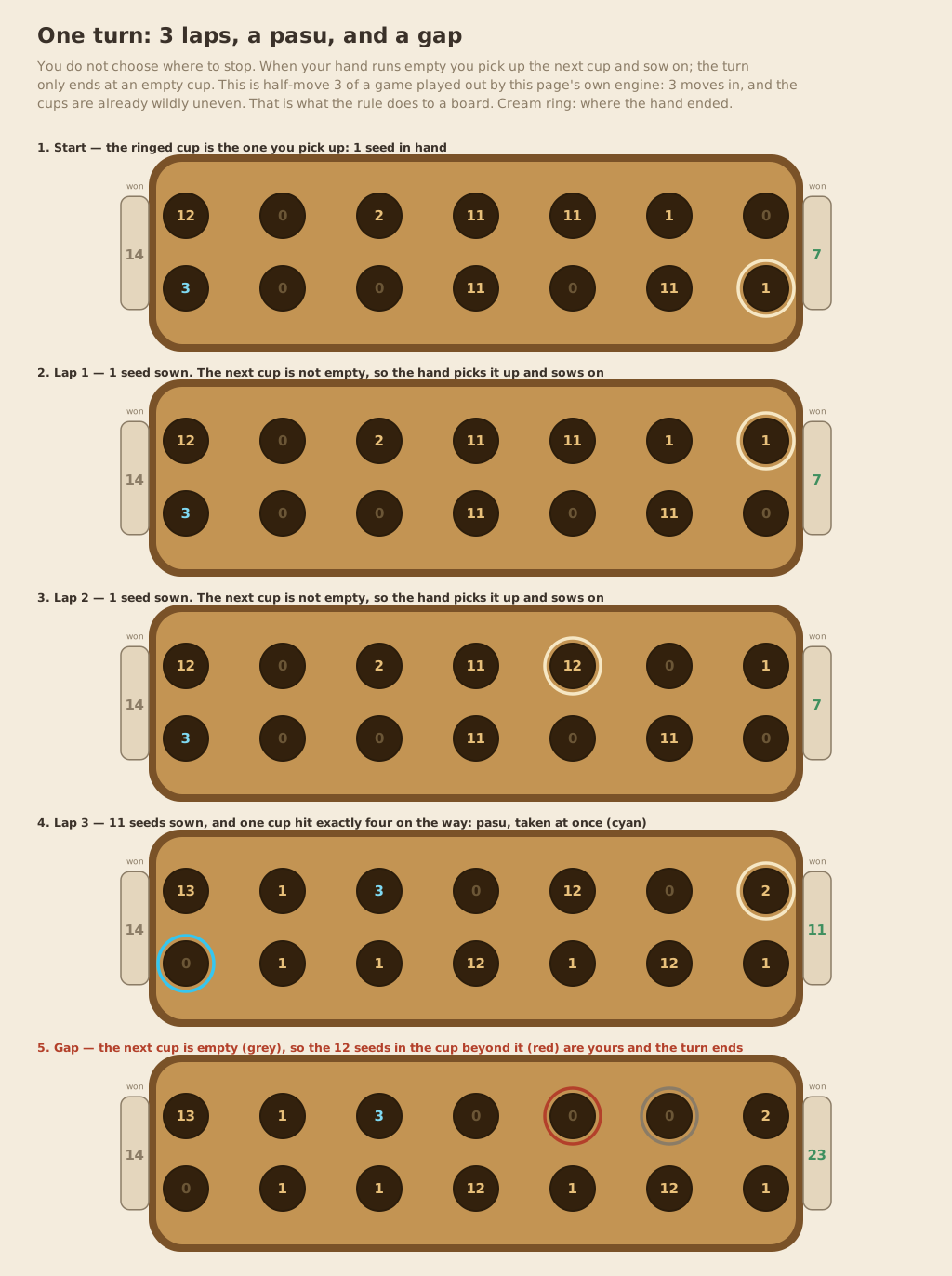
When your hand runs empty, you pick up the next cup and carry on sowing — whatever is in it, however many seeds, wherever the last one fell. You do not get to choose where to stop. Most turns are a single lap; the longest we have measured ran 27.
How does capturing work?
The turn ends when the cup you would pick up is empty. What happens then depends on what is behind it:
- The next cup has seeds — pick it up and keep sowing. The turn is not over.
- The next cup is empty — you capture whatever sits in the cup just beyond it, and your turn ends.
- That one is empty too — nothing is captured, and your turn ends anyway.
Where the seeds actually come from
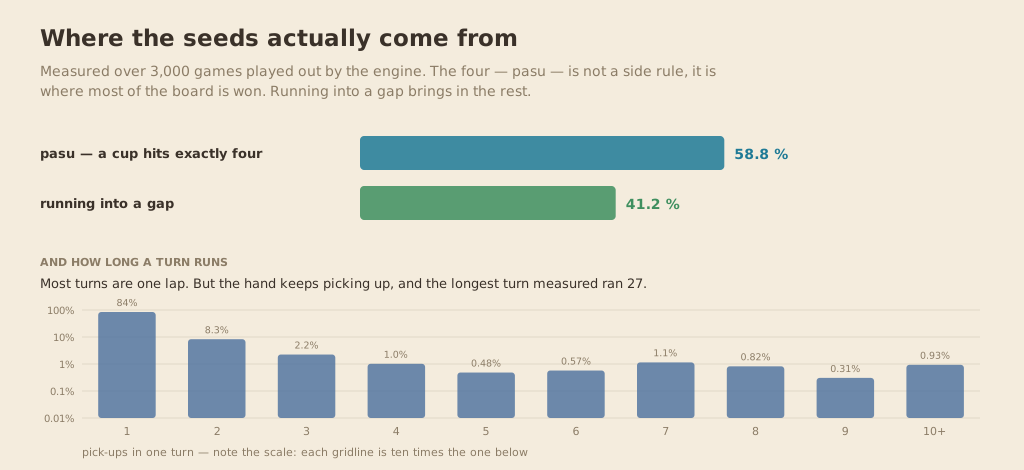
Nearly three-fifths of every seed captured comes from pasu, not from the end-of-turn capture. That changes how the game is played: you are not steering towards a good place to finish, because you cannot steer at all. You are choosing which cups to load and which to leave alone.
Three things that genuinely help:
- A cup of your own on three is an invitation. Your opponent needs one seed to take it, and almost any sowing from their side delivers one.
- Their cup on three is yours to take, if you can find a move whose path runs through it — which you work out by following the move, not by counting.
- A fat cup is a liability. The bigger it gets, the more of it ends up sown across the board when it finally goes.
How a Pallanguzhi round ends
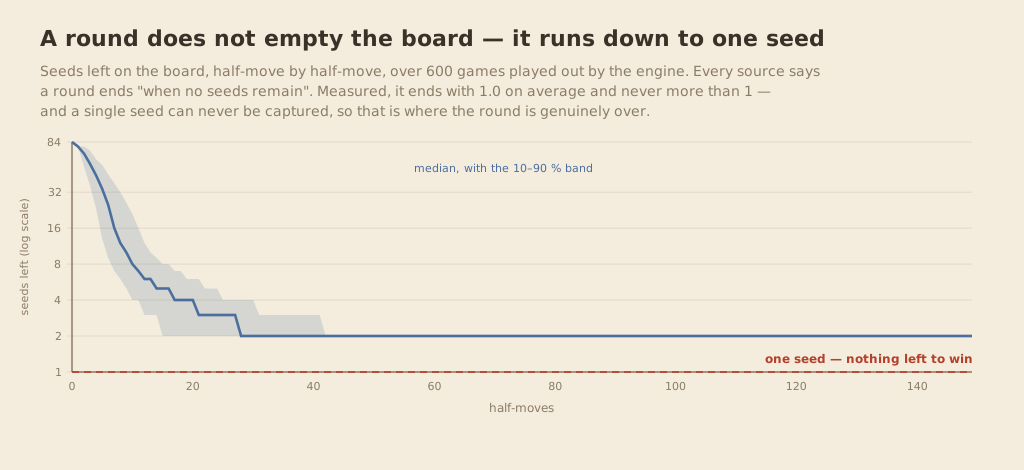
Every written account says the round is over "when no seeds remain". Played out, that almost never happens. The board runs down to exactly one seed and stays there — and one seed is not a near-miss, it is a proof: no cup can reach four with a single seed in play, and the cup past the gap is empty too, so nothing can ever be captured again. The seed would be shunted one cup along, for ever.
So a round here ends once at most one seed is left, which is the first moment nothing more can be won. Whatever lies in your row is yours. A second rule underneath it stops the two-seed shuffle, which can otherwise run for hundreds of half-moves over a single seed; the reasoning and the measurements are in the engine's own notes.
Rounds and rubbish holes
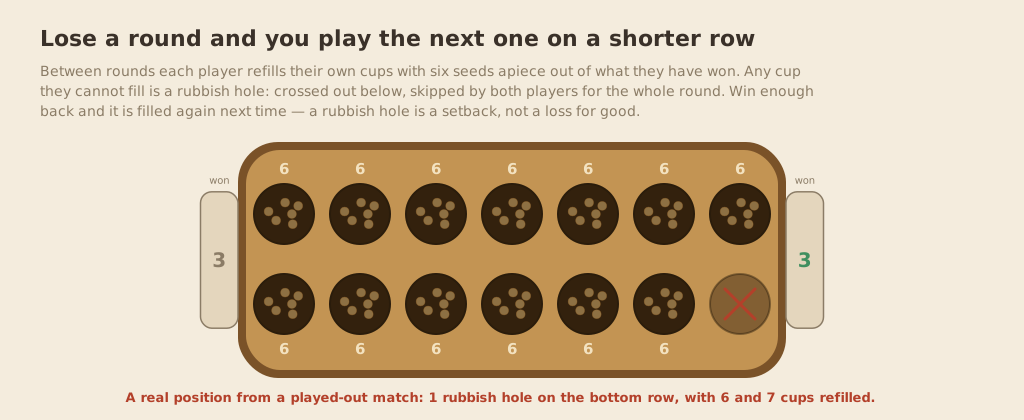
Choose a two- or three-round match and the game grows a second layer. Between rounds, each player refills their own cups with six seeds apiece out of what they have won. Any cup they cannot fill is a rubbish hole: skipped by both players for the whole of the next round.
Lose a round and you play the next one on a shorter row. Win enough back and the hole is filled again — unlike the burnt holes in Sungka, this is a setback and not a sentence.
Does going first matter?
Barely, and that is worth saying out loud, because in this family of games it usually does. Two separate runs of the computer against itself at equal strength gave the first player 53.7 % and 48.8 % — the two runs differ by as much as the effect we were trying to measure. Compare Sungka, where the first move wins 86.7 % of the time.
The reason is in the opening: with six seeds in every cup, all seven first moves do precisely the same thing. There is no good one to grab.
Playing against the computer
Four levels, and they differ in what they see rather than only in how deep they think — the weakest one is blind to the three-seed trap altogether. Measured over 300 games a pairing: medium beats easy 79.7 %, hard beats medium 91.3 %, and perfect beats hard 96.7 %.
Where Pallanguzhi comes from
Pallanguzhi — also written Pallankuzhi or Pallanguli — is the Tamil member of the mancala family, played across Tamil Nadu and Kerala and carried from there to Sri Lanka, Malaysia and the Caribbean. Its close relatives are Ali Guli Mane in Karnataka and Vamana Guntalu in Andhra Pradesh. The wider family, and how differently these boards play, is laid out in mancala variants.
Which Pallanguzhi is this?
Folk games are not standardised, and the reachable sources disagree loudly — on the seeds per cup (four, five, six and twelve are all claimed) and on the pasu number (four or six). Worse, the two fullest accounts share their wording, so they are one source and not two.
They differ in two places, and one gives the game away: the twelve-seed account ends the game when a player cannot fill a cup with six seeds — a refill rule that belongs to a six-seed game and cannot belong to a twelve-seed one. The rule body is the six-seed game's. So these are the six-seed rules with pasu at four, the only internally consistent set the sources support.
Two further choices worth stating plainly: after capturing past a gap the turn ends here, and a pasu goes to the player sowing, not to the owner of the row. Both are the majority reading, and both are places where a different village would tell you otherwise.
If you want the seven-hole cousin with stores and a relay that only triggers on an occupied cup, that is Sungka; for the six-cup game nearly everyone learns first, see Mancala; and for the West African game where you may not starve your opponent, Oware.