PlayNook

Board Game · Jump Game

Play Konane Online — Hawaiian Checkers, Free

Every square starts full, black and white alternating. Jump an enemy piece to capture it — that is the only move there is, and whoever runs out of jumps first loses.

Every square starts full. Jump an enemy piece to take it — that is the entire rulebook once the opening two squares are cleared, and it is enough to make Konane feel completely different from the checkers it gets compared to.

How to play Konane

The opening: two pieces come off first

Black removes one of their own pieces, but not from just anywhere — only from a board corner or one of the two centre squares, six cells in total. White then removes one of their own pieces from directly next to that new gap. That leaves two empty squares touching each other, and only then does the real game begin, with Black to move.

Those six starting cells collapse further under the board's own symmetry: the four corners are interchangeable with each other by rotation, and the two centre squares are interchangeable with each other, which leaves only two genuinely different opening choices — corner or centre — no matter how the rule is written down.

Capturing: jump in a straight line, same direction
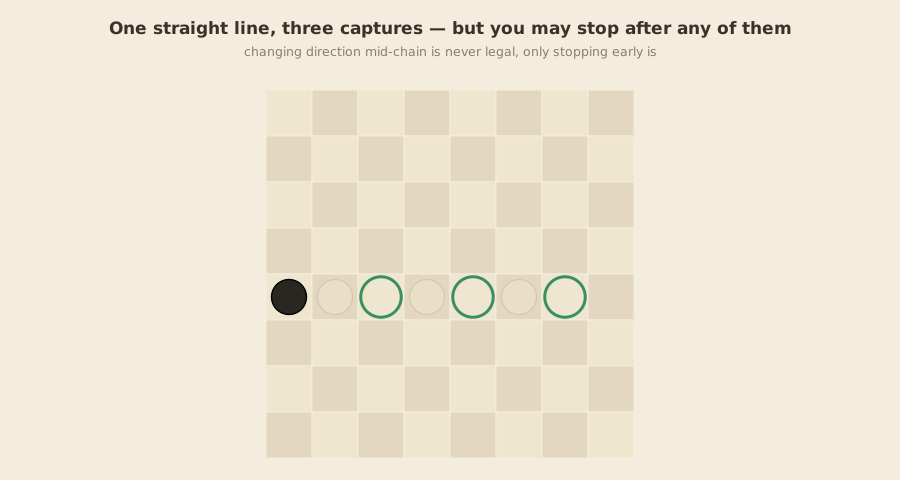
A Konane board with a single black piece and three white pieces in a row along one line, with green rings on the three squares where the black piece could choose to stop after capturing one, two, or three whites
One direction, three captures available — the piece may stop after any one of them, but never turn a corner mid-chain.

Jump one of your pieces over an adjacent enemy piece into the empty square directly beyond it, and take the jumped piece off. If another capture is available with the same piece in the same direction, you may continue — any number of times, your choice when to stop. The instant you would need a different direction, the turn is over, even if a capture sits right there waiting. That single restriction is what turns Konane from simple hopping into real planning: a piece racing down one line can be completely safe from a threat one square to its side.

How do you win?

Whoever cannot make a single legal capture on their turn loses. Since every move removes exactly one piece — and often several — from a board that starts with only 64, the game can never drag on forever and a draw is not possible: someone always eventually runs out of jumps.

Is Konane the same as checkers?

Related in feel, not in rule. Konane jumps in straight lines — up, down, left, right — where checkers jumps diagonally, and Konane fills the entire board at the start rather than only the dark squares. There are no kings here and no promotion: every piece plays exactly the same way on the last move of the game as it did on the first. The endings differ too — a checkers game usually finishes with the board cleared or one side blocked solid, while a Konane board at game's end typically still has plenty of pieces on it, just none able to jump.

Playing Konane against the computer

How do the three computer levels differ?

In how many candidate moves get a second look and how often a merely good move gets played instead of insisting on the exact best one — the same design as the Halma and Hex opponents on this site. The evaluation itself is simple: count each side's remaining pieces, since a capture is permanent, and count each side's currently available captures, since that count hitting zero is exactly how the game ends.

How long does a game of Konane take?

Short, compared to most of what is on this site. Matched computer levels played against themselves settled in roughly 40 to 55 plies in our own testing, and even random, purposeless play finishes in a similar range — every ply takes at least one piece off a board of just 64, so the game is structurally incapable of running long.

Where Konane comes from

Hawaii, and far enough back that there is no invention date to give. The Kumulipo, the Hawaiian creation chant, references the game, and Captain Cook's expedition recorded it being played during his third voyage in the 1770s — already established, not newly encountered.

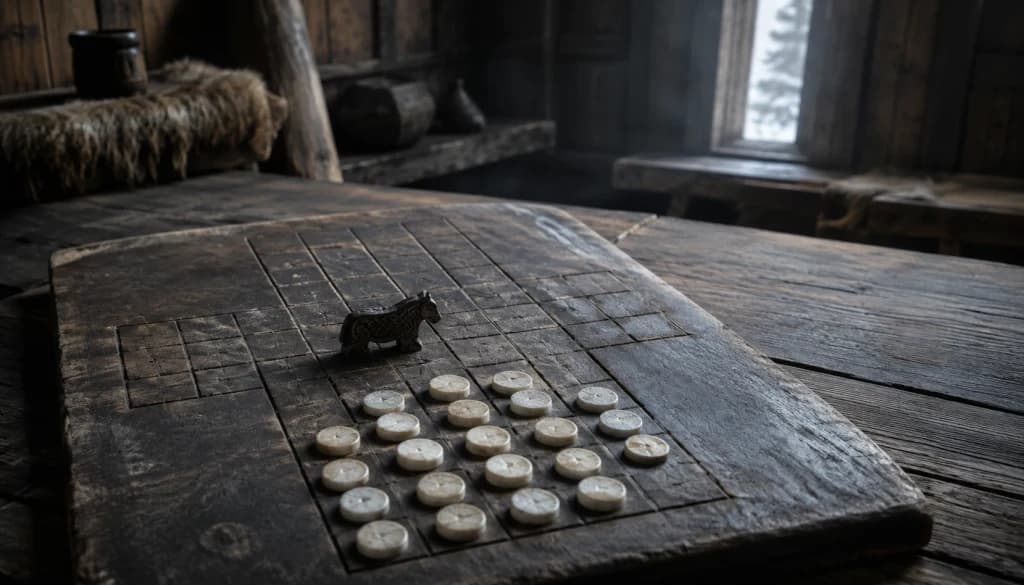
Boards were pecked directly into flat lava rock rather than built as separate objects; a number of these stone boards survive across the islands today. Pieces were beach pebbles: white coral for one side, smooth black lava for the other — which is exactly the colour scheme this page keeps.

If you like this one

  • Peg Solitaire — the opposite kind of jump: there a piece can turn any corner mid-chain; here it cannot turn at all
  • Fox and Geese — the same orthogonal jump, one jump per turn, no chains at all
  • Halma — jumping without capturing, on a board four times the size
  • Checkers — the diagonal, forced-capture cousin most players already know
Frequently asked questions

+ How do you play Konane?

Eight by eight squares, every one filled at the start with alternating black and white pieces — the whole board, not just the dark squares like Western checkers. After a short opening, every move is a capture: jump one of your pieces over an adjacent enemy piece into the empty square directly beyond it, orthogonally, and remove the jumped piece. Whoever cannot make a legal capture on their turn loses.

+ How does a game of Konane start?

Black removes one of their own pieces first — only from a board corner or one of the two centre squares, six eligible cells in total. White then removes one of their own pieces from directly next to that new gap. Only after both removals does capturing begin, with Black to move first.

+ Why can Black only open from a corner or the centre?

Those are the only squares whose removal leaves a genuinely different position — every other cell on the board is equivalent to one of these six by the board's own symmetry. And the six collapse further still: the four corners are interchangeable with each other by rotating the board, and so are the two centre squares, which leaves only two meaningfully different opening choices, corner or centre, however the rule is phrased.

+ Can a capture chain change direction?

No, and this is the rule newcomers miss most often. A single turn may keep jumping with the same piece as many times as a line of enemy pieces and gaps allows, but only in the one direction the turn started in. Landing somewhere with a capture available in a different direction does not let you take it — that ends the turn, exactly like it would if no further capture existed at all. Stopping early, before the line runs out, is always allowed.

+ How do the three computer levels differ?

In how many candidate moves get weighed and how often a merely good move gets played instead of the exact best one — the same approach as the other computer opponents on this site. Every move is scored on two things: how many pieces each side has left, since a capture is permanent, and how many captures each side currently has available, since running out of those is literally how the game is lost.

+ How long does a game of Konane take?

Short compared to most board games here. We measured matched computer levels against themselves and random play against itself: games settle in roughly 40 to 55 plies, with every one of those plies removing at least one piece from a board that started with only 64.

+ Can I play Konane with a friend online?

Yes. Choose 'With a friend online' below the board and press Open a table. You get a four-character code; send it to your friend, they type it in and press Join. There is a chat window built in, and neither of you needs an account or a download.

+ Is Konane the same as checkers?

Related in feel, not in rule. Konane jumps straight — up, down, left, right — where checkers jumps diagonally, and Konane fills the entire board at the start rather than only the dark squares. There are no kings and no promotion: every piece plays exactly the same way from the first move to the last. And the two games are decided differently — checkers usually ends by clearing the board or blocking every piece, while a Konane game almost always ends with plenty of pieces still standing, just none of them able to jump.

+ Where does Konane come from?

Hawaii, before written record — the Kumulipo creation chant references it, and Captain Cook's expedition described it being played during his third voyage in the 1770s. Boards were pecked directly into flat lava rock, some of which still survive across the islands, and pieces were pebbles: white coral, black lava.

+ Is it free?

Yes, and there is no sign-up, for the online tables either. Nothing about a solo or hotseat game is saved anywhere; close the tab and start fresh next time.

More games like this