Nineteen pieces racked at the centre, four corner pockets, one striker. Drag to aim and set power, and a real physics simulation — collisions, friction, rebounds, all of it — decides what actually happens next. Nothing here is a dice roll wearing a board game's clothes.
How to play Carrom
Two players, one striker, nineteen pieces: nine white, nine black, one red queen. You're assigned a colour. Pocket your own colour to keep shooting; clear all nine, with the queen resolved, and you win.
How is a Carrom board set up?
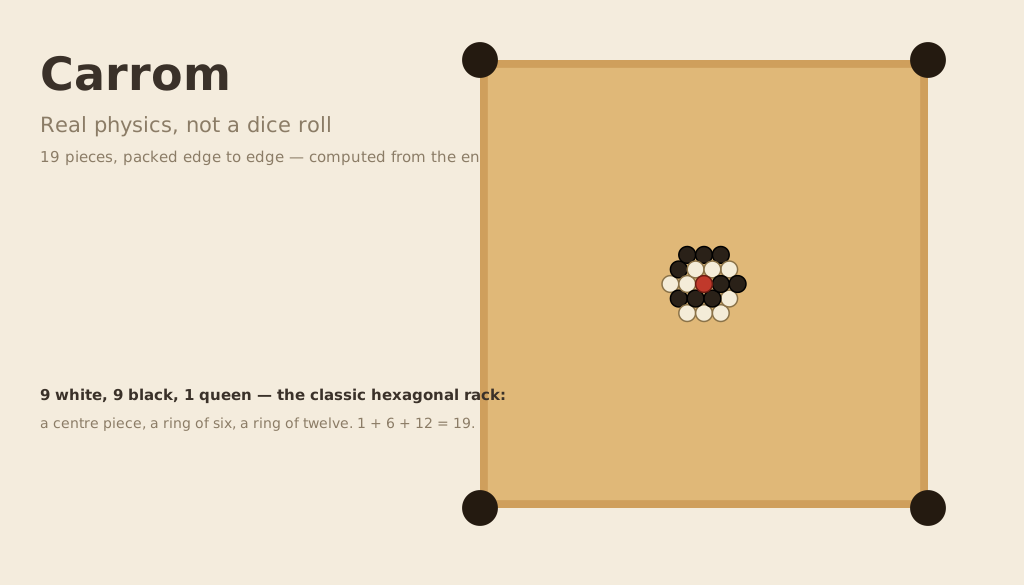
All nineteen pieces start touching, packed into the traditional hexagonal cluster right in the middle of the board: the queen alone in the centre, six pieces forming a ring around her, twelve more forming a larger ring around that. Each player shoots from their own baseline — the short line set back from their own edge of the board — and may place the striker anywhere along it before every shot.
That packed arrangement matters more than it looks like it should: because every piece starts touching its neighbours, an opening shot into the cluster almost always disturbs several pieces at once, not just the one directly struck. Reading which pieces are about to become loose — and which pockets they're now sitting near — starts on the very first shot of the game, not several turns in once things have already scattered.
Shooting: aim, power, physics
Drag along your baseline to position the striker, then drag it outward to aim — the direction you pull sets the shot's direction, and how far you pull sets its power. Let go, and the shot plays out for real: this page runs actual circle-on-circle collision physics underneath, with mass, friction and rebound built in, not a hidden dice roll dressed up as a striker.
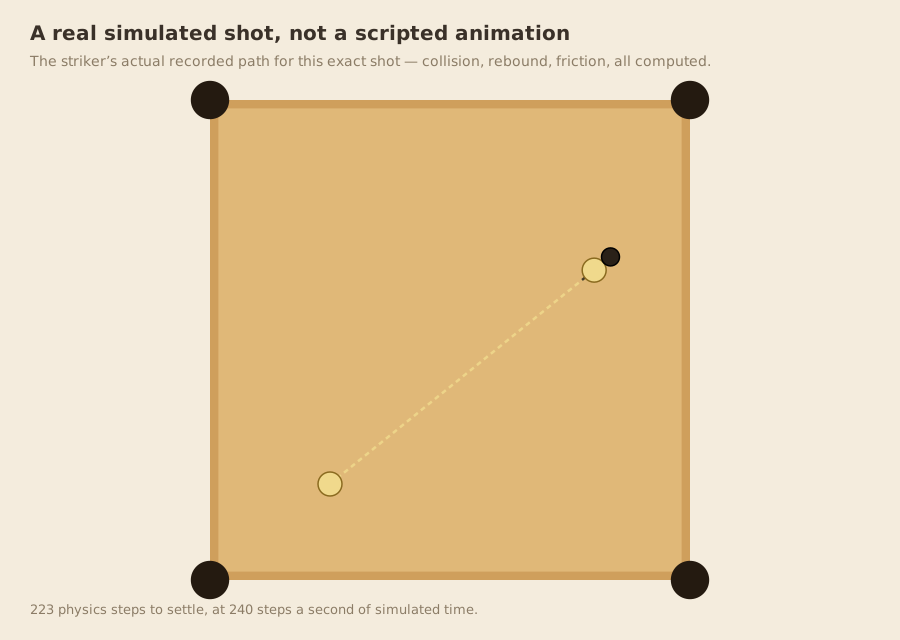
Pocket one of your own colour and you shoot again immediately. Miss everything and your turn ends. Pocket the striker itself and it's a foul — more on that below.
Aiming the way it actually works: the "ghost ball"
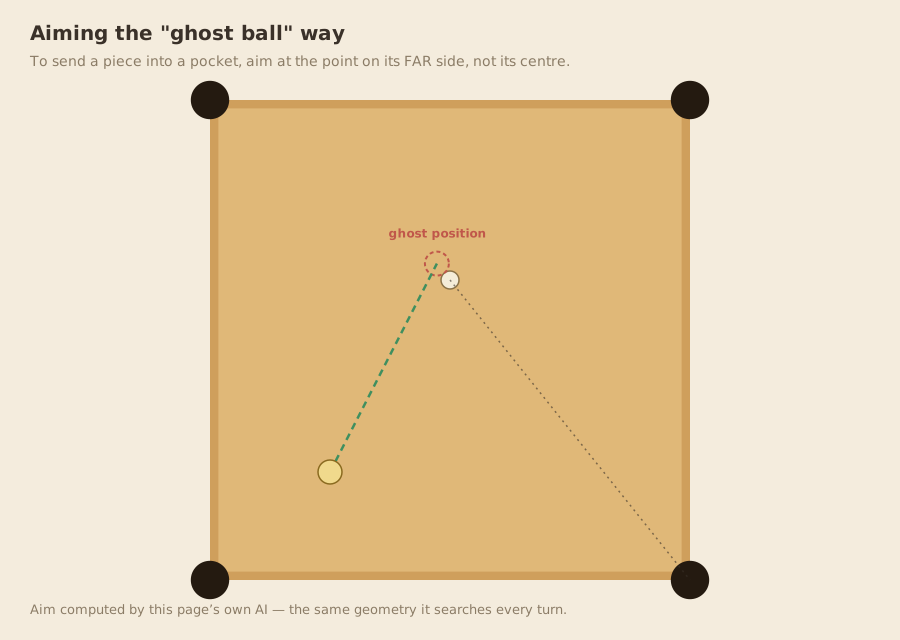
The single most useful thing to understand about aiming here: you don't aim at the piece you want to hit — you aim at the empty spot right next to it. Picture a circle the size of your striker sitting on the far side of the target piece, touching it exactly along the line toward the pocket you want. Aim your striker at the centre of that imaginary circle (billiards players call it the "ghost ball"), and the real contact point sends the target piece toward the pocket. Aiming straight at a piece's centre almost never lines up with where you actually want it to go.
Fouls and the queen
- Pocketing the striker is a foul: one of your own already-pocketed pieces comes back onto the board as a penalty.
- Touching nothing at all ends your turn, without that penalty.
- Pocketing your opponent's colour is legal, just not useful to you — no extra shot, and the piece counts toward their total instead.
- The queen needs covering: pocket her, then pocket one of your own colour on your very next shot, or she returns to the centre for either side to try again.
How do you win at Carrom?
Clear all nine pieces of your own colour, with the queen off the board for good — pocketed and covered, not sitting back at the centre waiting to be tried again.
Carrom strategy
Should you go for power or precision?
Precision, almost every time. A weak, well-aimed shot that actually pockets a piece beats a hard, roughly-aimed one that scatters the rack without sinking anything — this page's own physics doesn't reward brute force, it rewards hitting the ghost point accurately. Save real power for shots that need it: breaking open a tightly packed cluster, or sending a piece a long distance across the board.
Why position matters as much as the shot itself
Where you place the striker along your baseline changes every angle available to you, not just the shot you're about to take. A position that lines up a clean shot at one piece might leave you with nothing useful if that shot misses — worth glancing at what a slightly different starting point on the baseline would open up before committing to your first idea.
When is it worth deliberately fouling?
Almost never on purpose, but it's worth knowing the cost precisely rather than fearing it vaguely: pocketing the striker only costs you one previously pocketed piece, returned to the centre — not your whole turn's progress, and not a piece you never had. Early in a game, before you've pocketed anything, a foul costs nothing but the turn itself. That's very different from a foul late in a close game, where giving back a piece can undo real progress.
Playing against the computer
How do the three computer levels differ?
Completely differently from every other computer opponent on this site, because a Carrom shot isn't a move from a short list — it's three real numbers, a position, an angle, and a power, drawn from a continuous range. This AI can't score a handful of candidate squares the way Reversi's does. Instead it builds a shortlist of plausible aims using the ghost-ball geometry above, actually runs each one through the same physics simulation the real game uses on a private copy of the board, and keeps whichever shot's simulated outcome actually looks best. Easy tries only a couple of aim-and-power combinations with a wide margin of error baked in; hard searches dozens of them with none.
The history of Carrom
Carrom is generally traced to India, sometime in the early twentieth century, though — like a lot of games that grew up as something people built and played rather than something a company patented — there's no single clean origin date attached to it. One of the oldest surviving boards, with a glass playing surface, still sits in a palace in Patiala, India.
State-level competitions were already running across India by the early 1900s, and organised tournament play is generally said to have reached Sri Lanka around 1935; both countries had official federations by 1958. The International Carrom Federation followed in 1988, founded in Chennai, publishing the first formal written rulebook the same year — which is itself worth knowing, since it means "official" Carrom rules are barely older than some of the players who grew up learning the game informally from family first. National federations have since followed in the UK, Germany, Italy, Japan, Pakistan and elsewhere, but the game's real centre of gravity is still South Asia, where it's as ordinary a thing to find in a café or a front room as a deck of cards.
If you like this one
- Nine Men's Morris — a much older capture game, no physics at all, pure position
- Reversi — the site's default computer-opponent design, for a game where every candidate move really is just a square
- Sea Battle — this site's other genuinely different mechanic: hidden information instead of open physics
- Mancala — another game built around physically moving real pieces by hand, with its own centuries of history