
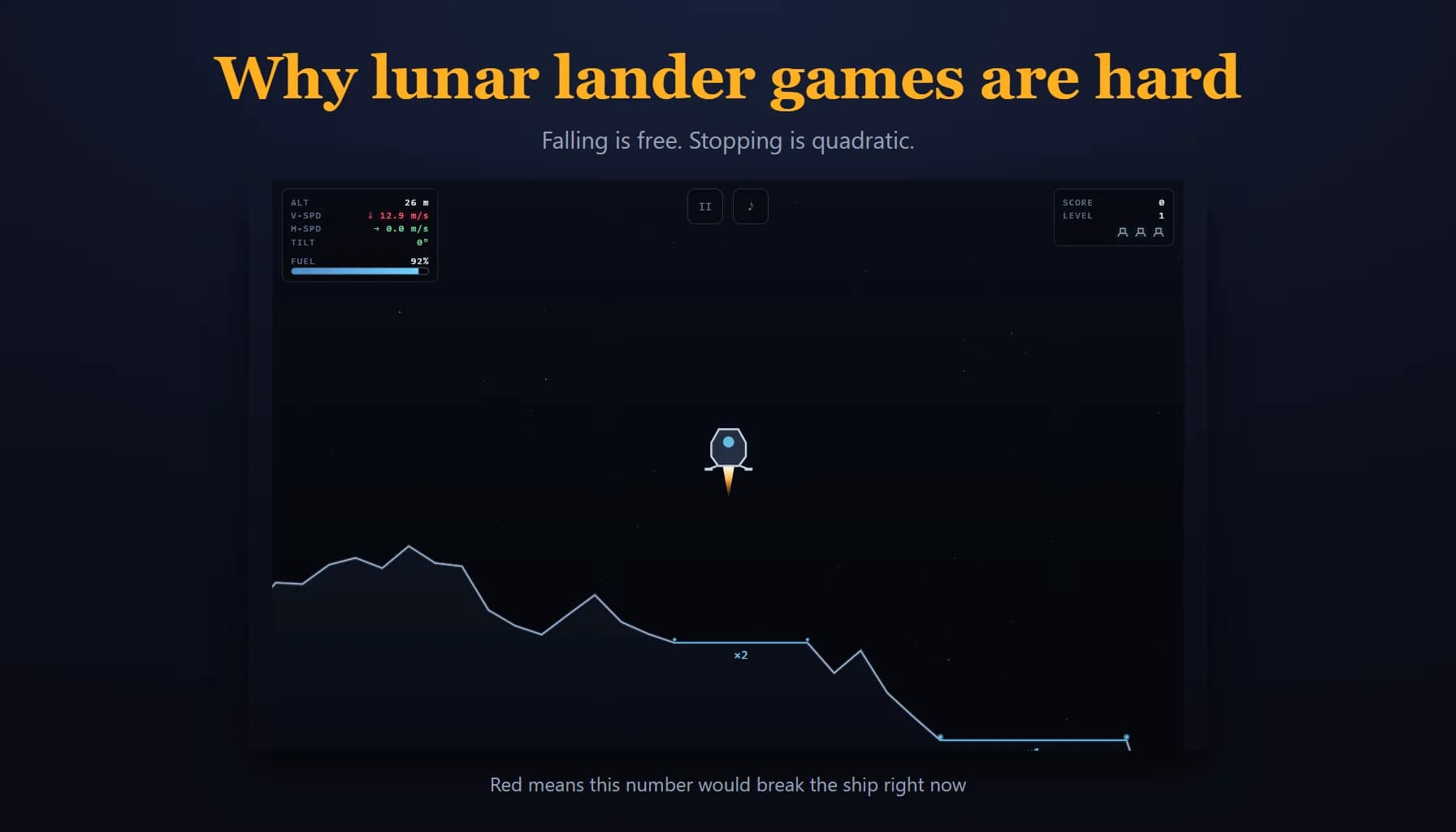
Everybody crashes the first ten times. Then they crash a few more times, usually while saying something rude about the controls.
It is worth knowing that this is not a reflex problem, and you are not missing a trick. A lunar lander game is hard for the same five reasons the real manoeuvre is hard, and once you can name them the game changes from frustrating to merely difficult. The numbers below come from Touchdown, but the physics is the genre's, not ours.
1. Nothing slows you down for free
In almost every other game, letting go of the controls makes things calmer. A car coasts to a stop. A platform character lands and stands still. Even in most space games, ships drift to a halt because the designer added invisible friction to make them feel good.
There is no air on the moon, so there is no friction to add. Every bit of speed you build is yours until you spend fuel removing it. A nudge sideways at 100 metres is still a nudge sideways at 10 metres, and it will still be there at contact.
That single fact is what makes the genre feel unfamiliar. You are not steering. You are budgeting.
2. Falling is free, stopping is quadratic
Here is the number that explains most crashes. Braking distance grows with the square of your speed, so a descent that feels only slightly too fast needs dramatically more room to fix.
| Falling at | Height needed to slow to a safe landing speed | Fuel spent |
|---|---|---|
| 8 m/s | 8 m | 11 |
| 10 m/s | 16 m | 18 |
| 15 m/s | 42 m | 35 |
| 20 m/s | 78 m | 53 |
| 25 m/s | 125 m | 71 |
Doubling your speed from 10 to 20 does not double the recovery — it costs nearly five times the height and three times the fuel. A full tank holds 100 units, so letting the ship reach 25 m/s spends roughly seventy per cent of everything you have just undoing your own descent.
This is why "I'll slow down at the bottom" fails so reliably. By the time the ground looks close, the cheque has already been written.
3. Your engine does not point where you want to go
The thrust fires along the ship's axis. To move sideways you have to tilt, and the moment you tilt, part of your engine is pushing you across rather than holding you up.
The trade is not as bad as it feels: at a 30° tilt you still climb, and you can remove a full three metres per second of sideways drift in about a second and a half. But you have to decide to do it. Players who try to fix drift by nudging gently at 5° spend ten seconds achieving very little while gravity keeps working at full strength.
Tilt properly, fix it, come back upright. Half-measures cost more than the commitment does.
4. Sideways speed is the one you are not watching
Every instinct points your eyes at the ground, which shows you your vertical speed. Meanwhile the number that fails most landings is the horizontal one, and it usually has a tighter tolerance — in Touchdown you may arrive at 5 m/s vertically but only 3 m/s sideways.
It gets worse: in most lunar lander games the ship does not start at rest. Touchdown hands you a drift from level 3 onwards — up to ±3.2 m/s at first, and up to ±5.2 m/s by level 8. That means you can begin an attempt already outside the landing tolerance, before you have touched a key.
The habit that fixes this is boring and works: read the horizontal readout first, every single attempt, before you look at anything else.
5. Fuel is a clock, not a resource
Players treat fuel like ammunition — something you have plenty of until suddenly you do not. It behaves more like a stopwatch.
A full tank in Touchdown is about twelve seconds of continuous burn. You cannot hold the engine on and think; there is no thinking budget. What you can do is hover, because holding altitude only needs the engine roughly 40 % of the time, which stretches the same tank to nearly thirty seconds of hanging in the air deciding what to do.
Short taps, not long holds. Then, near the ground, stop fighting: from a standstill you can simply fall the last eight metres or so and still touch down legally. Fuel you did not burn converts to points, so the elegant line and the high-scoring line are the same line.
The real skill is noticing early
Put those five together and you get the feeling that defines this genre, and the reason it has survived since 1969: the slow, calm horror of realising — twenty seconds before impact — that you have already made the mistake, and everything from here is just watching it arrive.
That is not an action game. It is a planning game wearing an action game's clothes, and the skill it rewards is noticing a problem while it is still small and cheap. Ten metres per second is a shrug. Twenty-five is most of a tank.
If you want the step-by-step version — the order to fly the descent in, and what to do about the solar wind on the later levels — that is on the game page itself. If you want to know where all this came from, the genre is older than the arcade, and its first version had no graphics at all.