
The oldest video game genre still being made is not about shooting anything. It is about arriving slowly.
In the autumn of 1969, a few months after two men actually did it, a high-school student in Massachusetts wrote a program that let anyone else try. It had no graphics, no sound and no opponent. It asked you, once per second of simulated flight, how much fuel to burn. Then it told you how fast you hit the ground.
Everything since has been a variation on that question.
1969: a few dozen lines of text
Jim Storer was a student at Lexington High School when he wrote Lunar — often called the Lunar Landing Game — in FOCAL, a language for Digital Equipment Corporation's PDP-8 minicomputer. The whole thing was a few dozen lines long. Each turn printed your altitude, your speed and your remaining fuel, and asked for a burn rate. Get it wrong and the program calculated, politely and in plain English, the crater you had just made.
Storer sent it to DEC's users' newsletter, which passed the source code to its readers, and that was enough. Other programmers rewrote it almost immediately — a BASIC version called Rocket by Eric Peters at DEC, another called LEM by William Labaree II. In 1973 David H. Ahl translated the idea into BASIC for his book 101 BASIC Computer Games, which put three lunar landing programs into the hands of nearly everyone who owned a computer in the 1970s.
A generation of programmers learned the same lesson from those listings: a game does not need an enemy. Gravity is enough of one.
1973: someone draws it
The first version you could actually see came from DEC itself. To show off the new GT40 vector graphics terminal, the company commissioned Jack Burness to write Moonlander, finished on 25 February 1973. Now the lander was a shape on a screen, the ground was a jagged line, and you steered with a light pen instead of typing numbers.
The detail worth keeping: before writing it, Burness went to MIT to get the real specifications of the Apollo Lunar Module. The first graphical version of this genre was built on the actual engineering numbers of the actual spacecraft — which tells you something about who was writing games in 1973, and why the physics in this genre has always been unusually honest.
1979: the cabinet
Atari's Lunar Lander arrived in arcades in August 1979 and was the company's first vector graphics game. It gave players something no home version had: a proportional throttle, a large lever that fired the engine as hard as you pulled it, rather than an on-off button. As the lander neared the ground the view zoomed in — reportedly the first video game to change perspective like that.
It also gave players a crueller deal than usual for a quarter. There was no time limit; instead a coin bought fuel, somewhere between 450 and 900 units depending on how the operator set the machine. A bad landing did not end your session so much as invoice you for it.
4,830 cabinets were sold. Then something happened that says everything about the arcade business of that year: Atari released Asteroids, it became a phenomenon, and production of Lunar Lander was cut short to make room for it. The first 300 Asteroids machines shipped inside Lunar Lander cabinets, still wearing Lunar Lander artwork on the sides. The genre's most famous cabinet was partly eaten by its own stablemate — and if you ever see an Asteroids machine with a lander painted on it, that is why.
The idea kept going regardless. Bill Budge wrote Tranquility Base for the Apple II in 1980, Commodore shipped Jupiter Lander in the early eighties, and Tom Hudson's Retrofire put the whole thing in isometric 3D in 1983.
Why the physics stuck
Most arcade genres of that era have dated badly, because reflex tests age into button-mashing. The lunar lander game did not, and the reason is that it was never a reflex test.
Four rules do all the work, and they have not changed since Storer's text version:
- Gravity is constant and never stops. There is no safe altitude and no pause.
- Thrust points where the ship points. Wanting to go sideways means tilting, and tilting means you are no longer fighting gravity with your whole engine.
- There is no air. Nothing slows you down for free. Every bit of speed you build must be cancelled deliberately, by you, using fuel.
- The fuel is finite. Which turns every correction into a decision rather than a reflex.
That combination produces a specific feeling that almost nothing else in games produces: the slow realisation, twenty seconds before impact, that you have already made the mistake and are now watching it arrive. You are not reacting. You are doing arithmetic while falling.
The landing that actually happened
The reason this genre exists at all is that on 20 July 1969, the real thing came far closer to failing than the celebrations suggested.
During the final descent, the Apollo Guidance Computer began throwing 1201 and 1202 program alarms — its processor was overloaded. The software had been built to shed low-priority work and keep flying rather than stop, so it kept flying. Mission control made the call to continue.
Then Neil Armstrong looked out of the window and saw the automatic system taking them into a field of boulders. He took manual control and flew on, looking for somewhere flat, while mission control counted down the seconds of hovering he had left: sixty, then thirty. Eagle touched down with something like twenty-five seconds of fuel in hand — reconstructions of the numbers differ, and some put the margin a little higher, but every version of the story ends with a commander flying manually, low on fuel, hunting for flat ground.
Which is, more or less exactly, the game.
Playing one now
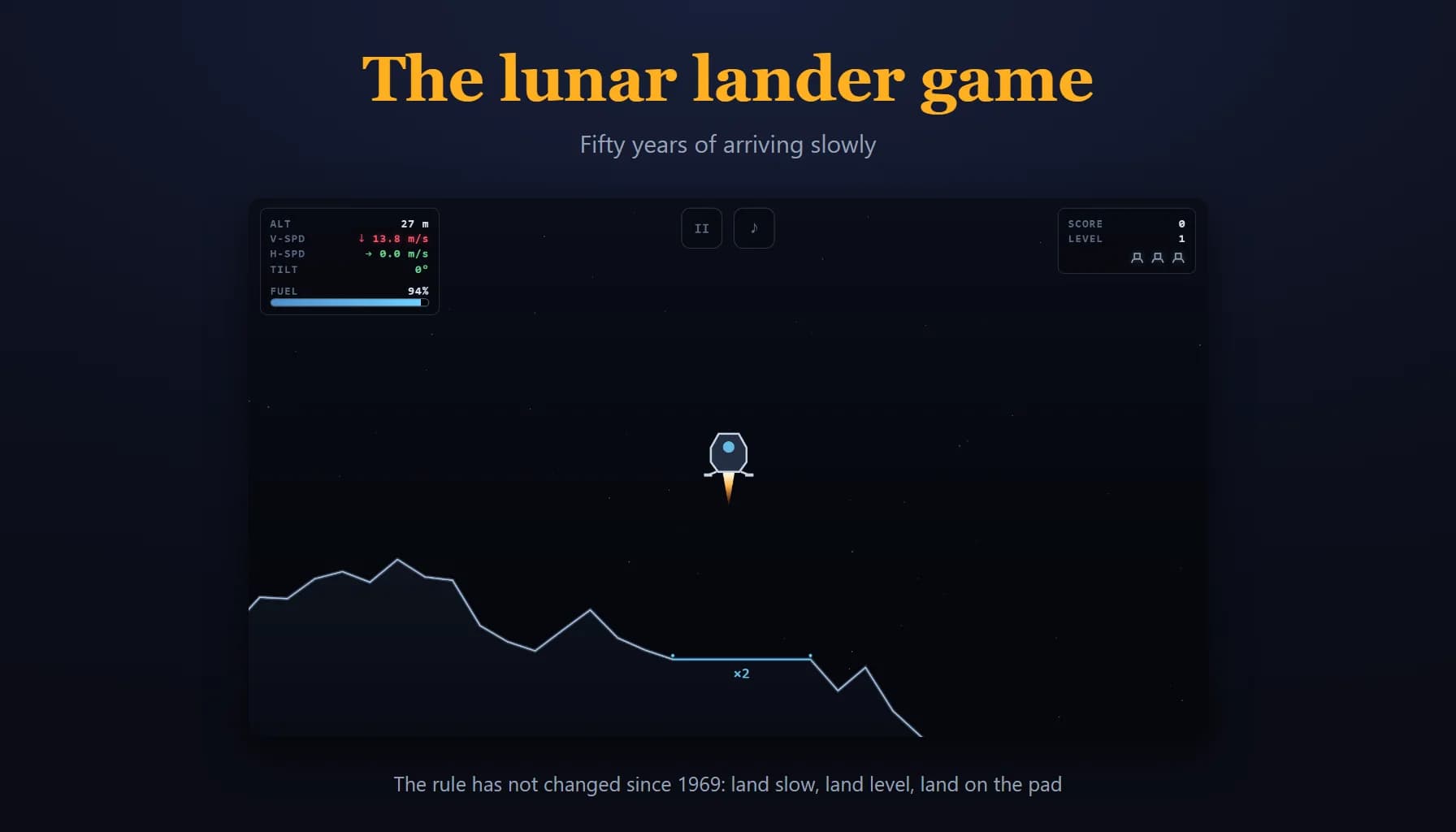
The genre is fifty-odd years old and needs nothing to run: a shape, a line, and four numbers. That is why it survives in browsers, where Touchdown is our take on it — constant gravity, thrust along the ship's axis, a fuel gauge that does not refill, and a pad you have to hit slowly and level. It is an original game rather than a version of any of the ones above; what it shares with them is the physics, which nobody owns.
Land under 5 m/s, under 3 m/s sideways, within 10° of upright, both legs on the pad. Storer's program would have understood every one of those numbers in 1969.
Sources: Jim Storer's own archive of the 1969 Lunar Landing Game at Brandeis University; Wikipedia's history of the lunar lander genre; NASA and Royal Museums Greenwich accounts of the Apollo 11 descent.