
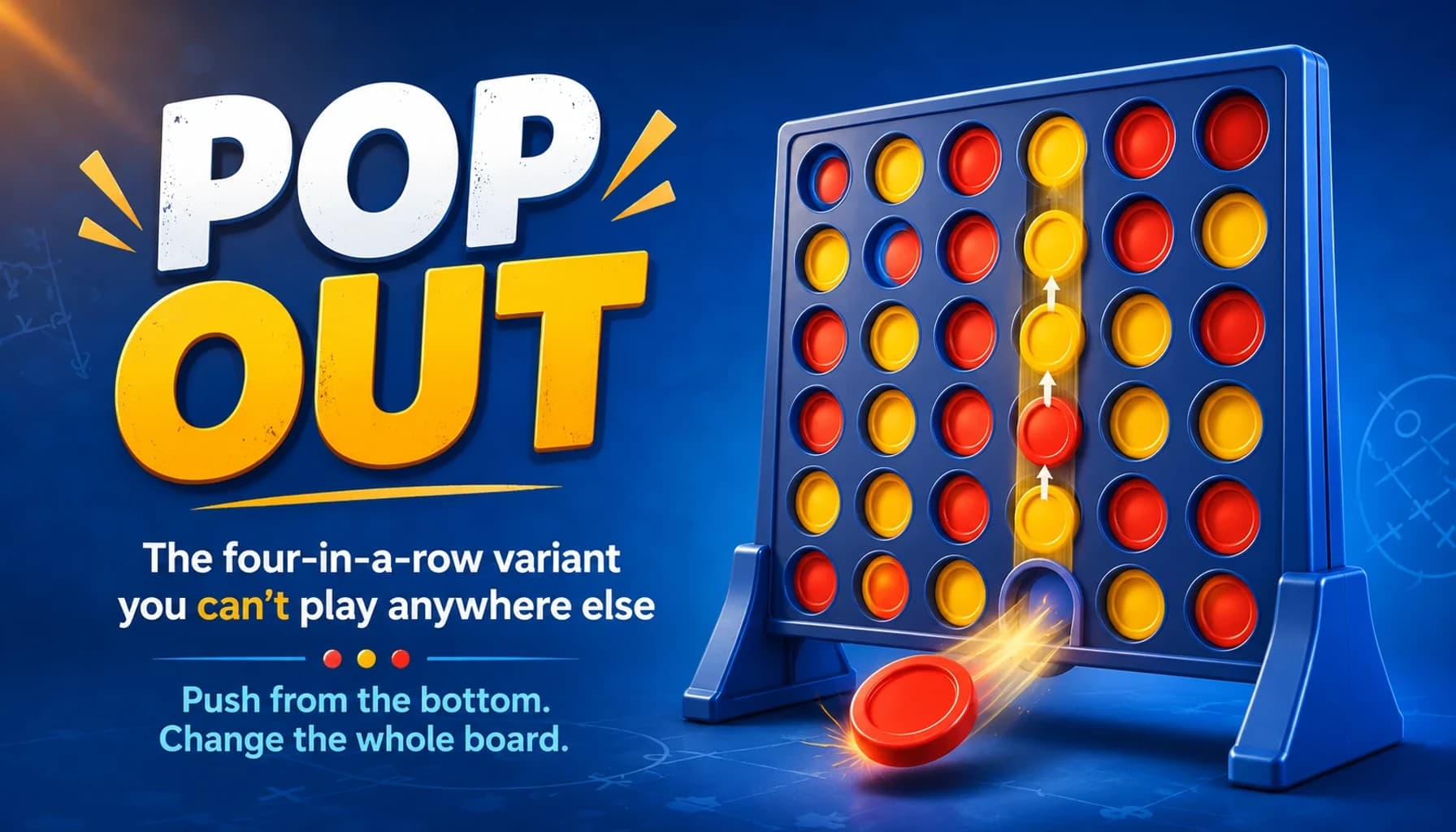
There is an official variant of this game that changes it more than any board size does, and almost nobody has played it.
The rule is one sentence. Instead of dropping a disc, you may pull one of your own out of the bottom of a column — everything above it drops down by one place. Hasbro prints it in the instructions as one of the three ways to play the boxed game, alongside the original and Pop 10. It has been in the box for years.
Search for a browser version and you will find rule descriptions, a downloadable build on itch.io, and page after page of the standard game. When we looked, we could not find a single site where you can actually play Pop Out against somebody. So we built it — and it turned out to be the most interesting thing about four in a row.
The rules of Pop Out, exactly
Everything is as normal, plus one option on your turn:
- Drop a disc into a column, as always. Or:
- Pop one of your own discs out of the bottom of a column. Every disc above it moves down one row. The popped disc goes back to your supply.
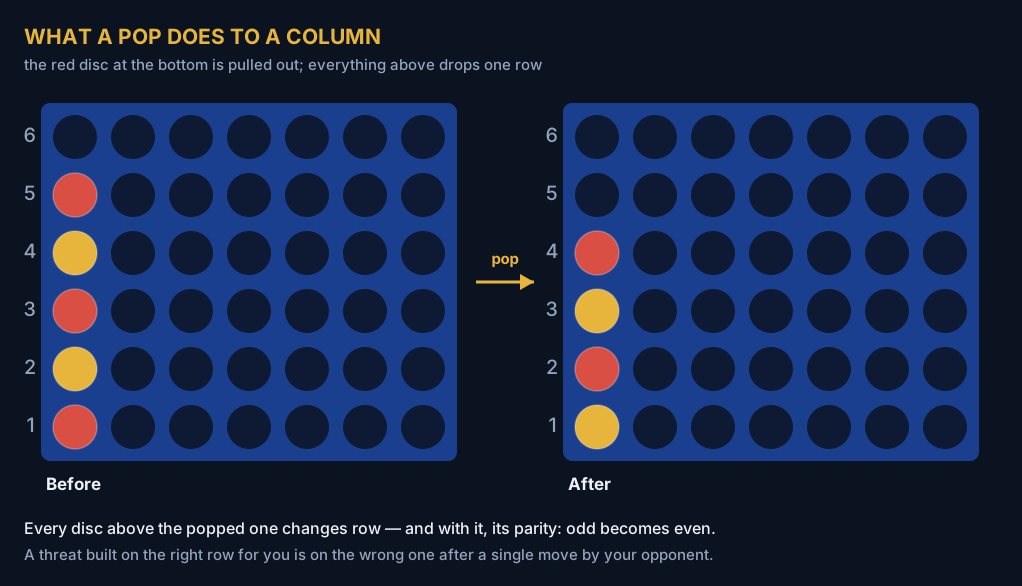
Three restrictions, and the third is the one people miss:
- The disc must be yours.
- It must be at the very bottom of a column.
- You cannot pop from an empty column — an empty floor belongs to nobody.
The rule about both players winning at once
One more rule matters more than it looks:
If a pop completes four in a row for both players at once, the opponent wins.
That sounds arbitrary until you try to play without it. Without that rule, a player about to lose could always pop a disc that hands both sides a line simultaneously and argue for a draw. With it, a pop that gives your opponent four is simply a losing move, whatever else it does for you.
What Pop Out actually changes
The board can go backwards
In the standard game every move adds information and nothing is ever taken away. Here a column that was settled can be unsettled, a wall you built can be taken apart from underneath, and a position you carefully blocked can reopen.
A full column is still a resource
In the normal game, once a column fills, its squares are decided for good. In Pop Out a full column is a place you can still play: pop from the bottom and you have a fresh square at the top.
And the parity theory breaks
This is the part worth the whole variant.
In the standard game the strongest idea available to a good player is the odd/even rule: counting the bottom row as row 1, whoever moved first ends up owning the odd rows and the second player the even ones, so each side wants their threats on the rows that will fall to them. It is the difference between a decent player and a strong one.
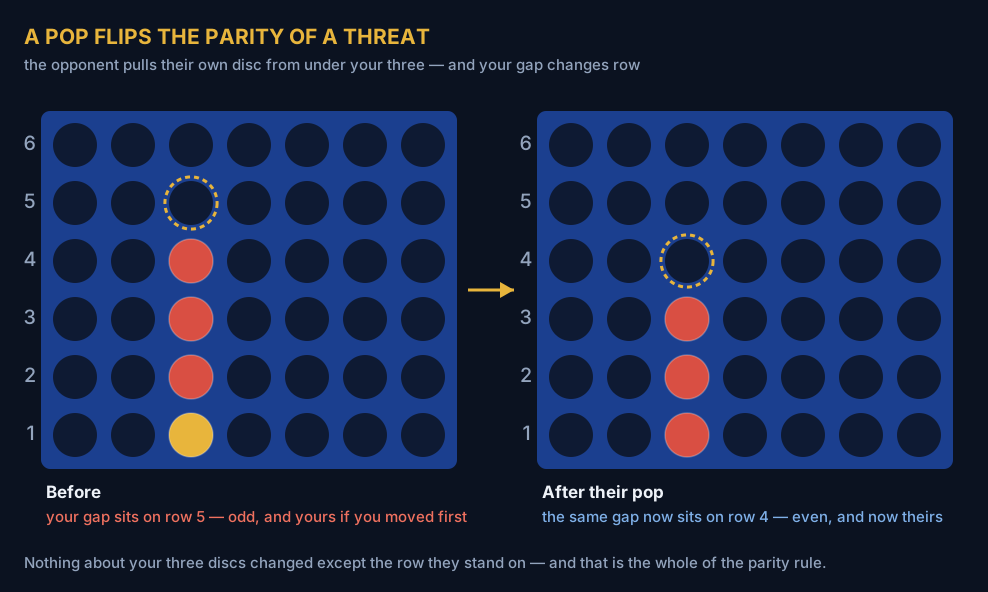
A pop moves every disc above it down one row. Odd becomes even and even becomes odd, for the whole column, in one move by the other player.
A threat you spent five turns building on the right parity is now on the wrong one, and you did not do anything wrong. There is no equivalent of that anywhere in the standard game. That is why Pop Out is not "the same game with an extra option": the deepest strategic idea in four in a row is something your opponent can undo.
The pop that loses on the spot
You may only pop your own disc, which sounds like a safety rail and is not.
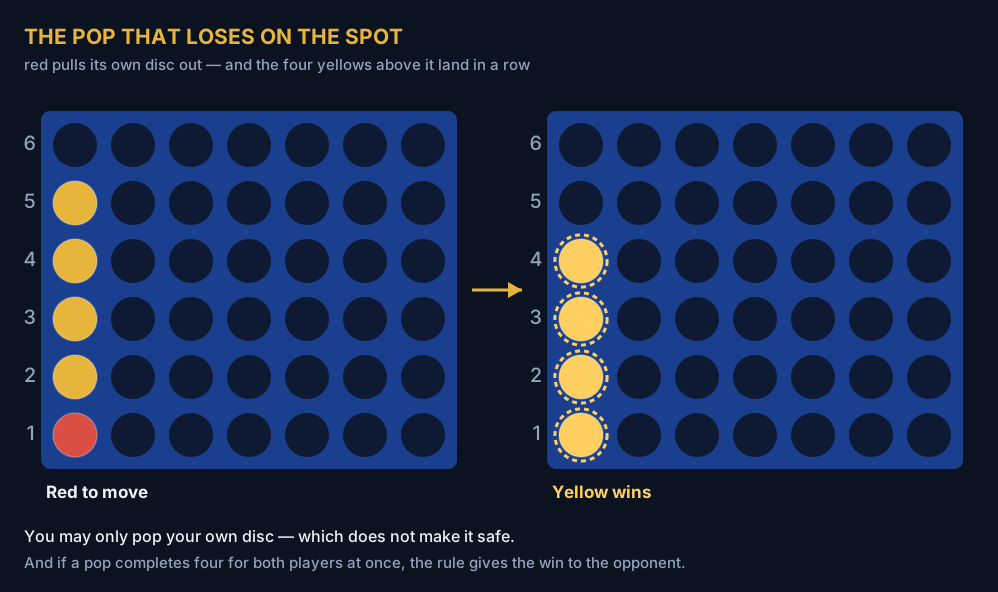
Everything above your disc belongs to whoever put it there. Pull out the floor and their stack settles one row lower — and if that completes four for them, you have lost by your own move. Before you pop, look at what is sitting on top of it, not only at what you gain.
Does Pop Out make the games longer?
Yes, and by more than we expected. Four hundred games with moves chosen at random, so that the pop rule is used as often as it is available rather than as often as it is wise:
| Standard | Pop Out | |
|---|---|---|
| Moves per game | 20.8 | 29.5 |
| Pops per game | — | 6.8 |
| Games that filled the board | 0 of 400 | 0 of 400 |
Games run about forty per cent longer. At 6.8 pops in a 29.5-move game, close to a quarter of everything played is a pop: it is not a rare emergency option, it is a normal move.
The draw row is the surprise that is not one. Neither version drew a single game out of four hundred with random play — random play blunders into a line long before forty-two squares fill up. Draws in this game are a product of competence, not of the board.
It hands the game back to whoever starts
Here is the finding we did not expect, and the one number in this article we have not seen anywhere else.
A search plays the same move in the same position every time, so a program playing itself gives you one game repeated, not a sample. To get real variation the opening is varied instead: every one of the seven first moves against every one of the seven replies, forty-nine genuinely different games, both sides on the same setting. We ran that on both versions.
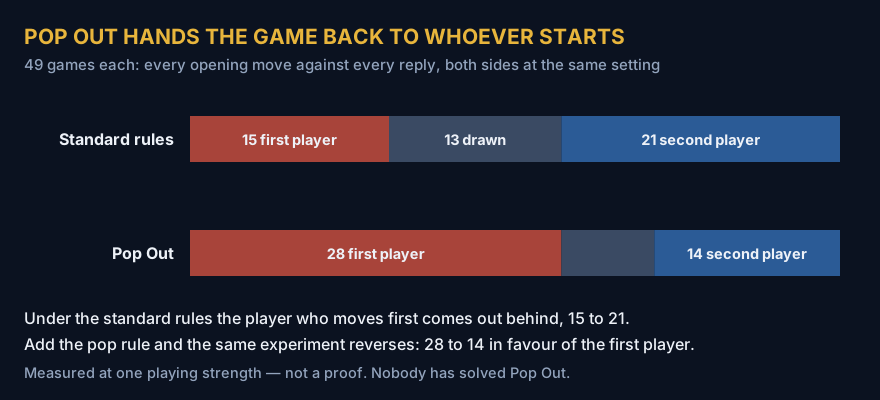
That fits the parity argument rather neatly. In the standard game the second player's most reliable resource is patience — build threats on the even rows, refuse to be provoked, and let the board deliver them. Popping is precisely what breaks that plan, and the player on move first is the one who gets to break it first.
Treat it as a measurement at one playing strength, not as a theorem. Nobody has solved Pop Out, and with a board that can empty as well as fill, nobody is going to solve it the way 7×6 was solved.
The centre column, incidentally, is still the best opening under Pop Out: five wins, no losses and two draws out of the seven games that began there. Some things survive the rule change.
Is it harder than the ordinary game?
Harder to calculate, certainly. In the standard game the tree of moves never branches more than seven ways and every branch makes the board fuller. In Pop Out it branches up to fourteen ways, and half of those make the board emptier — which means a game can, in principle, go on for a very long time.
It is also harder to feel safe. In the standard game, if you have blocked every line your opponent can build, you have blocked it permanently. Here you have blocked it until they decide to move the floor.
Whether that makes it a better game is a matter of taste. What is not a matter of taste is that it is a different game, and that hardly anybody has had the chance to find out which they prefer.
Where to play Pop Out
Four in a Row on this site has Pop Out in the rules menu under the board, against a computer opponent at three strengths or against a friend online — you get a four-character code, they type it in, and there is a chat window. Nothing to install, no account.
Handles appear under each column as soon as popping is legal there, which is the only interface question the variant really poses: you have to be able to say "this column, from the bottom" with no risk of it being read as "this column, from the top".
Away from a screen, the printable sheet works for Pop Out too, provided you play with the cut-out counters rather than a pencil. A board filled in with a pen cannot go backwards, and going backwards is the entire point.
The other official variants
For completeness, because they are usually named together:
- Pop 10 — you pop discs out and keep the ones that were part of a line of four; first to collect ten wins. A different scoring game rather than a different placing game.
- Five in a Row — a nine-wide board where you need five. Playable here too, and what happens to the outcome when you change the board is a subject of its own.
- Power Up — special discs with one-off abilities. Fun, and far enough from the original that it is really a separate product.
Pop Out is the one that stays recognisably four in a row while genuinely changing how it is played. That is rare for a variant, and it deserves better than being a rule printed on the back of a box.