
Print and play
Printable MENACE Kit
All 304 matchbox labels for the 1961 machine that learns noughts and crosses — worked out, drawn, and ready to cut out.
How big a machine
Every box Michie built, all four moves. Eleven sheets of labels and about a fortnight of evenings. This is the one that learns properly.
Style
Pale blue rules on warm paper — what the game looks like in a school exercise book.
Paper
For a PDF, pick Save as PDF as the printer in the print dialog.
Sheets
304 boxes · 13 pagesHow to build and run MENACE
- What you need. One matchbox per label — 304 for the full machine, 13 for the one-lesson version — and glass beads in the nine colours on the key sheet. Cheap craft beads work; so do lentils and nine felt pens if you would rather colour a dot on a scrap of paper.
- Build it. Cut out the labels and glue one to each box. Fill every box using the number printed inside each coloured dot: four beads of each colour for MENACE's first move, three for its second, two for its third, one for its fourth. Occupied squares get nothing.
- MENACE moves. MENACE always goes first. Find the label matching the board — turning or mirroring it if you must — shake that box, and draw one bead without looking. Play the square its colour is lying on. Leave the box open with the bead on the lid so you can find it again.
- Settle up at the end. Only when the game is over. MENACE won: every bead it drew goes back with three more of the same colour. Drawn: back with one more. Lost: thrown away. Nobody ever tells it a rule — this is the whole of the learning.
- When a box runs empty. MENACE resigns. That is in Michie's original and worth keeping: it means the machine has run out of moves it believes in, and it is the clearest signal you will get that it is learning something painful.
- How long it takes. Two hundred games or so before it plays sensibly, and who it plays changes what it learns. Beat it every time and it learns to defend; let it win and it learns very little. Play it online first if you want to see where this ends up.
playnook.io
What you get
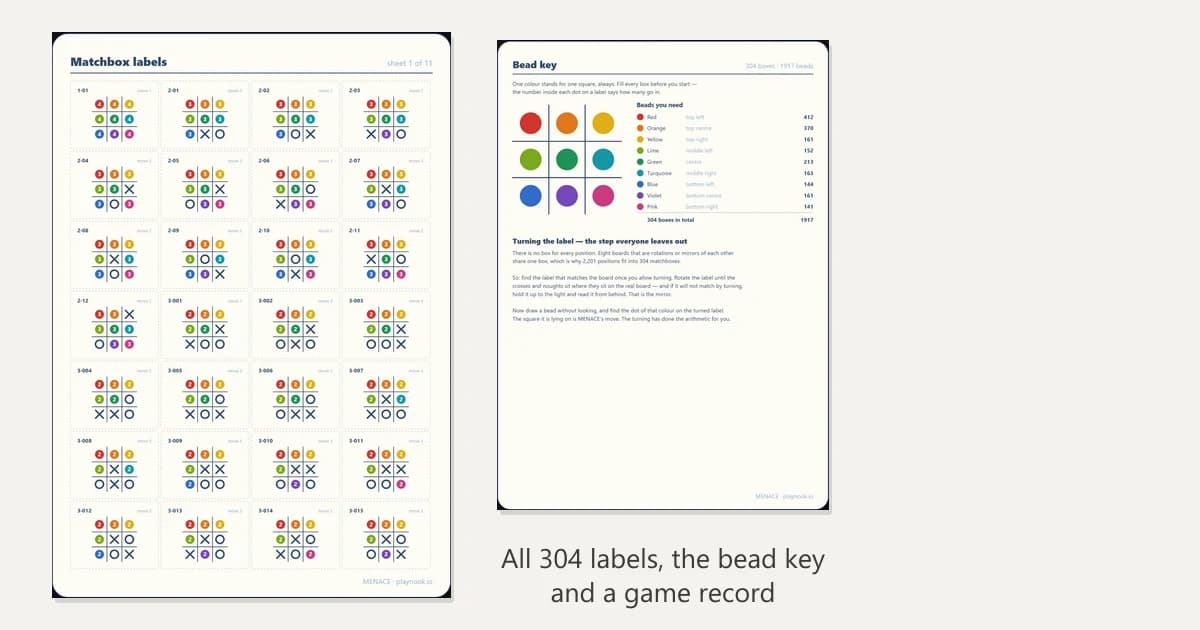
Eleven sheets of labels, a bead key and a game record. Every label carries its position drawn out, and in each empty square a coloured dot with the number of beads that go in it. Cut, glue, fill, play.
Why nobody prints these
Every guide to building MENACE says take 304 matchboxes and label them and stops there. The labelling is the entire job. You would have to derive 304 positions by hand without miscounting and without building two rotations of the same position twice — which is why most attempts stall at about forty boxes.
These come out of the same engine that runs the machine you can play online, so the count on the sheet and the count on the screen cannot drift apart. There are 304 boxes and 1,917 beads, and we counted both rather than repeating them.
The turning trick
The hard part of a physical MENACE is that most positions have no box of their own. Eight boards — four rotations, each of them also mirrored — share one box. That is what turns 2,201 positions into 304, and it is what makes the machine small enough to build at all.
It also means that during a game the label will usually not match the board as drawn. So the bead colours here sit inside the squares rather than in a legend down the side. Turn the label until it matches the board, draw a bead, and look at which square that colour is lying on. That is the move. Turning the paper performs the conversion, and nobody has to work anything out.
For a lesson, and for a fortnight
The full machine is a serious build: eleven sheets, 304 boxes, an evening or several. The kit therefore also prints a 13-box versioncovering MENACE’s first two moves on a single sheet. It is a genuine simplification and labelled as one — the machine plays at random once its boxes run out — but thirteen boxes fit in a lesson and three hundred do not, and children can watch beads change hands within twenty minutes.
Pick Ink saver for a class set. Three hundred labels of nine coloured dots is a cartridge; without colour the dots carry a letter instead and cost almost nothing.
What it teaches
A bead count is a policy. Adding and removing beads is a policy update. Win, draw and loss at +3, +1 and −1 are a reward function. This is reinforcement learning with the computer taken out, which is why it has survived sixty years of curriculum changes — and why a child who has run one understands what a training loop is doing.
There is a longer version of that argument in how to build one, including the measured finding that who you train it against matters more than how long you train it for.
Frequently asked questions
How many matchboxes do I need? 304 for the full machine. That is not a round number somebody chose — it is how many positions MENACE can face once rotations and mirror images are counted as the same position. There are 2,201 such positions and the eight symmetries of a square fold them into 304. If that is too many boxes, the kit also prints a 13-box version covering MENACE's first two moves, which fits on one sheet and in one lesson.
How many beads, and which colours? 1,917 beads for the full machine, in nine colours — one colour per square of the board. The kit prints the exact count of each colour on the bead key sheet, so you can buy or count them out before you start. Glass craft beads are the traditional choice, but nine colours of dried bean, bead or button work identically.
How do I find the right box during a game? This is the step other instructions skip, and the labels are drawn to solve it. Because eight boards that are rotations or mirrors of each other share a single box, the label will often not match the board as printed. Turn the label until the crosses and noughts line up — and if it will not line up by turning, hold it to the light and read it from behind. Then draw a bead and look at which square the dot of that colour is now lying on. That square is MENACE's move: the turning has done the conversion for you.
How many beads go in each box? Four of each colour for MENACE's first move, three for its second, two for its third and one for its fourth. Every label prints its own number inside each coloured dot, so you never have to remember. The staircase is deliberate: early positions come up in every game, so more beads there means the machine changes its mind about them more slowly.
How long before it plays well? A couple of hundred games, and it depends entirely on who it plays. We measured this on the online version: after 1,000 games it loses 4.2% against a careful opponent but 12.7% against someone playing at random — training against weak play teaches it to beat weak play and never teaches it to defend. Play it properly and it improves faster.
Do I really need 304 matchboxes? No, and most classrooms do not use them. Small envelopes, paper cups, a chest of drawers, or 304 squares chalked on the floor with beads in piles all work — the box is only a container that keeps its beads separate and can be shaken. Michie used matchboxes because he had matchboxes.
Can I use this in a lesson or sell what I print? Yes. The sheets you print are yours to use, in class or commercially, with no attribution required.
How do I get it as a PDF? Press Print, then choose “Save as PDF” as the printer in the print dialog. Every browser has that option built in. The full kit runs to thirteen pages, so check the page count before sending it to a shared printer.
More to print: tic-tac-toe grids, eight paper games in one print job, and everything else that comes out of a printer.